







Question: 35. Students in a third-grade class begin with equivalent squares representing one whole. They cut and label these squares into halves, thirds and fourths. The
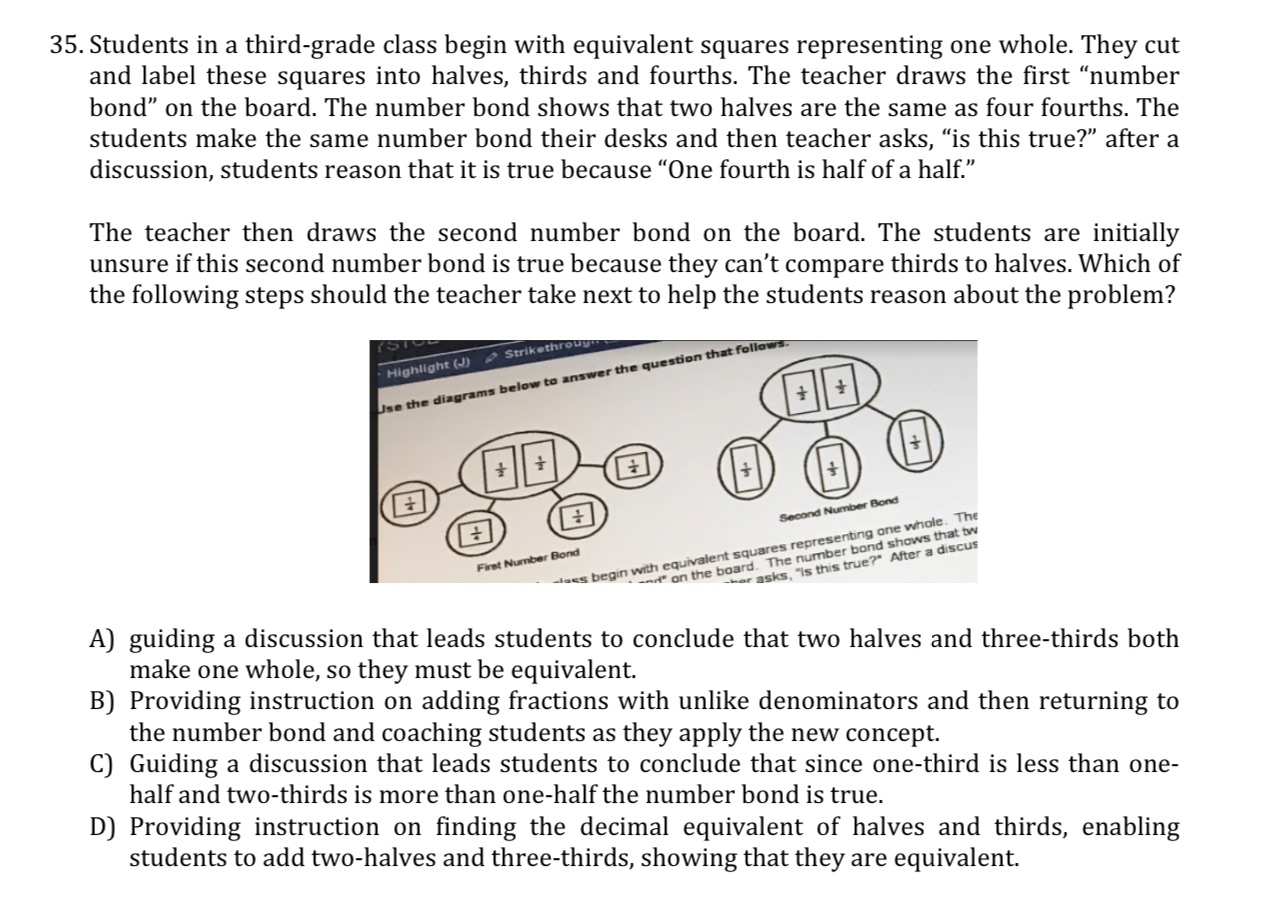
35. Students in a third-grade class begin with equivalent squares representing one whole. They cut and label these squares into halves, thirds and fourths. The teacher draws the first \"number bond\" on the board. The number bond shows that two halves are the same as four fourths. The students make the same number bond their desks and then teacher asks, \"is this true?\" after a discussion, students reason that it is true because \"One fourth is half of a half.\" The teacher then draws the second number bond on the board. The students are initially unsure if this second number bond is true because they can't compare thirds to halves. Which of the following steps should the teacher take next to help the students reason about the problem? The discus A) guiding a discussion that leads students to conclude that two halves and three-thirds both make one whole, so they must be equivalent. B) Providing instruction on adding fractions with unlike denominators and then returning to the number bond and coaching students as they apply the new concept. C) Guiding a discussion that leads students to conclude that since one-third is less than one- half and two-thirds is more than one-half the number bond is true. D) Providing instruction on finding the decimal equivalent of halves and thirds, enabling students to add two-halves and three-thirds, showing that they are equivalent
Step by Step Solution
There are 3 Steps involved in it

Get step-by-step solutions from verified subject matter experts
 Study Help