







Question: 3.5.8 Example. To find a basis for R4 containing the set S = {(2,0, 1, 2), (1, 3,-1,2)}, we consider each of the vectors

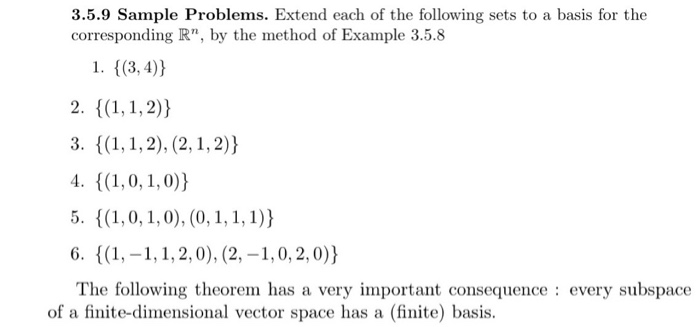
3.5.8 Example. To find a basis for R4 containing the set S = {(2,0, 1, 2), (1, 3,-1,2)}, we consider each of the vectors (1, 0, 0, 0), (0, 1, 0, 0), (0, 0, 1, 0), (0, 0, 0, 1) until we have a linearly independent set of size 4. Since (1, 0, 0, 0) is not in the span of S, we add it to our set, getting S3 = {(2,0, 1, 2), (1, 3,-1,2), (1, 0, 0, 0)}. The next point, (0, 1, 0, 0), is in the span of S3, so we don't add it. Since (0, 0, 1, 0) is not in the span of S3, we add it, getting S4= {(2,0,-1,2), (1, 3, -1, 2), (1, 0, 0, 0), (0, 0, 1, 0)}. This is a linearly independent set of size 4, so it is a basis. 3.5.9 Sample Problems. Extend each of the following sets to a basis for the corresponding R", by the method of Example 3.5.8 1. {(3,4)} 2. {(1,1,2)} 3. {(1, 1, 2), (2, 1, 2)} 4. {(1,0, 1, 0)} 5. {(1, 0, 1, 0), (0, 1, 1, 1)} 6. {(1,-1, 1, 2, 0), (2, -1,0,2,0)} The following theorem has a very important consequence every subspace of a finite-dimensional vector space has a (finite) basis.
Step by Step Solution
3.44 Rating (154 Votes )
There are 3 Steps involved in it
Question 34 Cowrider the vectous 10 01 Since 10 is not in the span of s We add it ... View full answer

Get step-by-step solutions from verified subject matter experts
 Study Help