







Question: 36. In problem 13 you calculated H and U for the combustion of one mole of propane at 298 K and 105Pa for when the
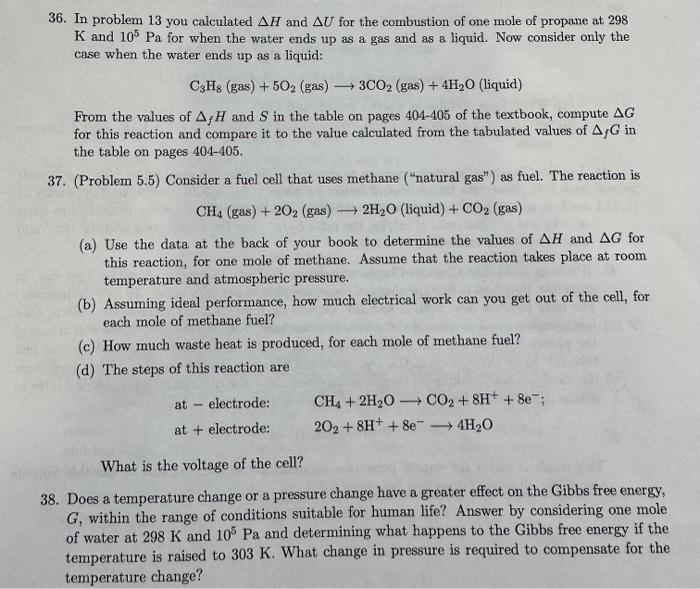
36. In problem 13 you calculated H and U for the combustion of one mole of propane at 298 K and 105Pa for when the water ends up as a gas and as a liquid. Now consider only the case when the water ends up as a liquid: C3H8(gas)+5O2(gas)3CO2(gas)+4H2O(liquid) From the values of fH and S in the table on pages 404-405 of the textbook, compute G for this reaction and compare it to the value calculated from the tabulated values of fG in the table on pages 404405. 37. (Problem 5.5) Consider a fuel cell that uses methane ("natural gas") as fuel. The reaction is CH4(gas)+2O2(gas)2H2O(liquid)+CO2(gas) (a) Use the data at the back of your book to determine the values of H and G for this reaction, for one mole of methane. Assume that the reaction takes place at room temperature and atmospheric pressure. (b) Assuming ideal performance, how much electrical work can you get out of the cell, for each mole of methane fuel? (c) How much waste heat is produced, for each mole of methane fuel? (d) The steps of this reaction are at-electrode:at+electrode:CH4+2H2OCO2+8H++8e2O2+8H++8e4H2O What is the voltage of the cell? 38. Does a temperature change or a pressure change have a greater effect on the Gibbs free energy, G, within the range of conditions suitable for human life? Answer by considering one mole of water at 298K and 105Pa and determining what happens to the Gibbs free energy if the temperature is raised to 303K. What change in pressure is required to compensate for the temperature change
Step by Step Solution
There are 3 Steps involved in it

Get step-by-step solutions from verified subject matter experts
 Study Help