







Question: 3-7. Sieving Coefficient in Ultrafiltration Ultrafiltration is a process in which pressure-driven flow of solvent across a size-selective membrane concentrates macromolecules or colloidal particles in
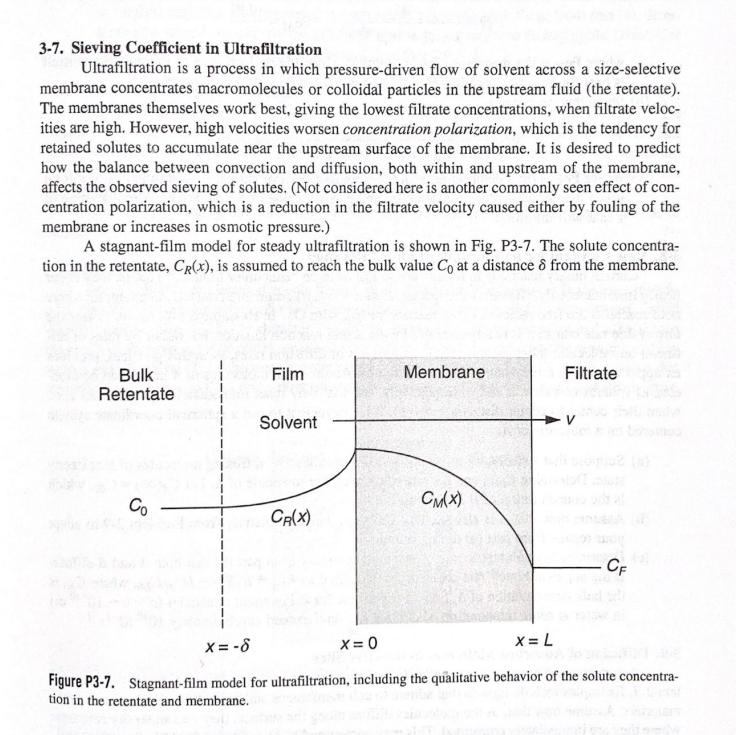
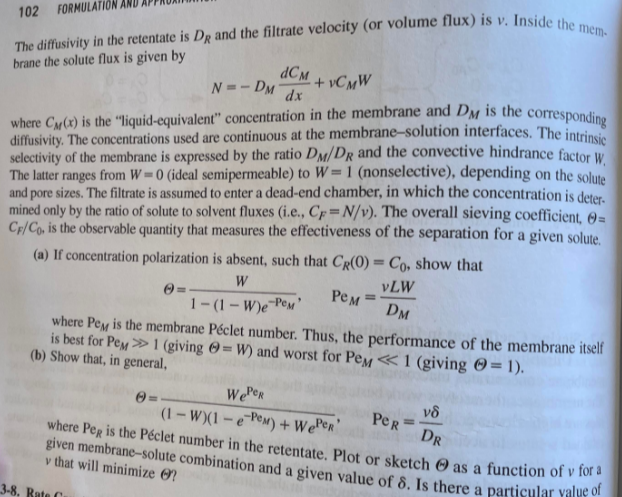
3-7. Sieving Coefficient in Ultrafiltration Ultrafiltration is a process in which pressure-driven flow of solvent across a size-selective membrane concentrates macromolecules or colloidal particles in the upstream fluid (the retentate). The membranes themselves work best, giving the lowest filtrate concentrations, when filtrate velocities are high. However, high velocities worsen concentration polarization, which is the tendency for retained solutes to accumulate near the upstream surface of the membrane. It is desired to predict how the balance between convection and diffusion, both within and upstream of the membrane, affects the observed sieving of solutes. (Not considered here is another commonly seen effect of concentration polarization, which is a reduction in the filtrate velocity caused either by fouling of the membrane or increases in osmotic pressure.) A stagnant-film model for steady ultrafiltration is shown in Fig. P3-7. The solute concentration in the retentate, CR(x), is assumed to reach the bulk value C0 at a distance from the membrane. Figure P3-7. Stagnant-film model for ultrafiltration, including the qualitative behavior of the solute concentration in the retentate and membrane. The diffusivity in the retentate is DR and the filtrate velocity (or volume flux) is v. Inside the mem. brane the solute flux is given by N=DMdxdCM+vCMW where CM(x) is the "liquid-equivalent" concentration in the membrane and DM is the corresponding diffusivity. The concentrations used are continuous at the membrane-solution interfaces. The intrinsic selectivity of the membrane is expressed by the ratio DM/DR and the convective hindrance factor W. The latter ranges from W=0 (ideal semipermeable) to W=1 (nonselective), depending on the solute and pore sizes. The filtrate is assumed to enter a dead-end chamber, in which the concentration is determined only by the ratio of solute to solvent fluxes (i.e., CF=N/v ). The overall sieving coefficient, = CF/C0, is the observable quantity that measures the effectiveness of the separation for a given solute. (a) If concentration polarization is absent, such that CR(0)=C0, show that =1(1W)ePeMW,PeM=DMLW where PeM is the membrane Peclet number. Thus, the performance of the membrane itself is best for PeM1 (giving =W ) and worst for PeM1 (giving =1 ). (b) Show that, in general, =(1W)(1ePeM)+WePeRWePeR,PeR=DRv where PeR is the Pclet number in the retentate. Plot or sketch as a function of v for a given membrane-solute combination and a given value of . Is there a particular value of 3-7. Sieving Coefficient in Ultrafiltration Ultrafiltration is a process in which pressure-driven flow of solvent across a size-selective membrane concentrates macromolecules or colloidal particles in the upstream fluid (the retentate). The membranes themselves work best, giving the lowest filtrate concentrations, when filtrate velocities are high. However, high velocities worsen concentration polarization, which is the tendency for retained solutes to accumulate near the upstream surface of the membrane. It is desired to predict how the balance between convection and diffusion, both within and upstream of the membrane, affects the observed sieving of solutes. (Not considered here is another commonly seen effect of concentration polarization, which is a reduction in the filtrate velocity caused either by fouling of the membrane or increases in osmotic pressure.) A stagnant-film model for steady ultrafiltration is shown in Fig. P3-7. The solute concentration in the retentate, CR(x), is assumed to reach the bulk value C0 at a distance from the membrane. Figure P3-7. Stagnant-film model for ultrafiltration, including the qualitative behavior of the solute concentration in the retentate and membrane. The diffusivity in the retentate is DR and the filtrate velocity (or volume flux) is v. Inside the mem. brane the solute flux is given by N=DMdxdCM+vCMW where CM(x) is the "liquid-equivalent" concentration in the membrane and DM is the corresponding diffusivity. The concentrations used are continuous at the membrane-solution interfaces. The intrinsic selectivity of the membrane is expressed by the ratio DM/DR and the convective hindrance factor W. The latter ranges from W=0 (ideal semipermeable) to W=1 (nonselective), depending on the solute and pore sizes. The filtrate is assumed to enter a dead-end chamber, in which the concentration is determined only by the ratio of solute to solvent fluxes (i.e., CF=N/v ). The overall sieving coefficient, = CF/C0, is the observable quantity that measures the effectiveness of the separation for a given solute. (a) If concentration polarization is absent, such that CR(0)=C0, show that =1(1W)ePeMW,PeM=DMLW where PeM is the membrane Peclet number. Thus, the performance of the membrane itself is best for PeM1 (giving =W ) and worst for PeM1 (giving =1 ). (b) Show that, in general, =(1W)(1ePeM)+WePeRWePeR,PeR=DRv where PeR is the Pclet number in the retentate. Plot or sketch as a function of v for a given membrane-solute combination and a given value of . Is there a particular value of
Step by Step Solution
There are 3 Steps involved in it

Get step-by-step solutions from verified subject matter experts
 Study Help