



Question: 38 5. INVERSION OF TRAVEL TIME DATA 2. (COMPUTER) You are given P-wave arrival times for two earthquakes reco by a 13-stat and also given
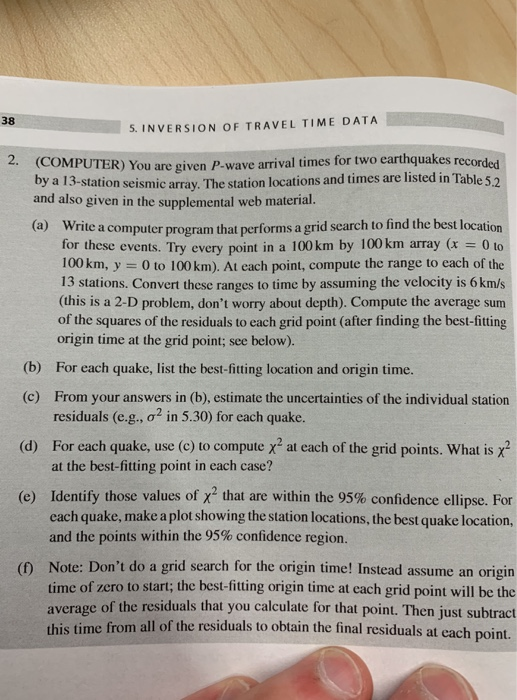
38 5. INVERSION OF TRAVEL TIME DATA 2. (COMPUTER) You are given P-wave arrival times for two earthquakes reco by a 13-stat and also given in the supplemental web material (a) Write a computer program that performs a grid search to find the best location ion seismic array. The station locations and times are listed in Tables for these events. Try every point in a 100 km by 100 km array (x = 0 to 100km, y 0 to 100km). At each point, compute the range to each of the 13 stations. Convert these ranges to time by assuming the velocity is 6 km/s (this is a 2-D problem, don't worry about depth). Compute the average sum of the squares of the residuals to each grid point (after finding the best-fitting origin time at the grid point; see below). (b) For each quake, list the best-fitting location and origin time. From your answers in (b), estimate the uncertainties of the individual station residuals (e.g., 2 in 5.30) for each quake. (c) For each quake, use (c) to compute " at each of the grid points. What is at the best-fitting point in each case? (d) Identify those values of " that are within the 95% confidence ellipse. For each quake, make a plot showing the station locations, the best quake location, and the points within the 95% confidence region. (e) (0 Note: Don't do a grid search for the origin time! Instead assume an origin time of zero to start; the best-fitting origin time at each grid point will be the average of the residuals that you calculate for that point. Then just subtract this time from all of the residuals to obtain the final residuals at each point. 38 5. INVERSION OF TRAVEL TIME DATA 2. (COMPUTER) You are given P-wave arrival times for two earthquakes reco by a 13-stat and also given in the supplemental web material (a) Write a computer program that performs a grid search to find the best location ion seismic array. The station locations and times are listed in Tables for these events. Try every point in a 100 km by 100 km array (x = 0 to 100km, y 0 to 100km). At each point, compute the range to each of the 13 stations. Convert these ranges to time by assuming the velocity is 6 km/s (this is a 2-D problem, don't worry about depth). Compute the average sum of the squares of the residuals to each grid point (after finding the best-fitting origin time at the grid point; see below). (b) For each quake, list the best-fitting location and origin time. From your answers in (b), estimate the uncertainties of the individual station residuals (e.g., 2 in 5.30) for each quake. (c) For each quake, use (c) to compute " at each of the grid points. What is at the best-fitting point in each case? (d) Identify those values of " that are within the 95% confidence ellipse. For each quake, make a plot showing the station locations, the best quake location, and the points within the 95% confidence region. (e) (0 Note: Don't do a grid search for the origin time! Instead assume an origin time of zero to start; the best-fitting origin time at each grid point will be the average of the residuals that you calculate for that point. Then just subtract this time from all of the residuals to obtain the final residuals at each point
Step by Step Solution
There are 3 Steps involved in it

Get step-by-step solutions from verified subject matter experts