







Question: 3.8 Figure 3.26 indicates a distributed arbitration scheme that can be used with an obsolete bus scheme known as Multibus I. Agents are daisy-chained physically
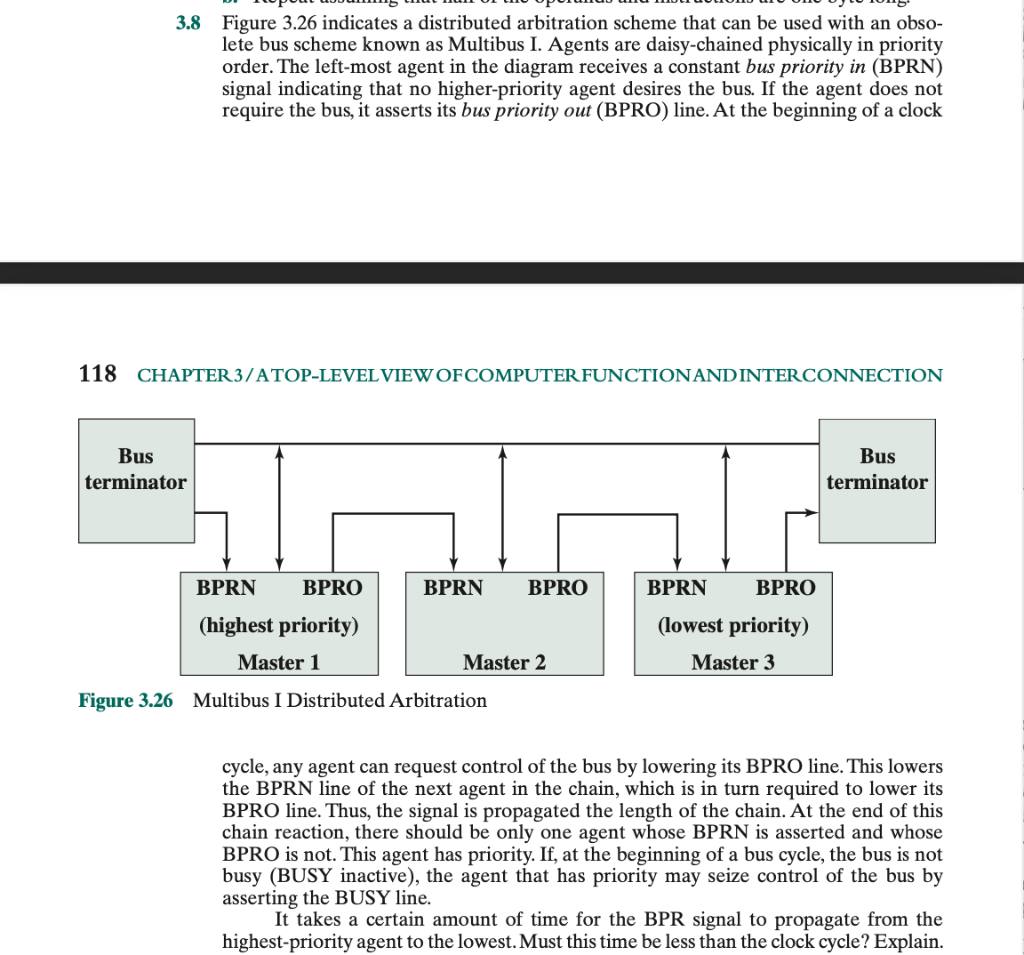
3.8 Figure 3.26 indicates a distributed arbitration scheme that can be used with an obsolete bus scheme known as Multibus I. Agents are daisy-chained physically in priority order. The left-most agent in the diagram receives a constant bus priority in (BPRN) signal indicating that no higher-priority agent desires the bus. If the agent does not require the bus, it asserts its bus priority out (BPRO) line. At the beginning of a clock 118 CHAPTER3/ATOP-LEVELVIEW OFCOMPUTERFUNCTIONANDINTERCONNECTION Figure 3.26 Multibus I Distributed Arbitration cycle, any agent can request control of the bus by lowering its BPRO line. This lowers the BPRN line of the next agent in the chain, which is in turn required to lower its BPRO line. Thus, the signal is propagated the length of the chain. At the end of this chain reaction, there should be only one agent whose BPRN is asserted and whose BPRO is not. This agent has priority. If, at the beginning of a bus cycle, the bus is not busy (BUSY inactive), the agent that has priority may seize control of the bus by asserting the BUSY line. It takes a certain amount of time for the BPR signal to propagate from the highest-priority agent to the lowest. Must this time be less than the clock cycle? Explain
Step by Step Solution
There are 3 Steps involved in it

Get step-by-step solutions from verified subject matter experts
 Study Help