Question: Example 3 ACTIVITY-ON-ARROW FOR MILWAUKEE PAPER Draw the complete AOA project network for Milwaukee Paper's problem. APPROACH Using the data from Table 3.1 in Example
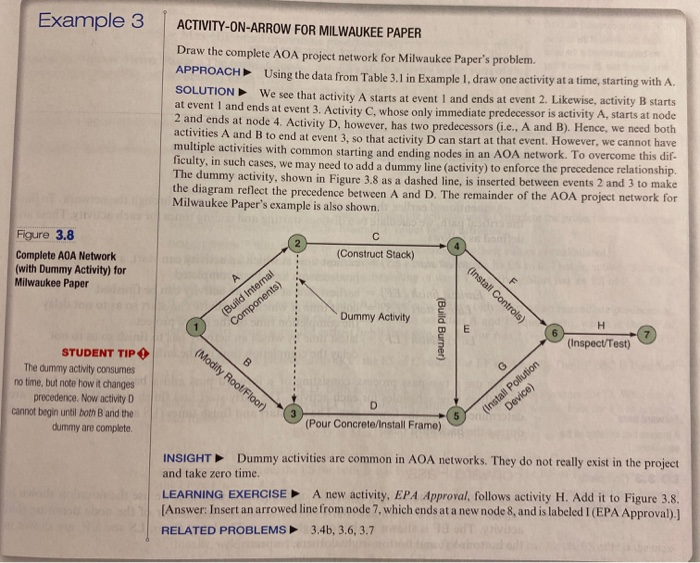
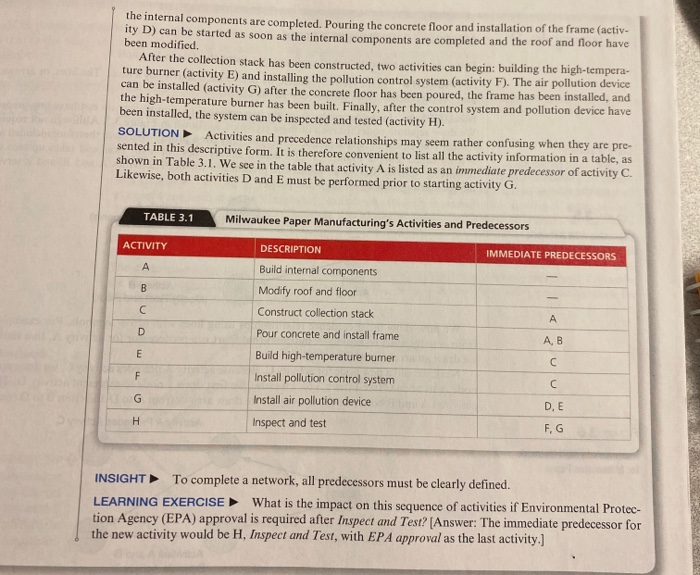
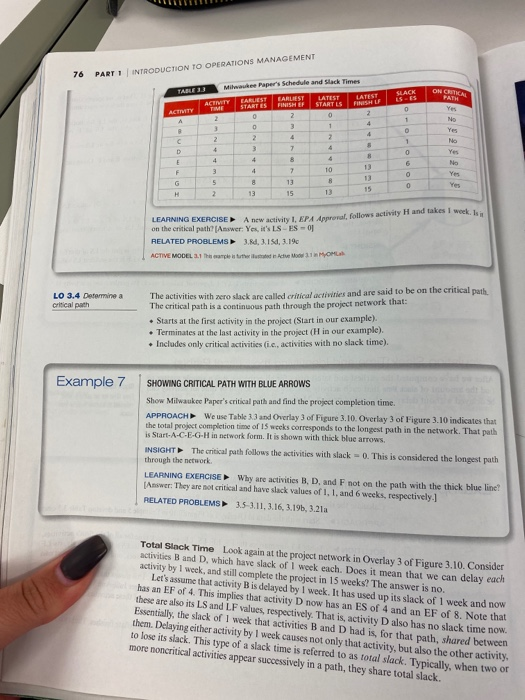
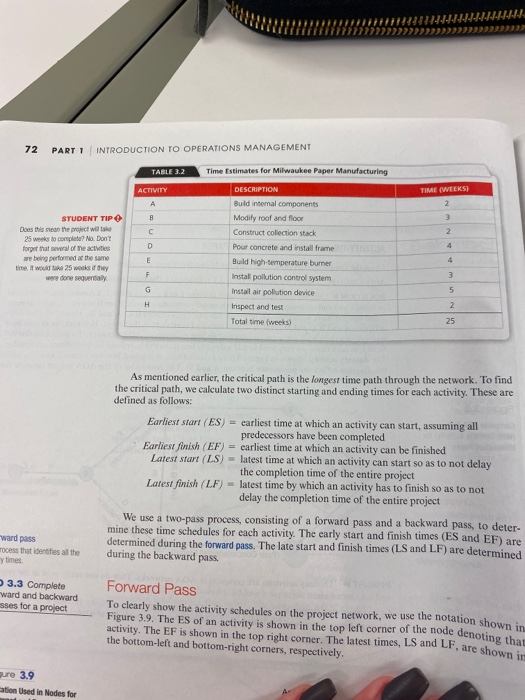
Example 3 ACTIVITY-ON-ARROW FOR MILWAUKEE PAPER Draw the complete AOA project network for Milwaukee Paper's problem. APPROACH Using the data from Table 3.1 in Example 1. draw one activity at a time, starting with A. SOLUTION We see that activity A starts at event and ends at event 2. Likewise, activity B starts at event and ends at event 3. Activity C, whose only immediate predecessor is activity A, starts at node Z and ends at node 4. Activity D, however, has two predecessors (ie.. A and B). Hence, we need both activities A and B to end at event 3, so that activity D can start at that event. However, we cannot have multiple activities with common starting and ending nodes in an AOA network. To overcome this dif- ficulty, in such cases, we may need to add a dummy line (activity) to enforce the precedence relationship The dummy activity, shown in Figure 3.8 as a dashed line, is inserted between events 2 and 3 to make the diagram reflect the precedence between A and D. The remainder of the AOA project network for Milwaukee Paper's example is also shown. Figure 3.8 Complete AOA Network (with Dummy Activity) for Milwaukee Paper (Construct Stack) (Install Controls) (Build Internal Components) Dummy Activity (Build Burner) (Inspect/Test) (Modily Root/Floor) STUDENT TIP The dummy activity consumes no time, but note how it changes precedence. Now activity D cannot begin until both B and the dummy are complete (Pour Concrete/Install Frame) (Install Pollution Device) INSIGHT Dummy activities are common in AOA networks. They do not really exist in the project and take zero time. LEARNING EXERCISE A new activity, EPA Approval, follows activity H. Add it to Figure 3.8. [Answer: Insert an arrowed line from node 7, which ends at a new node 8, and is labeled I(EPA Approval).] RELATED PROBLEMS 3.4b, 3.6, 3.7 the internal components are completed. Pouring the concrete floor and installation of the frame (activ- ity D) can be started as soon as the internal components are completed and the roof and floor have been modified After the collection stack has been constructed, two activities can begin: building the high-tempera- ture burner (activity E) and installing the pollution control system (activity . The air pollution device can be installed (activity G) after the concrete floor has been poured, the frame has been installed, and the high-temperature burner has been built. Finally, after the control system and pollution device have been installed, the system can be inspected and tested activity H). SOLUTION Activities and precedence relationships may seem rather confusing when they are pre- sented in this descriptive form. It is therefore convenient to list all the activity information in a table, as shown in Table 3.1. We see in the table that activity A is listed as an immediate predecessor of activity C Likewise, both activities D and E must be performed prior to starting activity G. TABLE 3.1 Milwaukee Paper Manufacturing's Activities and Predecessors ACTIVITY IMMEDIATE PREDECESSORS DESCRIPTION Build internal components Modify roof and floor Construct collection stack Pour concrete and install frame Build high-temperature burner Install pollution control system Install air pollution device AB D. E Inspect and test F G INSIGHT To complete a network, all predecessors must be clearly defined. LEARNING EXERCISE What is the impact on this sequence of activities if Environmental Protec- tion Agency (EPA) approval is required after inspect and Test? [Answer: The immediate predecessor for the new activity would be H, Inspect and Test, with EPA approval as the last activity.) 76 PART 1 INTRODUCTION TO OPERATIONS MANAGEMENT Milwaukee Paper's Schedule and stack Times MY EARLIEST EARLIEST LATEST LEARNING EXERCISE Anwar P anel, follows activity H and takes I week, on the critical path Anwer: Yes, it's LS - ESO RELATED PROBLEMS 3.Rd, 315, 3.190 ACTIVE MODEL 21h th e Moon MOM LO 3.4 Determine a Critical path The activities with no stack are called critical actities and are said to be on the critical path The critical path is a continuous path through the project network that: Starts at the first activity in the project (Start in our example). Terminates at the last activity in the project ( in our example). Includes only critical activities (i.c., activities with no slack time). Example 7 SHOWING CRITICAL PATH WITH BLUE ARROWS Show Milwaukee Paper's critical path and find the project completion time. APPROACH We use Table 33 and Overlay 3 of Figure 3.10. Overlay 3 of Figure 3.10 indicates that the total project completion time of 15 weeks corresponds to the longest path in the network. That path is Start-A-C-E-G-H in network form. It is shown with thick blue arrows INSIGHT The critical path follows the activities with slack - 0. This is considered the longest path through the network LEARNING EXERCISE Why are activities B, D, and F not on the path with the thick blue line Answer: They are not critical and have slack values of I, I, and 6 weeks, respectively RELATED PROBLEMS 3.5-3.11, 3.16, 3.1%, 3.21a These are Ford Duis activity Bilete the proces cach. in Overia them. Do the lack of LF valdes activity work. It hacks? The ans that we moose its slack. The activity bike that actively. That is an Es or 4 als slack of Total Slack Time Look again at the project network in Overlay 3 of Figure 3.10. Consider activities B and D, which have slack of 1 week each. Does it mean that we can delay each activity by 1 week, and still complete the project in 15 weeks? The answer is no Let's assume that activity B is delayed by I weck. It has used up its slack of 1 week and now has an EF of 4. This implies that activity D now has an ES of 4 and an EF of 8. Note that these are also its LS and LF values, respectively. That is, activity D also has no slack time now. Essentially, the slack of 1 week that activities B and D had is for that path, shared between them. Delaying either activity by 1 week causes not only that activity, but also the other activity to lose its slack. This type of a slack time is referred to as total slack. Typically, when two of more noncritical activities appear successively in a path, they share total slack. Vitis B and Dictivity D also has or 8. Note that 2222 72 PART 1 INTRODUCTION TO OPERATIONS MANAGEMENT Time Estimates for Milwaukee Paper Manufacturing ACTIVITY TIME ( WEEKS) DESCRIPTION Buld internal components STUDENT TIPO Does this mean the project will take 25 weeks to complete? No. Don't forget that several of the acties are being performed at the same time. It would take 25 wok it they done sequently Modify roof and floor Construct collection stack Pour concrete and install frame Build high-temperature burner Install pollution control system Install air pollution device Inspect and test Total time weeks) w on As mentioned earlier, the critical path is the longest time path through the network. To find the critical path, we calculate two distinct starting and ending times for each activity. These are defined as follows: Earliest start (ES) = earliest time at which an activity can start, assuming all predecessors have been completed Earliest finish (EF) = earliest time at which an activity can be finished Latest start (LS) - latest time at which an activity can start so as to not delay the completion time of the entire project Latest finish (LF) = latest time by which an activity has to finish so as to not delay the completion time of the entire project We use a two-pass process, consisting of a forward pass and a backward pass, to deter. mine these time schedules for each activity. The early start and finish times (ES and EF) are determined during the forward pass. The late start and finish times (LS and LF) are determined during the backward pass ward pass rocess that identifies all the y times 3.3 Complete ward and backward sses for a project Forward Pass To clearly show the activity schedules on the project network, we use the notation show Figure 3.9. The ES of an activity is shown in the top left corner of the node denotina activity. The EF is shown in the top right corner. The latest times, LS and LF, are she the bottom-left and bottom-right corners, respectively, activity. The Fe project network, we use the of an activity is shou oure 3.9 ation Used in Nodes for Example 3 ACTIVITY-ON-ARROW FOR MILWAUKEE PAPER Draw the complete AOA project network for Milwaukee Paper's problem. APPROACH Using the data from Table 3.1 in Example 1. draw one activity at a time, starting with A. SOLUTION We see that activity A starts at event and ends at event 2. Likewise, activity B starts at event and ends at event 3. Activity C, whose only immediate predecessor is activity A, starts at node Z and ends at node 4. Activity D, however, has two predecessors (ie.. A and B). Hence, we need both activities A and B to end at event 3, so that activity D can start at that event. However, we cannot have multiple activities with common starting and ending nodes in an AOA network. To overcome this dif- ficulty, in such cases, we may need to add a dummy line (activity) to enforce the precedence relationship The dummy activity, shown in Figure 3.8 as a dashed line, is inserted between events 2 and 3 to make the diagram reflect the precedence between A and D. The remainder of the AOA project network for Milwaukee Paper's example is also shown. Figure 3.8 Complete AOA Network (with Dummy Activity) for Milwaukee Paper (Construct Stack) (Install Controls) (Build Internal Components) Dummy Activity (Build Burner) (Inspect/Test) (Modily Root/Floor) STUDENT TIP The dummy activity consumes no time, but note how it changes precedence. Now activity D cannot begin until both B and the dummy are complete (Pour Concrete/Install Frame) (Install Pollution Device) INSIGHT Dummy activities are common in AOA networks. They do not really exist in the project and take zero time. LEARNING EXERCISE A new activity, EPA Approval, follows activity H. Add it to Figure 3.8. [Answer: Insert an arrowed line from node 7, which ends at a new node 8, and is labeled I(EPA Approval).] RELATED PROBLEMS 3.4b, 3.6, 3.7 the internal components are completed. Pouring the concrete floor and installation of the frame (activ- ity D) can be started as soon as the internal components are completed and the roof and floor have been modified After the collection stack has been constructed, two activities can begin: building the high-tempera- ture burner (activity E) and installing the pollution control system (activity . The air pollution device can be installed (activity G) after the concrete floor has been poured, the frame has been installed, and the high-temperature burner has been built. Finally, after the control system and pollution device have been installed, the system can be inspected and tested activity H). SOLUTION Activities and precedence relationships may seem rather confusing when they are pre- sented in this descriptive form. It is therefore convenient to list all the activity information in a table, as shown in Table 3.1. We see in the table that activity A is listed as an immediate predecessor of activity C Likewise, both activities D and E must be performed prior to starting activity G. TABLE 3.1 Milwaukee Paper Manufacturing's Activities and Predecessors ACTIVITY IMMEDIATE PREDECESSORS DESCRIPTION Build internal components Modify roof and floor Construct collection stack Pour concrete and install frame Build high-temperature burner Install pollution control system Install air pollution device AB D. E Inspect and test F G INSIGHT To complete a network, all predecessors must be clearly defined. LEARNING EXERCISE What is the impact on this sequence of activities if Environmental Protec- tion Agency (EPA) approval is required after inspect and Test? [Answer: The immediate predecessor for the new activity would be H, Inspect and Test, with EPA approval as the last activity.) 76 PART 1 INTRODUCTION TO OPERATIONS MANAGEMENT Milwaukee Paper's Schedule and stack Times MY EARLIEST EARLIEST LATEST LEARNING EXERCISE Anwar P anel, follows activity H and takes I week, on the critical path Anwer: Yes, it's LS - ESO RELATED PROBLEMS 3.Rd, 315, 3.190 ACTIVE MODEL 21h th e Moon MOM LO 3.4 Determine a Critical path The activities with no stack are called critical actities and are said to be on the critical path The critical path is a continuous path through the project network that: Starts at the first activity in the project (Start in our example). Terminates at the last activity in the project ( in our example). Includes only critical activities (i.c., activities with no slack time). Example 7 SHOWING CRITICAL PATH WITH BLUE ARROWS Show Milwaukee Paper's critical path and find the project completion time. APPROACH We use Table 33 and Overlay 3 of Figure 3.10. Overlay 3 of Figure 3.10 indicates that the total project completion time of 15 weeks corresponds to the longest path in the network. That path is Start-A-C-E-G-H in network form. It is shown with thick blue arrows INSIGHT The critical path follows the activities with slack - 0. This is considered the longest path through the network LEARNING EXERCISE Why are activities B, D, and F not on the path with the thick blue line Answer: They are not critical and have slack values of I, I, and 6 weeks, respectively RELATED PROBLEMS 3.5-3.11, 3.16, 3.1%, 3.21a These are Ford Duis activity Bilete the proces cach. in Overia them. Do the lack of LF valdes activity work. It hacks? The ans that we moose its slack. The activity bike that actively. That is an Es or 4 als slack of Total Slack Time Look again at the project network in Overlay 3 of Figure 3.10. Consider activities B and D, which have slack of 1 week each. Does it mean that we can delay each activity by 1 week, and still complete the project in 15 weeks? The answer is no Let's assume that activity B is delayed by I weck. It has used up its slack of 1 week and now has an EF of 4. This implies that activity D now has an ES of 4 and an EF of 8. Note that these are also its LS and LF values, respectively. That is, activity D also has no slack time now. Essentially, the slack of 1 week that activities B and D had is for that path, shared between them. Delaying either activity by 1 week causes not only that activity, but also the other activity to lose its slack. This type of a slack time is referred to as total slack. Typically, when two of more noncritical activities appear successively in a path, they share total slack. Vitis B and Dictivity D also has or 8. Note that 2222 72 PART 1 INTRODUCTION TO OPERATIONS MANAGEMENT Time Estimates for Milwaukee Paper Manufacturing ACTIVITY TIME ( WEEKS) DESCRIPTION Buld internal components STUDENT TIPO Does this mean the project will take 25 weeks to complete? No. Don't forget that several of the acties are being performed at the same time. It would take 25 wok it they done sequently Modify roof and floor Construct collection stack Pour concrete and install frame Build high-temperature burner Install pollution control system Install air pollution device Inspect and test Total time weeks) w on As mentioned earlier, the critical path is the longest time path through the network. To find the critical path, we calculate two distinct starting and ending times for each activity. These are defined as follows: Earliest start (ES) = earliest time at which an activity can start, assuming all predecessors have been completed Earliest finish (EF) = earliest time at which an activity can be finished Latest start (LS) - latest time at which an activity can start so as to not delay the completion time of the entire project Latest finish (LF) = latest time by which an activity has to finish so as to not delay the completion time of the entire project We use a two-pass process, consisting of a forward pass and a backward pass, to deter. mine these time schedules for each activity. The early start and finish times (ES and EF) are determined during the forward pass. The late start and finish times (LS and LF) are determined during the backward pass ward pass rocess that identifies all the y times 3.3 Complete ward and backward sses for a project Forward Pass To clearly show the activity schedules on the project network, we use the notation show Figure 3.9. The ES of an activity is shown in the top left corner of the node denotina activity. The EF is shown in the top right corner. The latest times, LS and LF, are she the bottom-left and bottom-right corners, respectively, activity. The Fe project network, we use the of an activity is shou oure 3.9 ation Used in Nodes for