







Question: ? PURPOSE To offer some practice solving inheritance questions. D To learn how variability in human characteristics is achieved through a random assortment of dominant
 ?
?
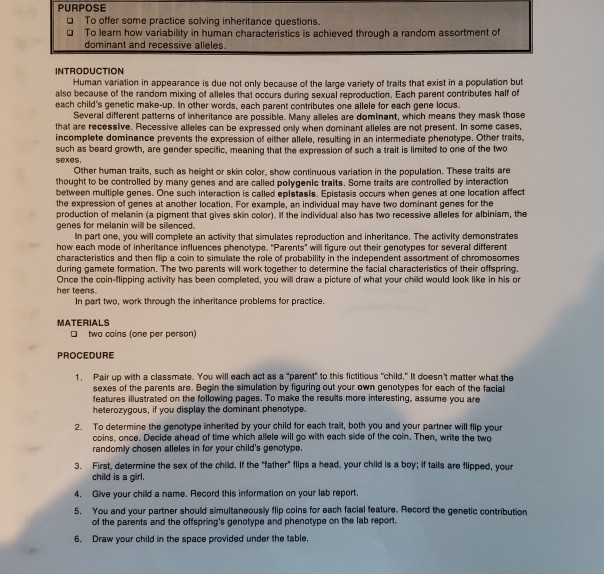
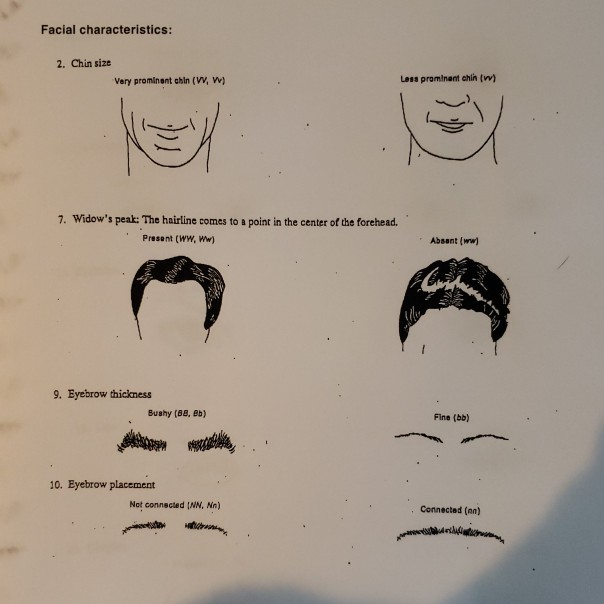
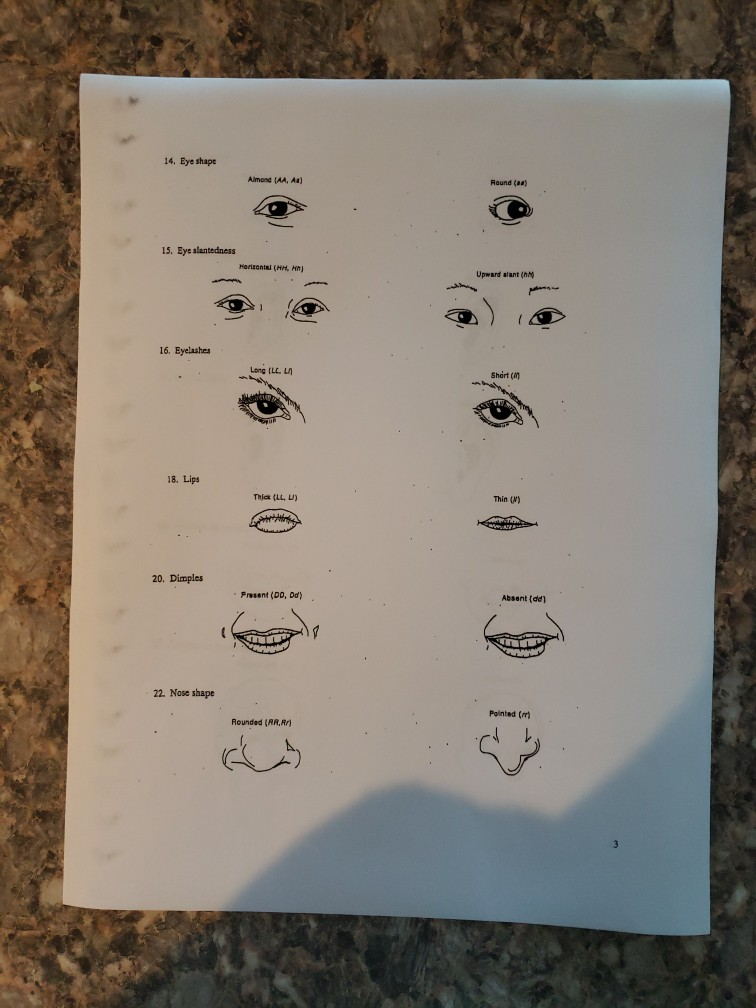
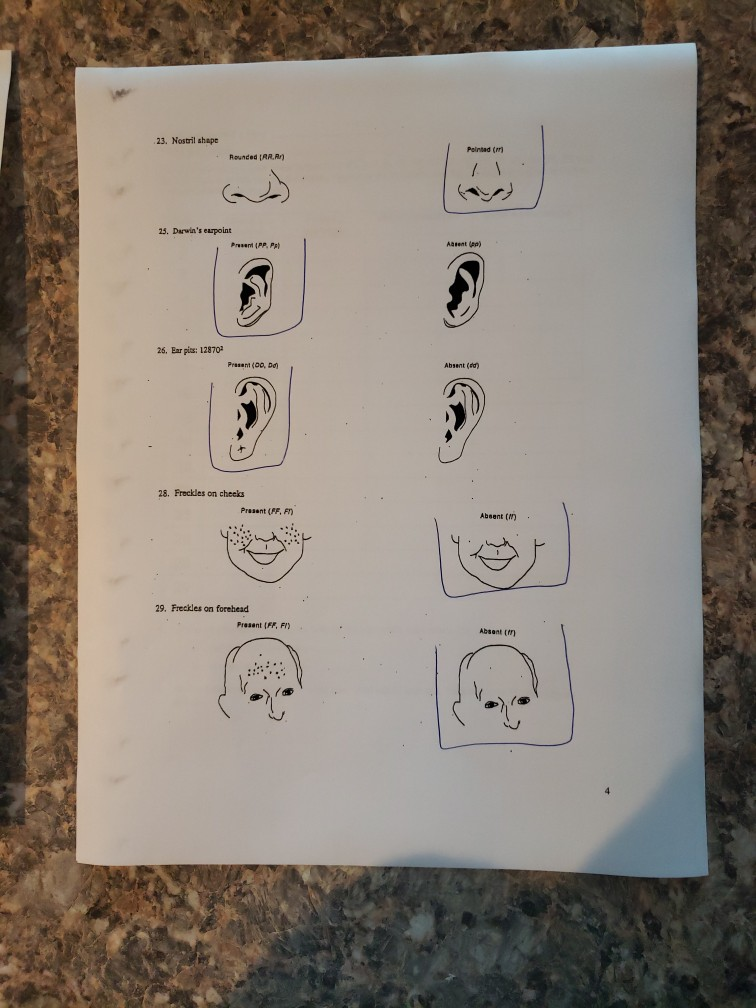
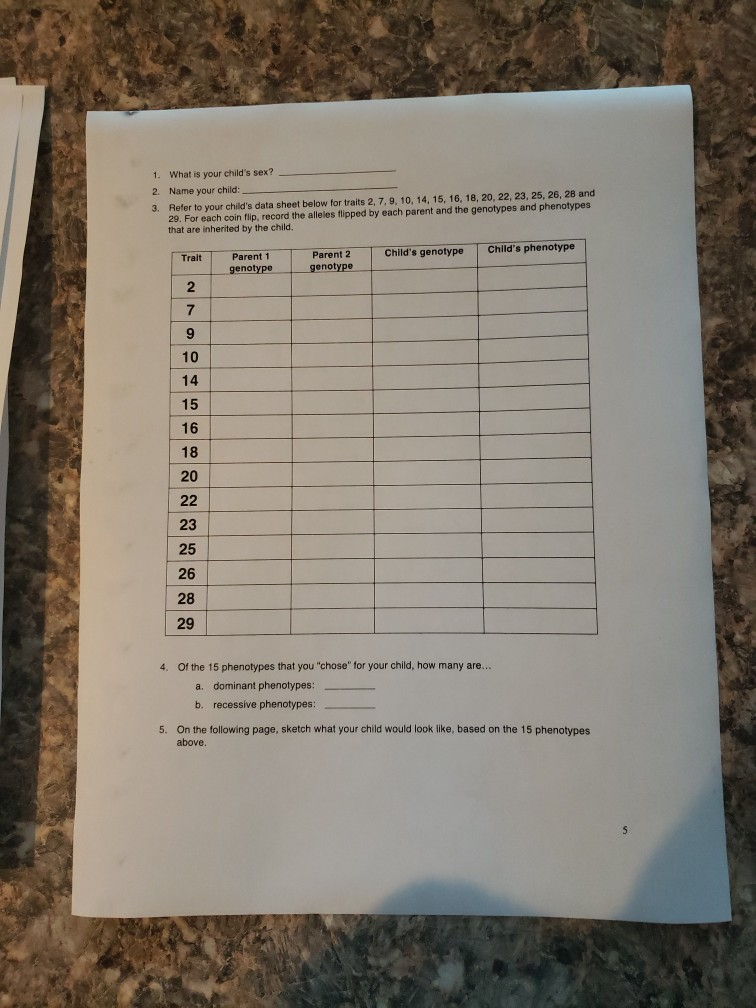
PURPOSE To offer some practice solving inheritance questions. D To learn how variability in human characteristics is achieved through a random assortment of dominant and recessive alleles. INTRODUCTION Human variation in appearance is due not only because of the large variety of traits that exist in a population but also because of the random mixing of alleles that occurs during sexual reproduction. Each parent contributes half of each child's genetic make-up. In other words, each parent contributes one allele for each gene locus. Several different patterns of inheritance are possible. Many alleles are dominant, which means they mask those that are recessive. Recessive alleles can be expressed only when dominant alleles are not present. In some cases, incomplete dominance prevents the expression of either allele, resulting in an intermediate phenotype. Other traits, such as beard growth, are gender specific, meaning that the expression of such a trait is limited to one of the two sexes. Other human traits, such as height or skin color, show continuous variation in the population. These traits are thought to be controlled by many genes and are called polygenic traits. Some traits are controlled by interaction between multiple genes. One such interaction is called epistasis. Epistasis occurs when genes at one location affect the expression of genes at another location. For example, an individual may have two dominant genes for the production of melanin (a pigment that gives skin color). If the individual also has two recessive alleles for albinism, the genes for melanin will be silenced. In part one, you will complete an activity that simulates reproduction and inheritance. The activity demonstrates how each mode of inheritance influences phenotype. "Parents will figure out their genotypes for several different characteristics and then flip a coin to simulate the role of probability in the independent assortment of chromosomes during gamete formation. The two parents will work together to determine the facial characteristics of their offspring. Once the coin-flipping activity has been completed, you will draw a picture of what your child would look like in his or her teens. In part two, work through the inheritance problems for practice. MATERIALS two coins (one per person) PROCEDURE 1. Pair up with a classmate. You will each act as a "parent" to this fictitious "child." It doesn't matter what the sexes of the parents are. Begin the simulation by figuring out your own genotypes for each of the facial features illustrated on the following pages. To make the results more interesting, assume you are heterozygous, if you display the dominant phenotype. 2. To determine the genotype inherited by your child for each trait, both you and your partner will flip your coins, once. Decide ahead of time which allele will go with each side of the coin. Then, write the two randomly chosen alleles in for your child's genotype. 3. First, determine the sex of the child. If the "father" flips a head, your child is a boy; if talls are flipped, your child is a girl. Give your child a name. Record this information on your lab report. 4. 5. You and your partner should simultaneously flip coins for each facial feature. Record the genetic contribution of the parents and the offspring's genotype and phenotype on the lab report. 6. Draw your child in the space provided under the table. Facial characteristics: 2. Chin size Very prominent chin (VV, V) 7. Widow's peak: The hairline comes to a point in the center of the forehead. Present (WW, WW) 9. Eyebrow thickness y Buahy (88, 8b) 10. Eyebrow placement Not connected INN, Nn) Less prominent chin (w) Absent (ww) Fine (bb) Connected (nn) 23. Nostril shape Rounded (RR.Rr) 25. Darwin's earpoint 26. Ear pits: 12870 Present (PP. Pal Present (DC, D) 28. Freckles on cheeks. Present (FF, FT) 29. Freckles on forehead. Present (FF, FI) Pointed (r) Absent (pp) Absent (dd) Absent (/) Absent (fr) What is your child's sex? Name your child: 3. Refer to your child's data sheet below for traits 2, 7, 9, 10, 14, 15, 16, 18, 20, 22, 23, 25, 26, 28 and 29. For each coin flip, record the alleles flipped by each parent and the genotypes and phenotypes that are inherited by the child. 1. 2. Trait 2 7 9 10 14 15 16 18 20 22 23 25 26 28 29 Parent 1 genotype Parent 2 genotype Child's genotype Child's phenotype 4. Of the 15 phenotypes that you "chose" for your child, how many are... a. dominant phenotypes: b. recessive phenotypes: 5. On the following page, sketch what your child would look like, based on the 15 phenotypes above.
Step by Step Solution
3.57 Rating (150 Votes )
There are 3 Steps involved in it
Trait Parent 1 genotype Parent 2 genotype Childs genot... View full answer

Get step-by-step solutions from verified subject matter experts
 Study Help