







Question: 4 - 1 2 . Absorption with a Nearly Irreversible Reaction Assume that gaseous species A is absorbed in a stagnant liquid, resulting in the
Absorption with a Nearly Irreversible Reaction
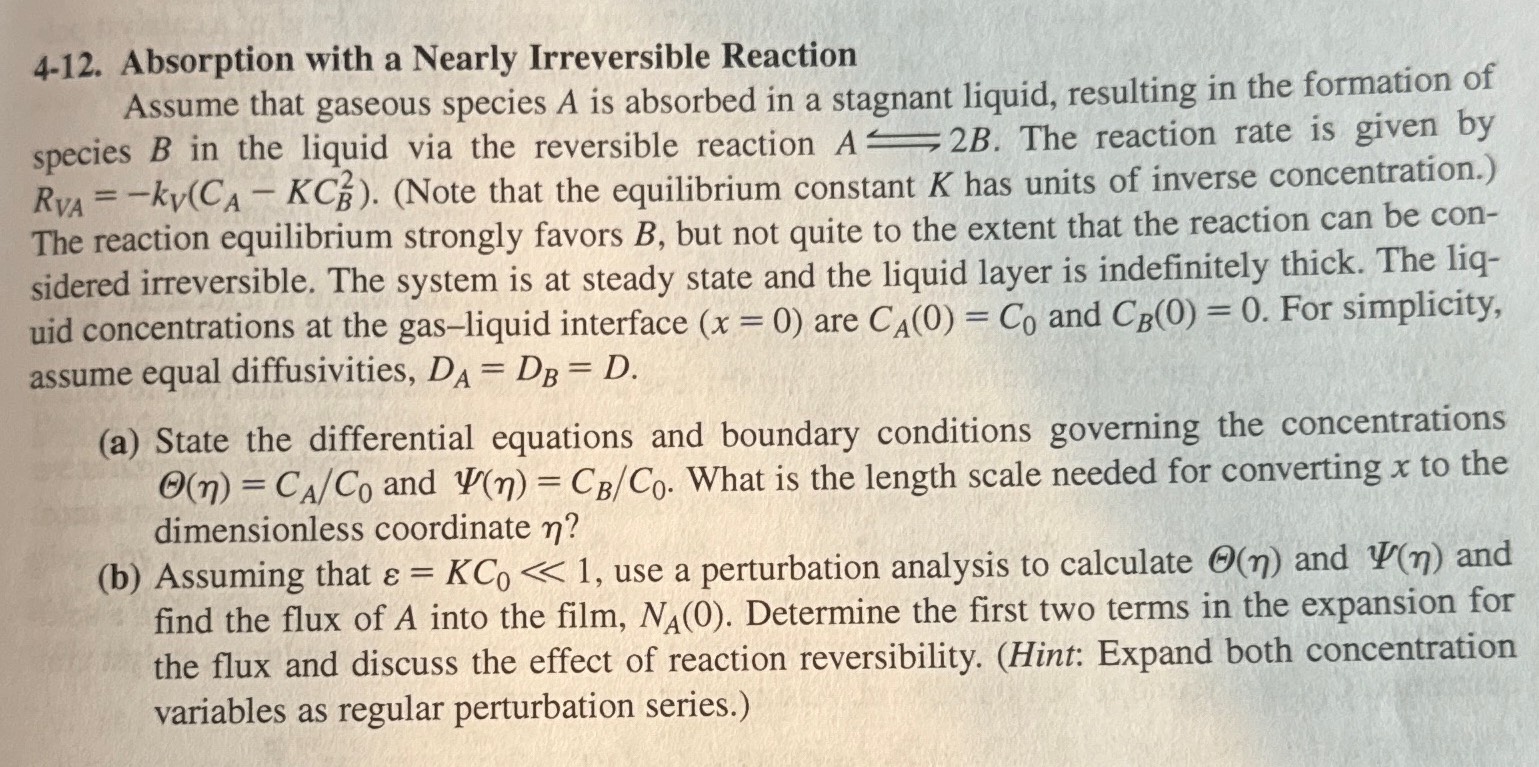
Assume that gaseous species is absorbed in a stagnant liquid, resulting in the formation of species in the liquid via the reversible reaction The reaction rate is given by Note that the equilibrium constant has units of inverse concentration. The reaction equilibrium strongly favors but not quite to the extent that the reaction can be considered irreversible. The system is at steady state and the liquid layer is indefinitely thick. The liquid concentrations at the gasliquid interface are and For simplicity, assume equal diffusivities,
a State the differential equations and boundary conditions governing the concentrations and What is the length scale needed for converting to the dimensionless coordinate
b Assuming that use a perturbation analysis to calculate and and find the flux of A into the film, Determine the first two terms in the expansion for the flux and discuss the effect of reaction reversibility. Hint: Expand both concentration variables as regular perturbation series.
Note: use regular perturbation. For thetaeta determine the first two terms of expansion. Use thetaeta to determine the flux of A into the film. For psieta you only need to determine the first term of the expansion.
For and ODE that looks like f f where CC C are known constants, you should guess the solution of the form fx where is the homogeneous solution and
is the particular solution. Guess the particular solution of the form
A BxD where AB and D are constants to be determined. Substitute this form into your ODE and compare terms with nonhomogeneous righthand side RHS to get the constsnts AB and D This strategy is called "Methods of Undetermined Coefficients". You can use "Variation of Parameters," if you want to instead.
Step by Step Solution
There are 3 Steps involved in it
1 Expert Approved Answer
Step: 1 Unlock

Question Has Been Solved by an Expert!
Get step-by-step solutions from verified subject matter experts
Step: 2 Unlock
Step: 3 Unlock
 Study Help