







Question: * * * 4 . 1 7 In this problem we perform five successive accesses to memory. The following table shows for each access whether
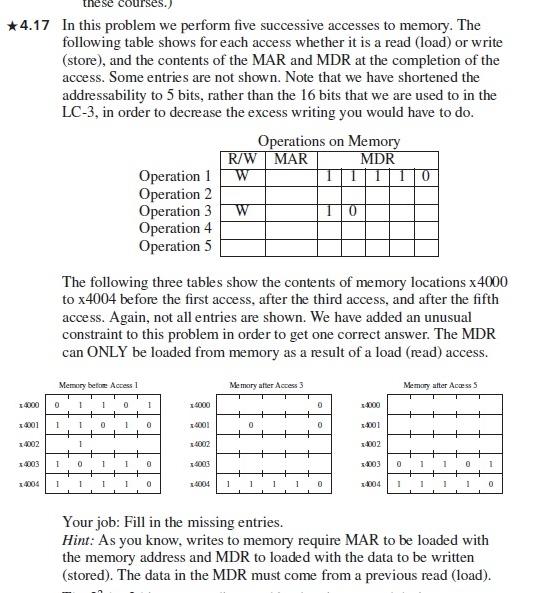
In this problem we perform five successive accesses to memory. The following table shows for each access whether it is a read load or write store and the contents of the MAR and MDR at the completion of the access. Some entries are not shown. Note that we have shortened the addressability to bits, rather than the bits that we are used to in the LC in order to decrease the excess writing you would have to do
tableOperation Operations on MemoryMAR,,,WOperation Operation WOperation Operation
The following three tables show the contents of memory locations to before the first access, after the third access, and after the fifth access. Again, not all entries are shown. We have added an unusual constraint to this problem in order to get one correct answer. The MDR can ONLY be loaded from memory as a result of a load read access.
Your job: Fill in the missing entries.
Hint: As you know, writes to memory require MAR to be loaded with the memory address and MDR to loaded with the data to be written stored The data in the MDR must come from a previous read load
Step by Step Solution
There are 3 Steps involved in it
1 Expert Approved Answer
Step: 1 Unlock

Question Has Been Solved by an Expert!
Get step-by-step solutions from verified subject matter experts
Step: 2 Unlock
Step: 3 Unlock
 Study Help