







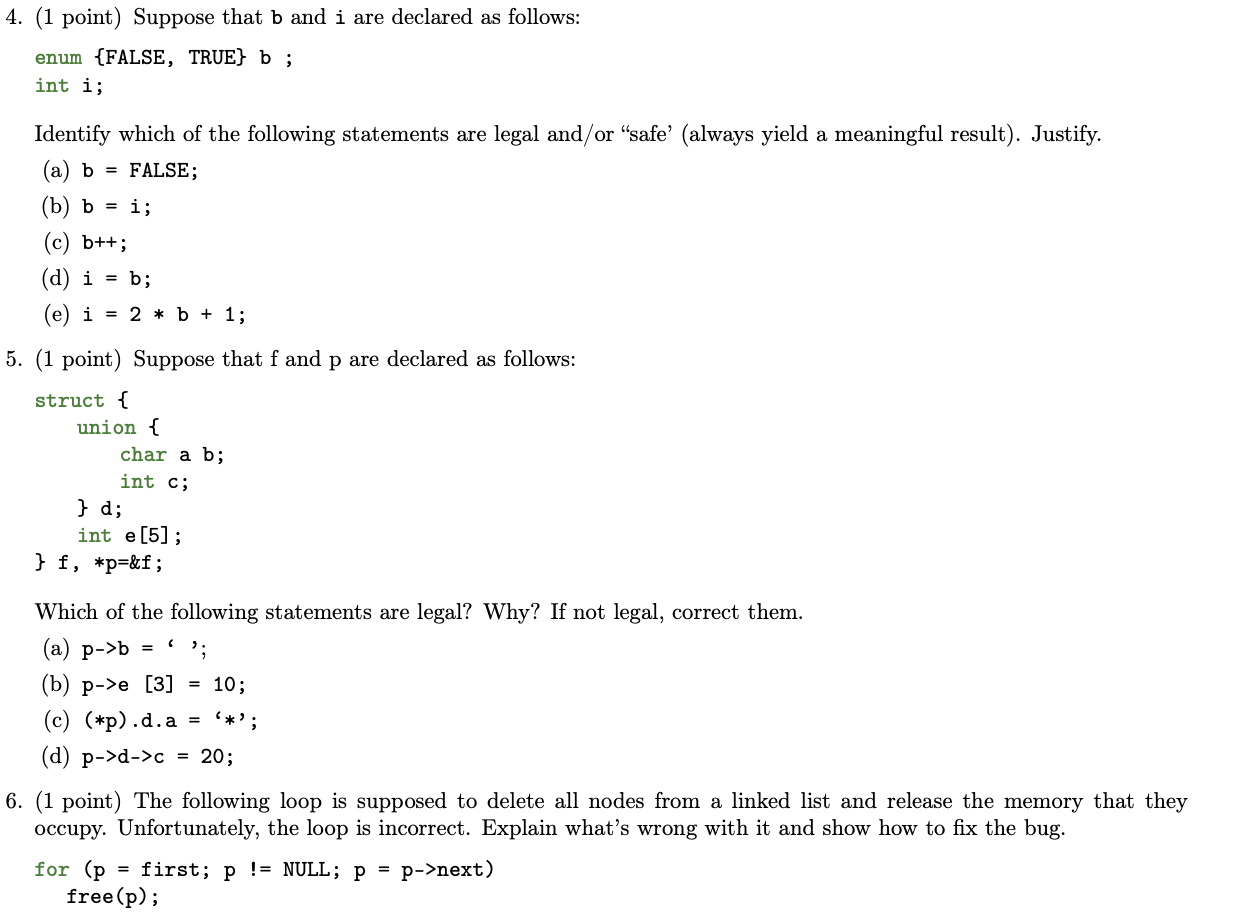
Question: 4 . ( 1 point ) Suppose that b and i are declared as follows: enum { FALSE , TRUE } b ;
point Suppose that b and i are declared as follows:
enum FALSE TRUE b ;
int i;
Identify which of the following statements are legal andor "safe' always yield a meaningful result Justify.
a b FALSE;
b b i;
c b;
dmathrmimathrmb;
emathrmimathrm~b;
point Suppose that f and p are declared as follows:
struct
union
char a b;
int c;
d;
int e;
fp&f;
Which of the following statements are legal? Why? If not legal, correct them.
amathrmpmathrmb;
b pe ;
cpda ;
dmathrmpmathrmdmathrmc;
point The following loop is supposed to delete all nodes from a linked list and release the memory that they occupy. Unfortunately, the loop is incorrect. Explain what's wrong with it and show how to fix the bug.
for p first; p NULL; p pnext
freep;
Step by Step Solution
There are 3 Steps involved in it
1 Expert Approved Answer
Step: 1 Unlock

Question Has Been Solved by an Expert!
Get step-by-step solutions from verified subject matter experts
Step: 2 Unlock
Step: 3 Unlock
 Study Help