Question: (4, $2) (-5) (15, $4) (20) (-0, $2) (, $2) (15, $1) (10, $6) (8, $4) (5, $3) (-15) 14, $1) Figure 8.1 Minimum-cost flow
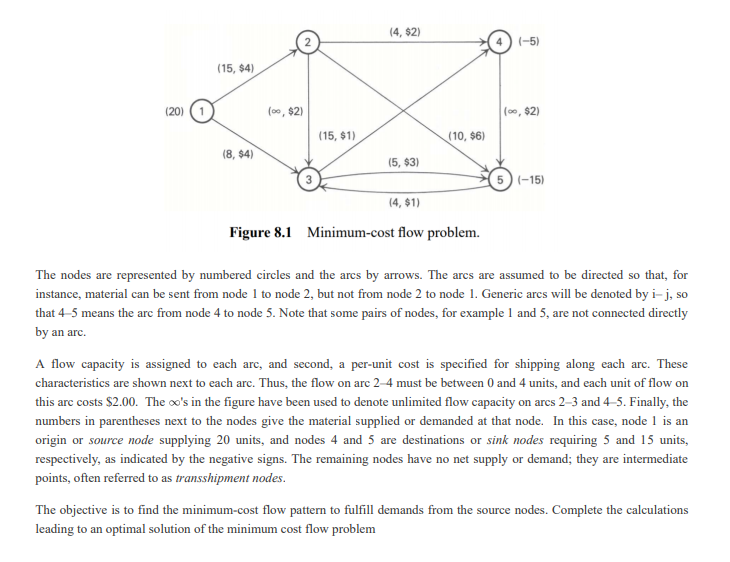
(4, $2) (-5) (15, $4) (20) (-0, $2) (, $2) (15, $1) (10, $6) (8, $4) (5, $3) (-15) 14, $1) Figure 8.1 Minimum-cost flow problem. The nodes are represented by numbered circles and the arcs by arrows. The arcs are assumed to be directed so that, for instance, material can be sent from node 1 to node 2, but not from node 2 to node 1. Generic arcs will be denoted by ij, so that 4-5 means the arc from node 4 to node 5. Note that some pairs of nodes, for example 1 and 5, are not connected directly by an arc. A flow capacity is assigned to each arc, and second, a per-unit cost is specified for shipping along each arc. These characteristics are shown next to each arc. Thus, the flow on arc 2-4 must be between 0 and 4 units, and each unit of flow on this arc costs $2.00. The co's in the figure have been used to denote unlimited flow capacity on arcs 23 and 45. Finally, the numbers in parentheses next to the nodes give the material supplied or demanded at that node. In this case, node 1 is an origin or source node supplying 20 units, and nodes 4 and 5 are destinations or sink nodes requiring 5 and 15 units, respectively, as indicated by the negative signs. The remaining nodes have no net supply or demand; they are intermediate points, often referred to as transshipment nodes. The objective is to find the minimum-cost flow pattern to fulfill demands from the source nodes. Complete the calculations leading to an optimal solution of the minimum cost flow problem (4, $2) (-5) (15, $4) (20) (-0, $2) (, $2) (15, $1) (10, $6) (8, $4) (5, $3) (-15) 14, $1) Figure 8.1 Minimum-cost flow problem. The nodes are represented by numbered circles and the arcs by arrows. The arcs are assumed to be directed so that, for instance, material can be sent from node 1 to node 2, but not from node 2 to node 1. Generic arcs will be denoted by ij, so that 4-5 means the arc from node 4 to node 5. Note that some pairs of nodes, for example 1 and 5, are not connected directly by an arc. A flow capacity is assigned to each arc, and second, a per-unit cost is specified for shipping along each arc. These characteristics are shown next to each arc. Thus, the flow on arc 2-4 must be between 0 and 4 units, and each unit of flow on this arc costs $2.00. The co's in the figure have been used to denote unlimited flow capacity on arcs 23 and 45. Finally, the numbers in parentheses next to the nodes give the material supplied or demanded at that node. In this case, node 1 is an origin or source node supplying 20 units, and nodes 4 and 5 are destinations or sink nodes requiring 5 and 15 units, respectively, as indicated by the negative signs. The remaining nodes have no net supply or demand; they are intermediate points, often referred to as transshipment nodes. The objective is to find the minimum-cost flow pattern to fulfill demands from the source nodes. Complete the calculations leading to an optimal solution of the minimum cost flow









 Study Help