



Question: 4. (26 points) Consider the search and matching models that covered in the class. The assump- tions are listed below: Risk-neutral workers (with discount rate
![discount rate r) range between [0, 1] An employed worker produces y,](https://dsd5zvtm8ll6.cloudfront.net/si.experts.images/questions/2024/10/6700be2b12651_9306700be2a90489.jpg)
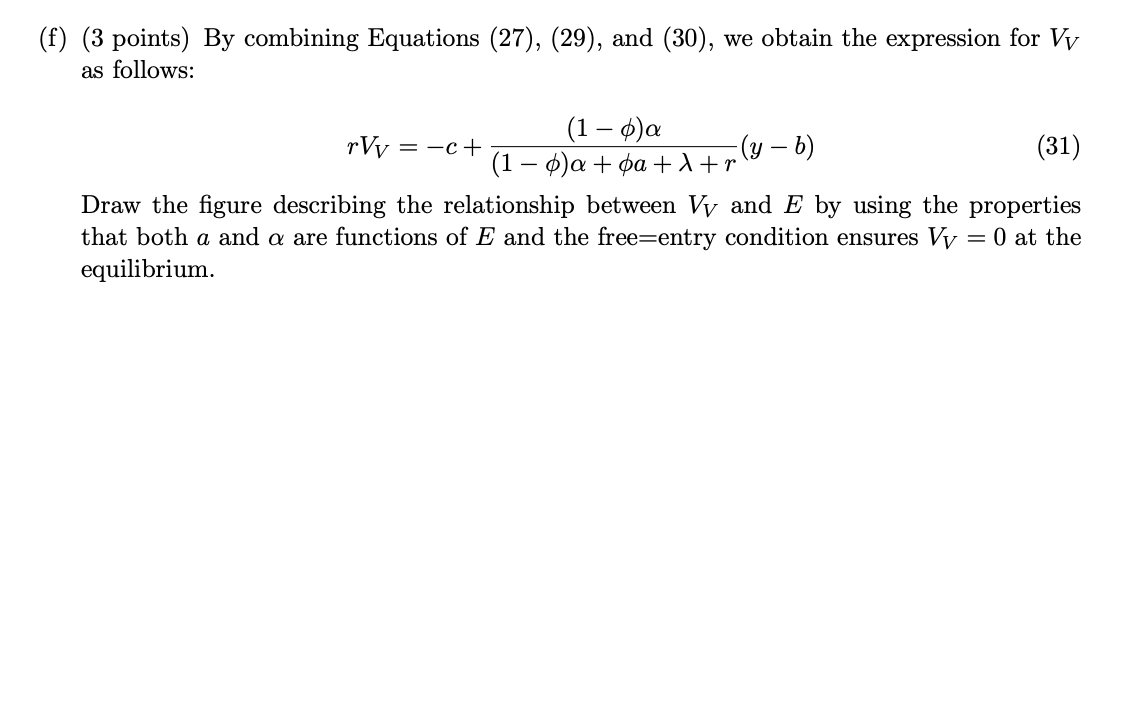
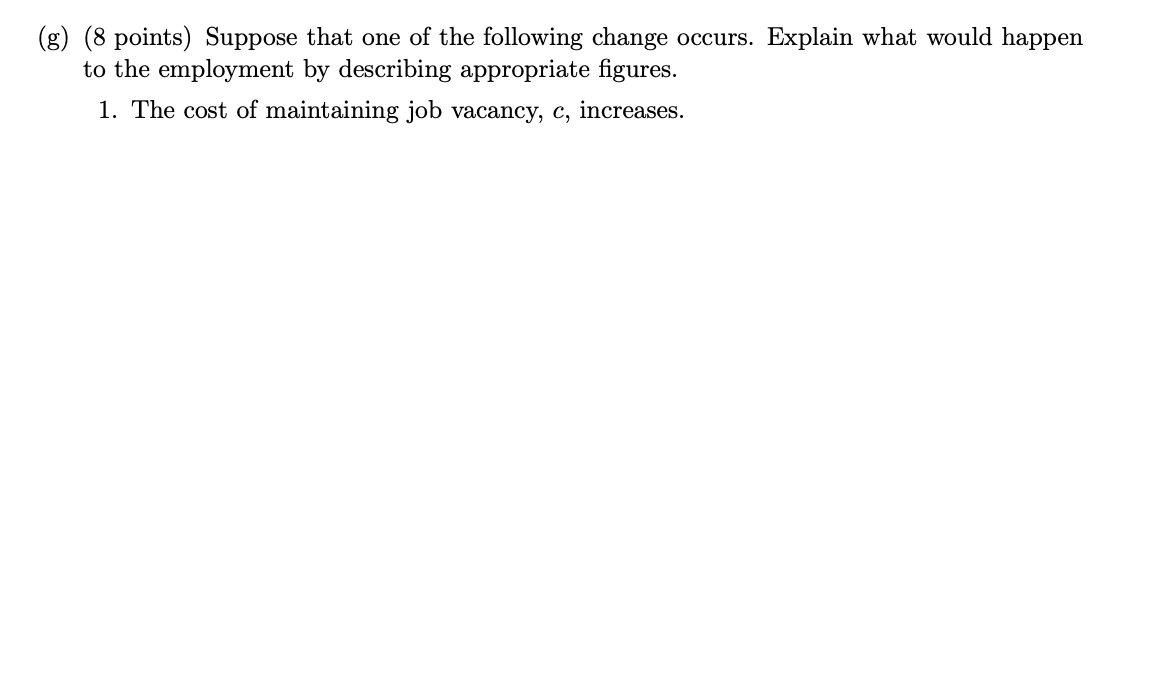
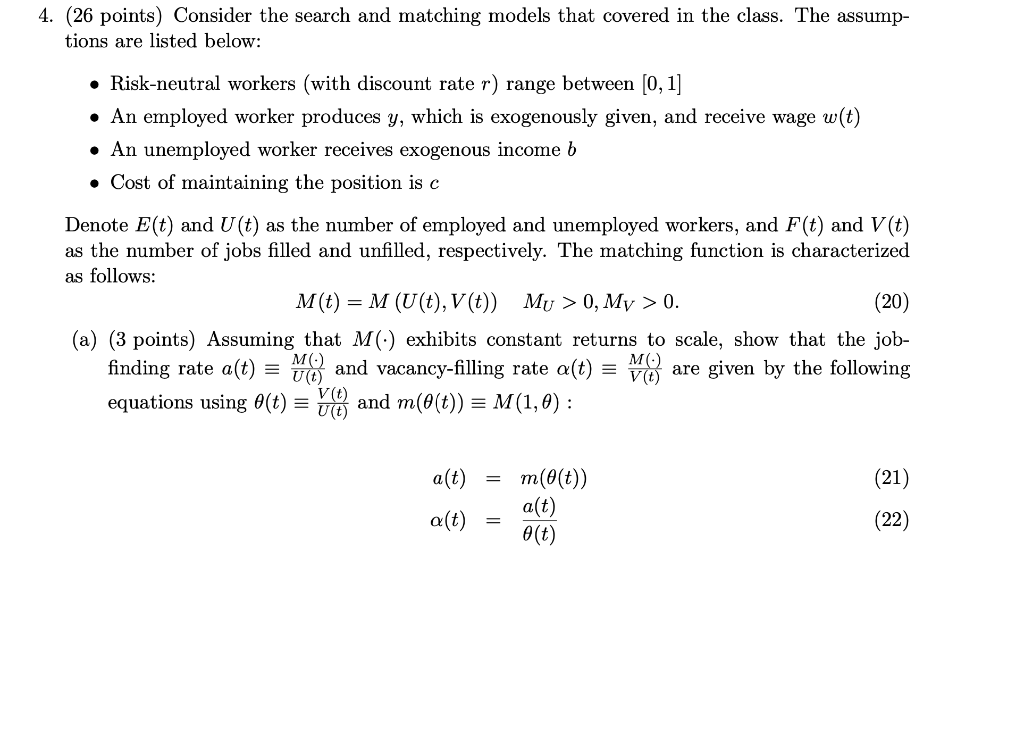
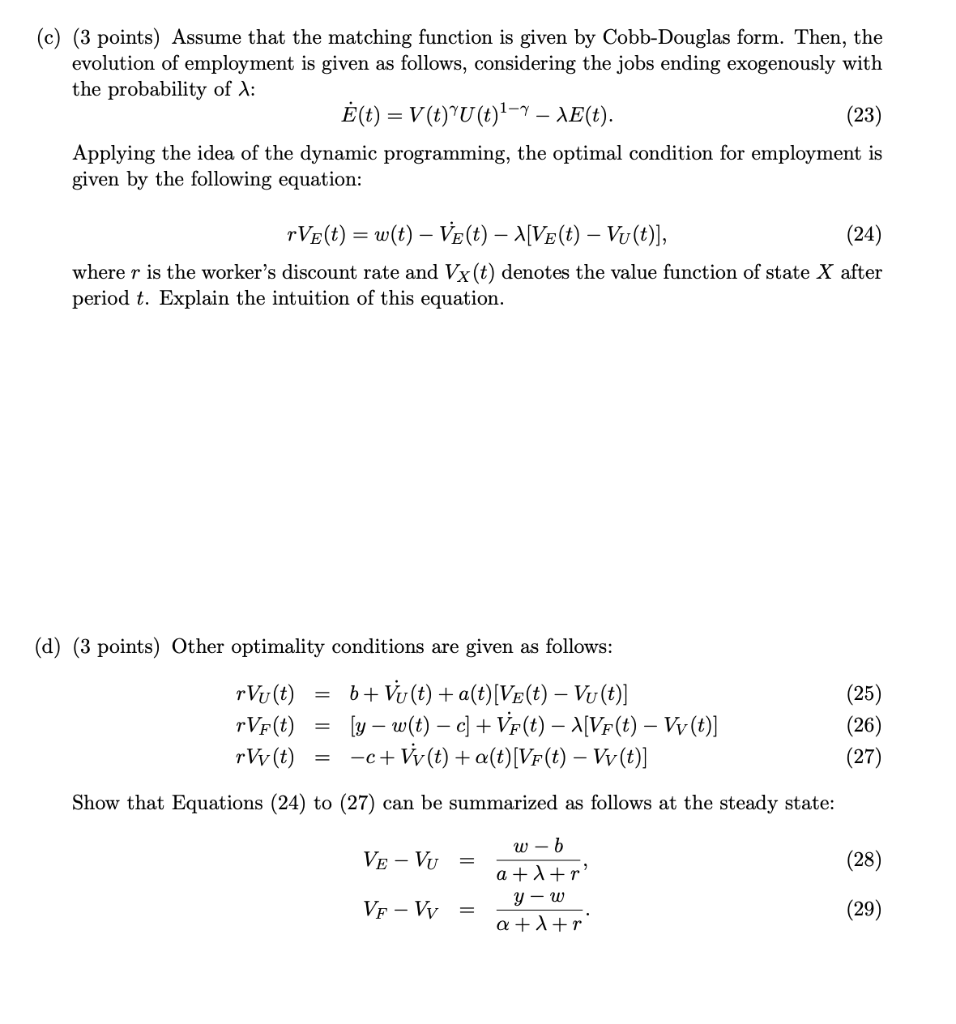
4. (26 points) Consider the search and matching models that covered in the class. The assump- tions are listed below: Risk-neutral workers (with discount rate r) range between [0, 1] An employed worker produces y, which is exogenously given, and receive wage w(t) An unemployed worker receives exogenous income b Cost of maintaining the position is c Denote E(t) and U(t) as the number of employed and unemployed workers, and F(t) and V(t) as the number of jobs filled and unfilled, respectively. The matching function is characterized as follows: M(t) = M (U(t), V(t)) Mu > 0, My > 0. (20) (a) (3 points) Assuming that M() exhibits constant returns to scale, show that the job- finding rate a(t) = MO and vacancy-filling rate a(t) = MO are given by the following ) 0) equations using e(t) = v(8) and m(Ot)) = M(1,0): Ut = 10 E = a(t) = (21) m(0(t)) alt) 0(t) a(t) (22) (c) (3 points) Assume that the matching function is given by Cobb-Douglas form. Then, the evolution of employment is given as follows, considering the jobs ending exogenously with the probability of 1: (t) = V(t)'U(t)- AE(t). (23) Applying the idea of the dynamic programming, the optimal condition for employment is given by the following equation: = rVE(t) = w(t) Ve(t) [VE(t) Vu(t)], (24) where r is the worker's discount rate and Vx(t) denotes the value function of state X after period t. Explain the intuition of this equation. (d) (3 points) Other optimality conditions are given as follows: = rVu(t) rVF(t) rVy(t) = 6+ Vu(t) + a(t)[Ve(t) Vu(t)] [y w(t) c] + Vf(t) 1[VF(t) Vy(t)] -c+V(t) +a(t)[VT(t) Vy(t)] (25) (26) (27) = Show that Equations (24) to (27) can be summarized as follows at the steady state: w-b VE - VU (28) VF - Vy a ++r y - W a ++r (29) 4. (26 points) Consider the search and matching models that covered in the class. The assump- tions are listed below: Risk-neutral workers (with discount rate r) range between [0, 1] An employed worker produces y, which is exogenously given, and receive wage w(t) An unemployed worker receives exogenous income b Cost of maintaining the position is c Denote E(t) and U(t) as the number of employed and unemployed workers, and F(t) and V(t) as the number of jobs filled and unfilled, respectively. The matching function is characterized as follows: M(t) = M (U(t), V(t) Mu > 0, My >0. (20) (a) (3 points) Assuming that M() exhibits constant returns to scale, show that the job- finding rate at) = MO and vacancy-filling rate a(t) = MO are given by the following equations using O(t) = vO) and m(0(t)) = M(1,0): = a(t) (21) m(0(t)) a(t) o(t) a(t) = (22) (b) (3 points) Discuss what would happen to a(t) and a(t) if & increases. Explain the intuition. (f) (3 points) By combining Equations (27), (29), and (30), we obtain the expression for Vv as follows: (1 - 0)a rVy = -c+ (y b) (31) (1 + + Draw the figure describing the relationship between Vy and E by using the properties that both a and a are functions of E and the free=entry condition ensures Vy = 0 at the equilibrium. = (g) (8 points) Suppose that one of the following change occurs. Explain what would happen to the employment by describing appropriate figures. 1. The cost of maintaining job vacancy, c, increases. 2. The interest rate (discount rate), r, increases. 4. (26 points) Consider the search and matching models that covered in the class. The assump- tions are listed below: Risk-neutral workers (with discount rate r) range between [0, 1] An employed worker produces y, which is exogenously given, and receive wage w(t) An unemployed worker receives exogenous income b Cost of maintaining the position is c Denote E(t) and U(t) as the number of employed and unemployed workers, and F(t) and V(t) as the number of jobs filled and unfilled, respectively. The matching function is characterized as follows: M(t) = M (U(t), V(t)) Mu > 0, My > 0. (20) (a) (3 points) Assuming that M() exhibits constant returns to scale, show that the job- finding rate a(t) = MO and vacancy-filling rate a(t) = MO are given by the following ) 0) equations using e(t) = v(8) and m(Ot)) = M(1,0): Ut = 10 E = a(t) = (21) m(0(t)) alt) 0(t) a(t) (22) (c) (3 points) Assume that the matching function is given by Cobb-Douglas form. Then, the evolution of employment is given as follows, considering the jobs ending exogenously with the probability of 1: (t) = V(t)'U(t)- AE(t). (23) Applying the idea of the dynamic programming, the optimal condition for employment is given by the following equation: = rVE(t) = w(t) Ve(t) [VE(t) Vu(t)], (24) where r is the worker's discount rate and Vx(t) denotes the value function of state X after period t. Explain the intuition of this equation. (d) (3 points) Other optimality conditions are given as follows: = rVu(t) rVF(t) rVy(t) = 6+ Vu(t) + a(t)[Ve(t) Vu(t)] [y w(t) c] + Vf(t) 1[VF(t) Vy(t)] -c+V(t) +a(t)[VT(t) Vy(t)] (25) (26) (27) = Show that Equations (24) to (27) can be summarized as follows at the steady state: w-b VE - VU (28) VF - Vy a ++r y - W a ++r (29) 4. (26 points) Consider the search and matching models that covered in the class. The assump- tions are listed below: Risk-neutral workers (with discount rate r) range between [0, 1] An employed worker produces y, which is exogenously given, and receive wage w(t) An unemployed worker receives exogenous income b Cost of maintaining the position is c Denote E(t) and U(t) as the number of employed and unemployed workers, and F(t) and V(t) as the number of jobs filled and unfilled, respectively. The matching function is characterized as follows: M(t) = M (U(t), V(t) Mu > 0, My >0. (20) (a) (3 points) Assuming that M() exhibits constant returns to scale, show that the job- finding rate at) = MO and vacancy-filling rate a(t) = MO are given by the following equations using O(t) = vO) and m(0(t)) = M(1,0): = a(t) (21) m(0(t)) a(t) o(t) a(t) = (22) (b) (3 points) Discuss what would happen to a(t) and a(t) if & increases. Explain the intuition. (f) (3 points) By combining Equations (27), (29), and (30), we obtain the expression for Vv as follows: (1 - 0)a rVy = -c+ (y b) (31) (1 + + Draw the figure describing the relationship between Vy and E by using the properties that both a and a are functions of E and the free=entry condition ensures Vy = 0 at the equilibrium. = (g) (8 points) Suppose that one of the following change occurs. Explain what would happen to the employment by describing appropriate figures. 1. The cost of maintaining job vacancy, c, increases. 2. The interest rate (discount rate), r, increases
Step by Step Solution
There are 3 Steps involved in it

Get step-by-step solutions from verified subject matter experts