



Question: 4) (3 points): An urn contains two balls labeled 2 and three balls labeled 3 (and no others). Two balls are randomly selected without replacement.
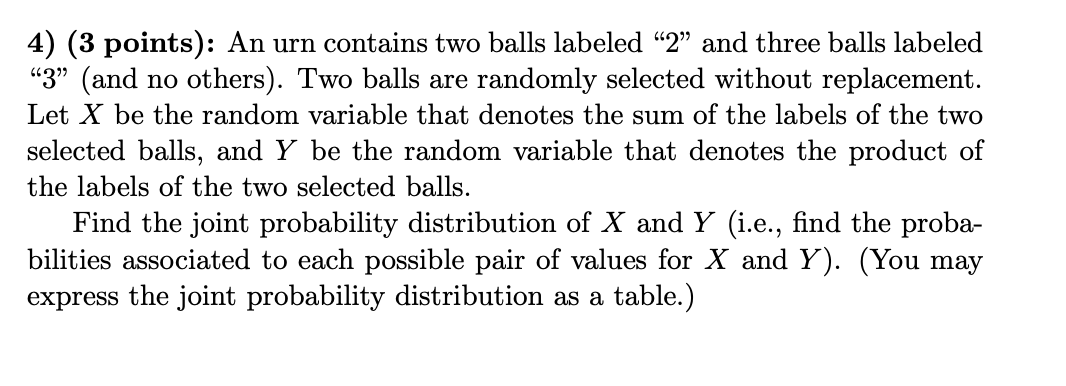
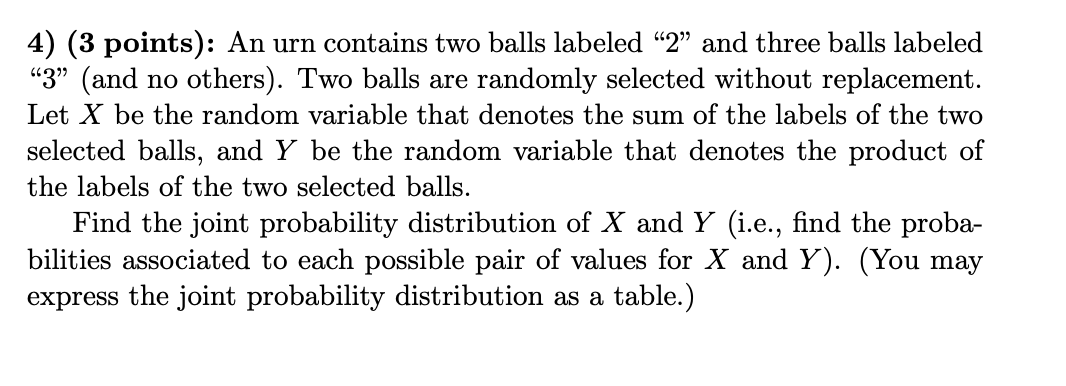
4) (3 points): An urn contains two balls labeled \"2\" and three balls labeled \"3\" (and no others). Two balls are randomly selected without replacement. Let X be the random variable that denotes the sum of the labels of the two selected balls, and Y be the random variable that denotes the product of the labels of the two selected balls. Find the joint probability distribution of X and Y (i.e., nd the proba- bilities associated to each possible pair of values for X and Y). (You may express the joint probability distribution as a table.)
Step by Step Solution
There are 3 Steps involved in it
1 Expert Approved Answer
Step: 1 Unlock

Question Has Been Solved by an Expert!
Get step-by-step solutions from verified subject matter experts
Step: 2 Unlock
Step: 3 Unlock