





Question: 4. (4pt) Recall how the command line arguments are represented in the memory. You are asked to write a program that dynamically creates another copy
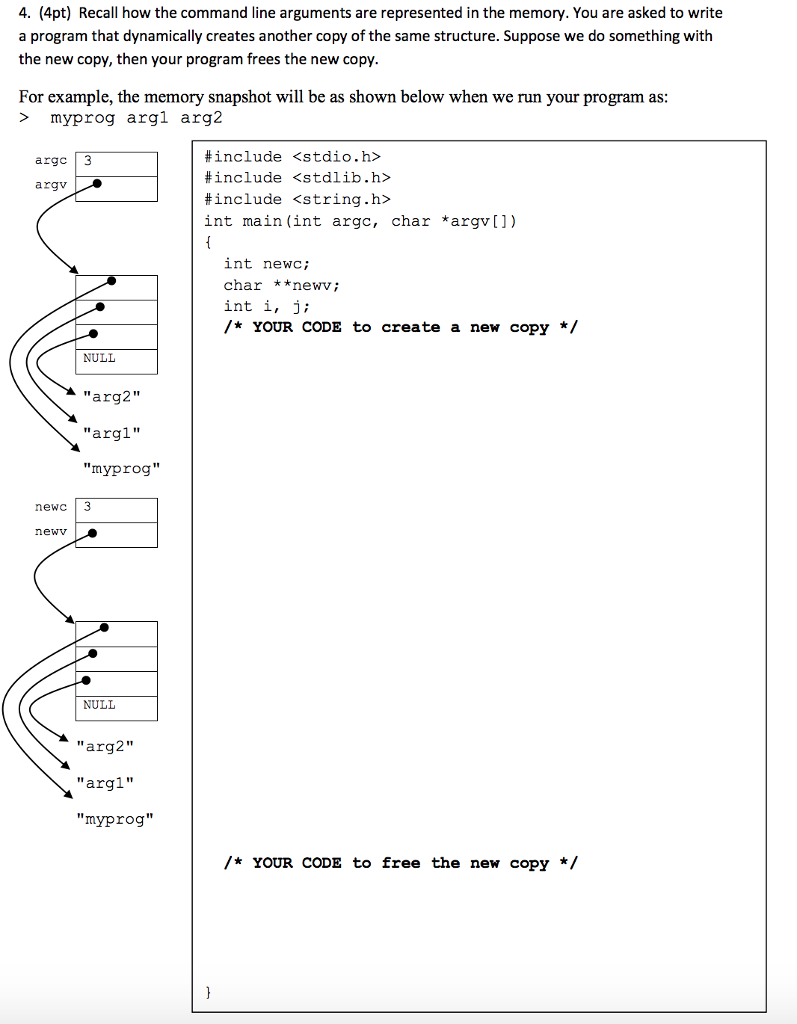
 4. (4pt) Recall how the command line arguments are represented in

4. (4pt) Recall how the command line arguments are represented in the memory. You are asked to write a program that dynamically creates another copy of the same structure. Suppose we do something with the new copy, then your program frees the new copy. For example, the memory snapshot will be as shown below when we run your program as: myprog argl arg2 #include #include #include int main (int argc, char *argv[) argc 3 argv int newci char **newvi int i, j /* YOUR CODE to create a new copY * NULL "arg2" "argl" "myprog" newc 3 neww NULL "arg2" "argl" "myprog" /* YOUR CoDE to free the new copy * 4. (4pt) Recall how the command line arguments are represented in the memory. You are asked to write a program that dynamically creates another copy of the same structure. Suppose we do something with the new copy, then your program frees the new copy. For example, the memory snapshot will be as shown below when we run your program as: myprog argl arg2 #include #include #include int main (int argc, char *argv[) argc 3 argv int newci char **newvi int i, j /* YOUR CODE to create a new copY * NULL "arg2" "argl" "myprog" newc 3 neww NULL "arg2" "argl" "myprog" /* YOUR CoDE to free the new copy *

Step by Step Solution

There are 3 Steps involved in it

1 Expert Approved Answer
Step: 1 Unlock blur-text-image
Question Has Been Solved by an Expert!

Get step-by-step solutions from verified subject matter experts

Step: 2 Unlock
Step: 3 Unlock

Students Have Also Explored These Related Databases Questions!