







Question: 4. A boundary layer forms on a convex curve. Over this curve the boundary layer detaches and does not reattach. (a) Sketch and label
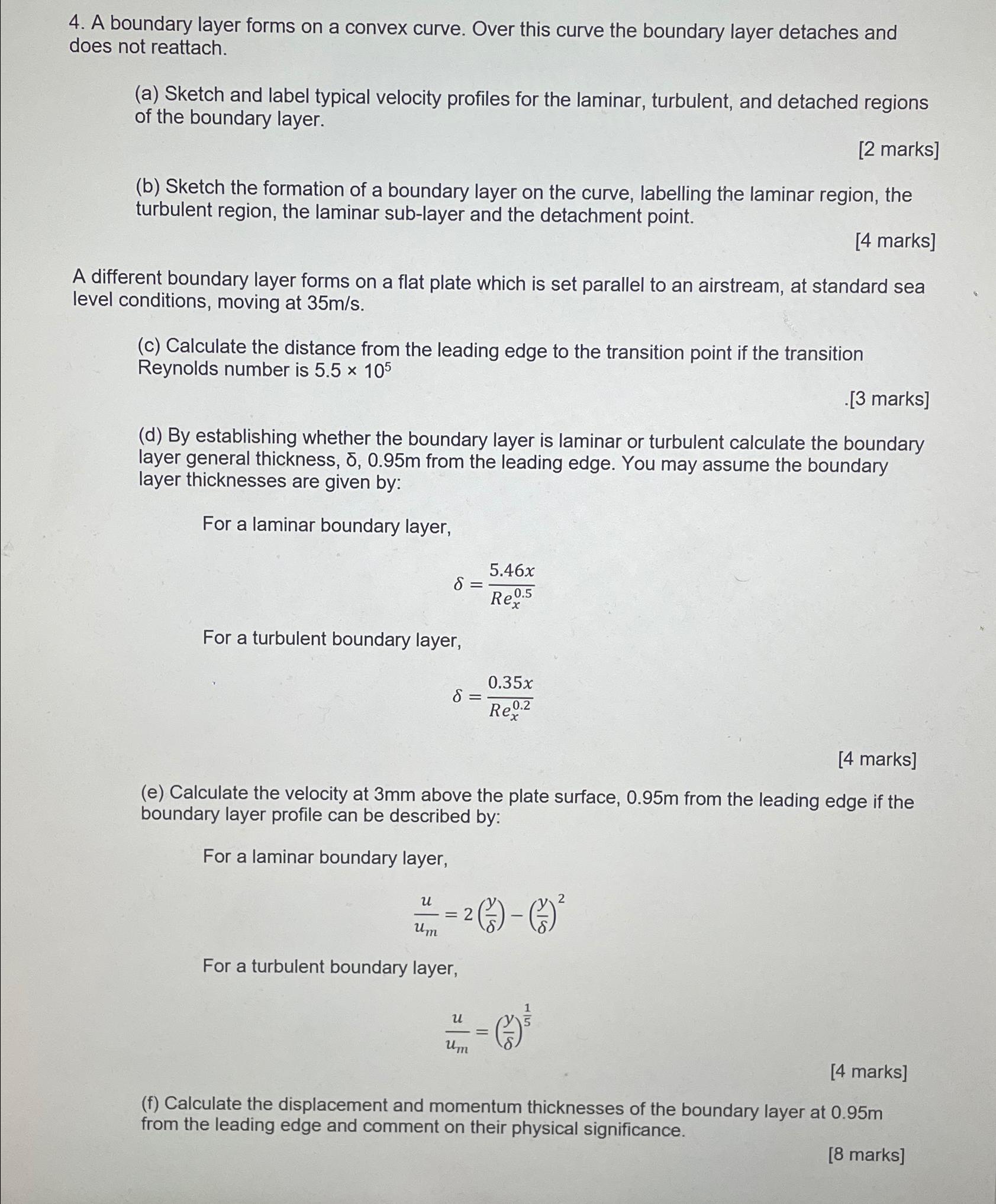
4. A boundary layer forms on a convex curve. Over this curve the boundary layer detaches and does not reattach. (a) Sketch and label typical velocity profiles for the laminar, turbulent, and detached regions of the boundary layer. [2 marks] (b) Sketch the formation of a boundary layer on the curve, labelling the laminar region, the turbulent region, the laminar sub-layer and the detachment point. [4 marks] A different boundary layer forms on a flat plate which is set parallel to an airstream, at standard sea level conditions, moving at 35m/s. (c) Calculate the distance from the leading edge to the transition point if the transition Reynolds number is 5.5 105 .[3 marks] (d) By establishing whether the boundary layer is laminar or turbulent calculate the boundary layer general thickness, 5, 0.95m from the leading edge. You may assume the boundary layer thicknesses are given by: For a laminar boundary layer, d = 5.46x Reg.5 For a turbulent boundary layer, 0.35x 6= = Re0.2 [4 marks] (e) Calculate the velocity at 3mm above the plate surface, 0.95m from the leading edge if the boundary layer profile can be described by: For a laminar boundary layer, -- =2(-) For a turbulent boundary layer, =-G [4 marks] (f) Calculate the displacement and momentum thicknesses of the boundary layer at 0.95m from the leading edge and comment on their physical significance. [8 marks]
Step by Step Solution
There are 3 Steps involved in it

Get step-by-step solutions from verified subject matter experts
 Study Help