







Question: 4. A PIC24H processors uses the output compare (OC1) module to generate PWM output signal. Assume the following: Fosc = 1 MHz. The frequency of
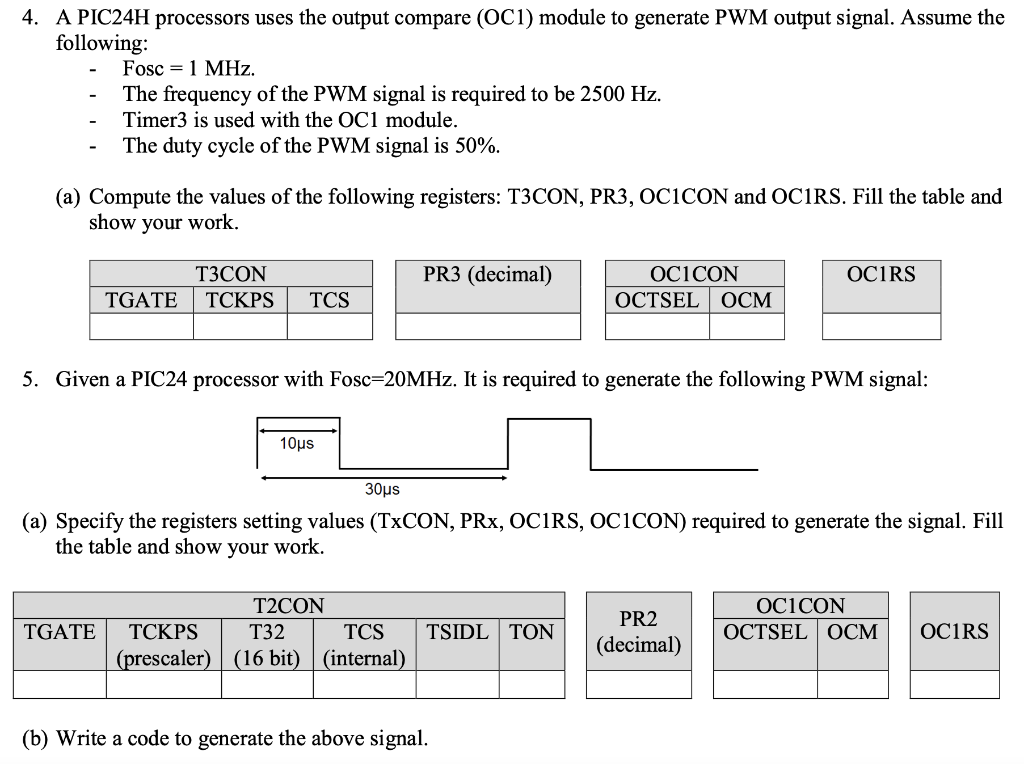
4. A PIC24H processors uses the output compare (OC1) module to generate PWM output signal. Assume the following: Fosc = 1 MHz. The frequency of the PWM signal is required to be 2500 Hz. Timer3 is used with the OC1 module. The duty cycle of the PWM signal is 50%. (a) Compute the values of the following registers: T3CON, PR3, OCICON and OCIRS. Fill the table and show your work. T3CON TGATE TCKPS PR3 (decimal) OCIRS OCICON OCTSEL OCM TCS 5. Given a PIC24 processor with Fosc=20MHz. It is required to generate the following PWM signal: 10us 30us (a) Specify the registers setting values (TxCON, PRx, OCIRS, OCICON) required to generate the signal. Fill the table and show your work. TGATE T2CON TCKPS T32 TCS (prescaler) (16 bit) (internal) OCICON OCTSEL OCM PR2 (decimal) TSIDL TON OCIRS (b) Write a code to generate the above signal. 4. A PIC24H processors uses the output compare (OC1) module to generate PWM output signal. Assume the following: Fosc = 1 MHz. The frequency of the PWM signal is required to be 2500 Hz. Timer3 is used with the OC1 module. The duty cycle of the PWM signal is 50%. (a) Compute the values of the following registers: T3CON, PR3, OCICON and OCIRS. Fill the table and show your work. T3CON TGATE TCKPS PR3 (decimal) OCIRS OCICON OCTSEL OCM TCS 5. Given a PIC24 processor with Fosc=20MHz. It is required to generate the following PWM signal: 10us 30us (a) Specify the registers setting values (TxCON, PRx, OCIRS, OCICON) required to generate the signal. Fill the table and show your work. TGATE T2CON TCKPS T32 TCS (prescaler) (16 bit) (internal) OCICON OCTSEL OCM PR2 (decimal) TSIDL TON OCIRS (b) Write a code to generate the above signal
Step by Step Solution
There are 3 Steps involved in it

Get step-by-step solutions from verified subject matter experts
 Study Help