







Question: 4. (a) Using 2's complement and 6-bit registers, can the operation ((+32) + (+32)) be executed to give the correct answer? If yes, do the
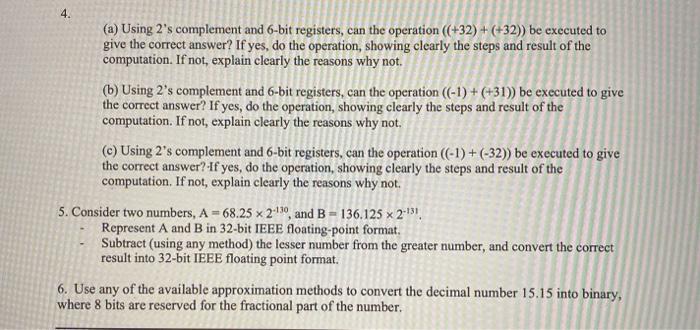
4. (a) Using 2's complement and 6-bit registers, can the operation ((+32) + (+32)) be executed to give the correct answer? If yes, do the operation, showing clearly the steps and result of the computation. If not, explain clearly the reasons why not. (b) Using 2's complement and 6-bit registers, can the operation ((-1) + (+31)) be executed to give the correct answer? If yes, do the operation, showing clearly the steps and result of the computation. If not, explain clearly the reasons why not. C) Using 2's complement and 6-bit registers, can the operation ((-1) + (-32)) be executed to give the correct answer?-If yes, do the operation, showing clearly the steps and result of the computation. If not, explain clearly the reasons why not. 5. Consider two numbers, A = 68.25 x 2-130, and B - 136.125 x 2-131 Represent A and B in 32-bit IEEE floating-point format. Subtract (using any method) the lesser number from the greater number, and convert the correct result into 32-bit IEEE floating point format. 6. Use any of the available approximation methods to convert the decimal number 15.15 into binary, where 8 bits are reserved for the fractional part of the number
Step by Step Solution
There are 3 Steps involved in it

Get step-by-step solutions from verified subject matter experts
 Study Help