







Question: 4. An n-periodic function is a function such that f(2) = f(r + n) for some value of n. Let f(z) be a continuous n-periodic
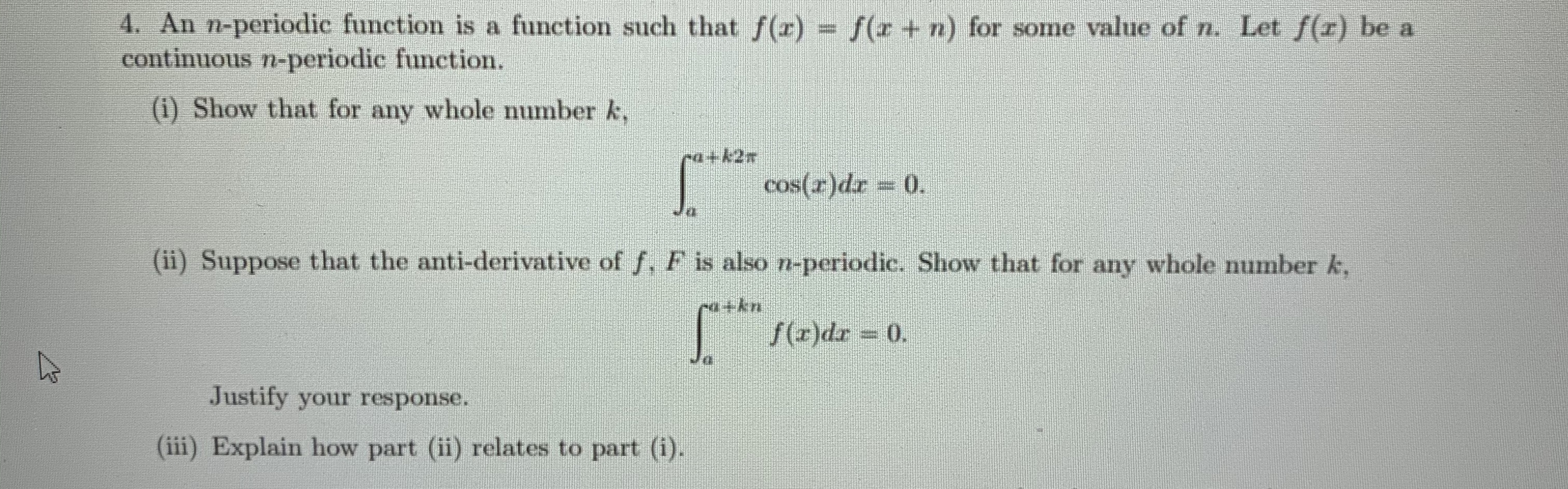
4. An n-periodic function is a function such that f(2) = f(r + n) for some value of n. Let f(z) be a continuous n-periodic function. (i) Show that for any whole number k, cos(x )dr = 0. (ii) Suppose that the anti-derivative of f. F is also n-periodic. Show that for any whole number k. f(x)de = 0. Justify your response. (iii) Explain how part (ii) relates to part (i)
Step by Step Solution
There are 3 Steps involved in it
1 Expert Approved Answer
Step: 1 Unlock

Question Has Been Solved by an Expert!
Get step-by-step solutions from verified subject matter experts
Step: 2 Unlock
Step: 3 Unlock
 Study Help