







Question: 4. Answer this question using calculus. Consider a version of the one period general equilibrium model with pro- duction, as seen in class. There is
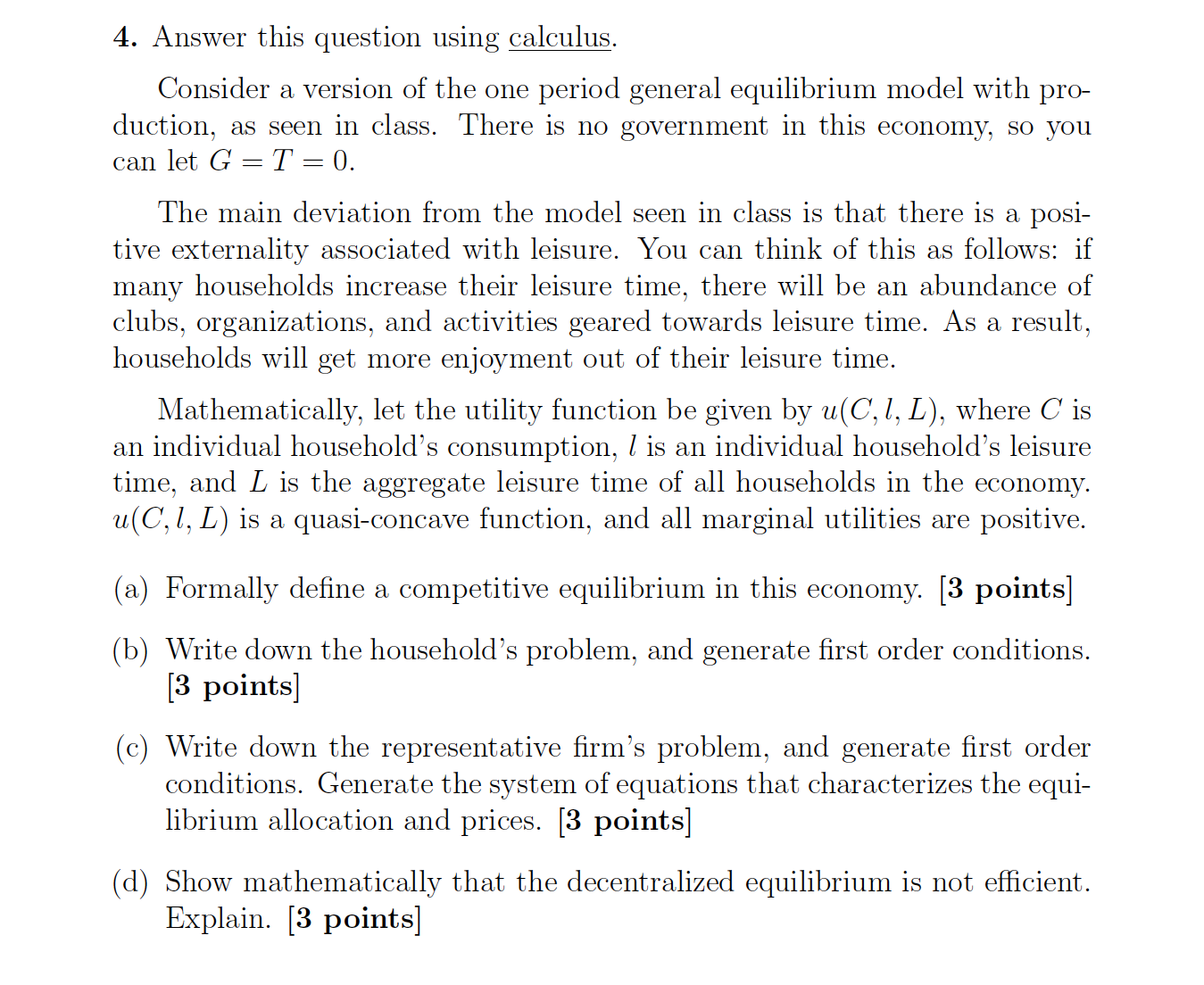
4. Answer this question using calculus. Consider a version of the one period general equilibrium model with pro- duction, as seen in class. There is no government in this economy, so you can let G = T = 0. The main deviation from the model seen in class is that there is a posi- tive externality associated with leisure. You can think of this as follows: if many households increase their leisure time, there will be an abundance of clubs, organizations, and activities geared towards leisure time. As a result, households will get more enjoyment out of their leisure time. Mathematically, let the utility function be given by u(C, l, L), where C is an individual household's consumption, I is an individual household's leisure time, and L is the aggregate leisure time of all households in the economy. u(C, l, L) is a quasi-concave function, and all marginal utilities are positive. (a) Formally define a competitive equilibrium in this economy. [3 points] (b) Write down the household's problem, and generate first order conditions. [3 points] (c) Write down the representative firm's problem, and generate first order conditions. Generate the system of equations that characterizes the equi- librium allocation and prices. [3 points] (d) Show mathematically that the decentralized equilibrium is not efficient. Explain. [3 points]
Step by Step Solution
There are 3 Steps involved in it

Get step-by-step solutions from verified subject matter experts
 Study Help