







Question: Answer this question using calculus. Consider a version of the one period general equilibrium model with production, as seen in class. 5. Answer this question
Answer this question using calculus.
Consider a version of the one period general equilibrium model with production, as seen in class.
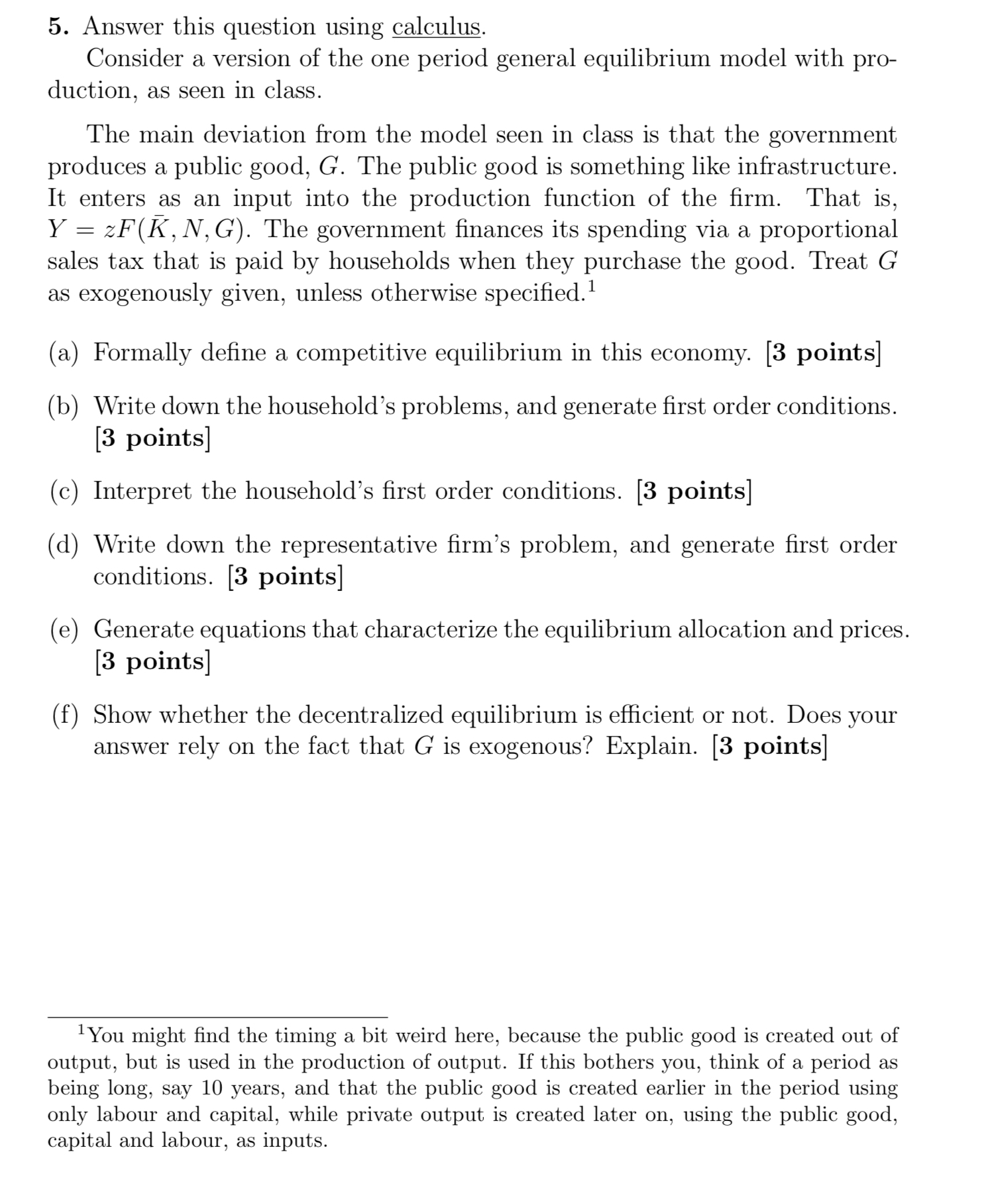
5. Answer this question using calculus. Consider a version of the one period general equilibrium model with pro- duction, as seen in class. The main deviation from the model seen in class is that the government produces a public good, G. The public good is something like infrastructure. It enters as an input into the production function of the firm. That is, Y = zF(K, N, G). The government finances its spending via a proportional sales tax that is paid by households when they purchase the good. Treat G as exogenously given, unless otherwise specified. (a) Formally define a competitive equilibrium in this economy. [3 points] (b) Write down the household's problems, and generate first order conditions. [3 points] (c) Interpret the household's first order conditions. [3 points] d) Write down the representative firm's problem, and generate first order conditions. [3 points] (e) Generate equations that characterize the equilibrium allocation and prices. [3 points] (f) Show whether the decentralized equilibrium is efficient or not. Does your answer rely on the fact that G is exogenous? Explain. [3 points] You might find the timing a bit weird here, because the public good is created out of output, but is used in the production of output. If this bothers you, think of a period as being long, say 10 years, and that the public good is created earlier in the period using only labour and capital, while private output is created later on, using the public good, capital and labour, as inputs
Step by Step Solution
There are 3 Steps involved in it

Get step-by-step solutions from verified subject matter experts
 Study Help