







Question: 4. Assigned reading two-phase horizontal separators: Arnold and Steward v. 1: Ch. 4: Two-Phase Oil and Gas Separation. Kumar: Ch. 4: Gas and Liquid Separation
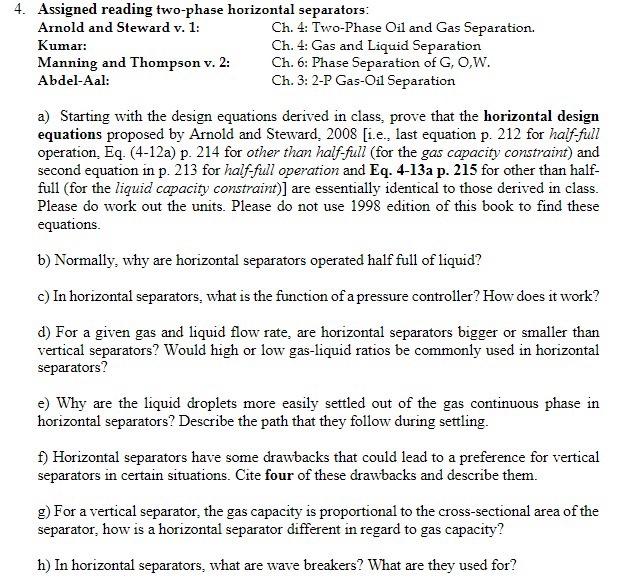
4. Assigned reading two-phase horizontal separators: Arnold and Steward v. 1: Ch. 4: Two-Phase Oil and Gas Separation. Kumar: Ch. 4: Gas and Liquid Separation Manning and Thompson v. 2: Ch. 6: Phase Separation of G, O,W. Abdel-Aal: Ch. 3:2-P Gas-Oil Separation a) Starting with the design equations derived in class, prove that the horizontal design equations proposed by Arnold and Steward. 2008 [i.e., last equation p. 212 for half-full operation. Eq. (4-12a) p. 214 for other than half-full (for the gas capacity constraint) and second equation in p. 213 for half-full operation and Eq. 4-13a p. 215 for other than half- full (for the liquid capacity constraint)] are essentially identical to those derived in class. Please do work out the units. Please do not use 1998 edition of this book to find these equations. b) Normally, why are horizontal separators operated half full of liquid? c) In horizontal separators, what is the function of a pressure controller? How does it work? d) For a given gas and liquid flow rate, are horizontal separators bigger or smaller than vertical separators? Would high or low gas-liquid ratios be commonly used in horizontal separators? e) Why are the liquid droplets more easily settled out of the gas continuous phase in horizontal separators? Describe the path that they follow during settling. f) Horizontal separators have some drawbacks that could lead to a preference for vertical separators in certain situations. Cite four of these drawbacks and describe them. g) For a vertical separator, the gas capacity is proportional to the cross-sectional area of the separator, how is a horizontal separator different in regard to gas capacity? h) In horizontal separators, what are wave breakers? What are they used for? 4. Assigned reading two-phase horizontal separators: Arnold and Steward v. 1: Ch. 4: Two-Phase Oil and Gas Separation. Kumar: Ch. 4: Gas and Liquid Separation Manning and Thompson v. 2: Ch. 6: Phase Separation of G, O,W. Abdel-Aal: Ch. 3:2-P Gas-Oil Separation a) Starting with the design equations derived in class, prove that the horizontal design equations proposed by Arnold and Steward. 2008 [i.e., last equation p. 212 for half-full operation. Eq. (4-12a) p. 214 for other than half-full (for the gas capacity constraint) and second equation in p. 213 for half-full operation and Eq. 4-13a p. 215 for other than half- full (for the liquid capacity constraint)] are essentially identical to those derived in class. Please do work out the units. Please do not use 1998 edition of this book to find these equations. b) Normally, why are horizontal separators operated half full of liquid? c) In horizontal separators, what is the function of a pressure controller? How does it work? d) For a given gas and liquid flow rate, are horizontal separators bigger or smaller than vertical separators? Would high or low gas-liquid ratios be commonly used in horizontal separators? e) Why are the liquid droplets more easily settled out of the gas continuous phase in horizontal separators? Describe the path that they follow during settling. f) Horizontal separators have some drawbacks that could lead to a preference for vertical separators in certain situations. Cite four of these drawbacks and describe them. g) For a vertical separator, the gas capacity is proportional to the cross-sectional area of the separator, how is a horizontal separator different in regard to gas capacity? h) In horizontal separators, what are wave breakers? What are they used for
Step by Step Solution
There are 3 Steps involved in it

Get step-by-step solutions from verified subject matter experts
 Study Help