







Question: Question 1: Where do you think Work fits into the Good Life? Question 2: Reflection on module activities Module 1 Activity: Your beliefs about child
Question 1:
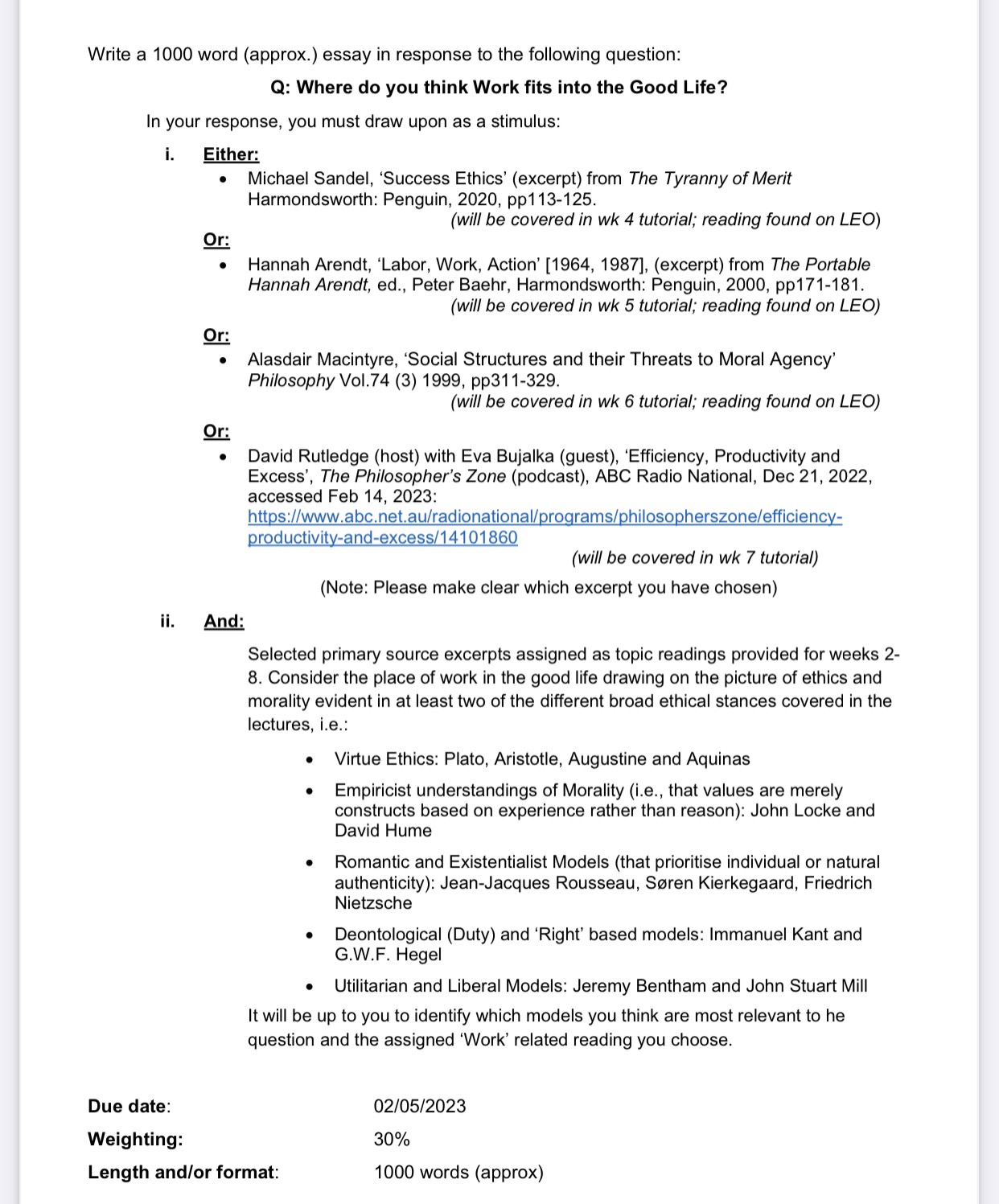
Where do you think Work fits into the Good Life?
Question 2:
Reflection on module activities
| Module 1 Activity: Your beliefs about child and childhood 200w |
| Reflection |
| Module 2 Activity: Difference between experiences of childhood 200w |
| Reflection |
| Module 3 Activity: Diverse childhoods children as social actors 200w |
| Reflection |
| Module 4 Activity: Map environments public and private 200w |
| Reflection |
| Module 5 Activity: Home-schooling, online learning, mainstream schooling comparison 200w |
| Reflection |
| Module 6 Activity: Childrens agency and rights - key considerations 200w |
| Reflection |
Appendix: Annotated Bibliography
| Module 1: Reading 150w |
| Reference |
| Description of Purpose of reading |
| Summary of reading |
| Module 2: Reading 150w |
| Reference |
| Description of Purpose of reading |
| Summary of reading |
| Module 3: Reading 150w |
| Reference |
| Description of Purpose of reading |
| Summary of reading |
| Module 4: Reading 150w |
| References |
| Description of Purpose of reading |
| Summary of reading |
| Module 5: Reading 150w |
| Reference |
| Description of Purpose of reading |
| Summary of reading |
| Module 6: Reading 150w |
| References |
| Description of Purpose of reading |
| Summary of reading |
rite a 1000 word (approx.) essay in response to the following question: Q: Where do you think Work fits into the Good Life? In your response, you must draw upon as a stimulus: i. Either: - Michael Sandel, 'Success Ethics' (excerpt) from The Tyranny of Merit Harmondsworth: Penguin, 2020, pp113-125. (will be covered in wk 4 tutorial; reading found on LEO) Or: - Hannah Arendt, 'Labor, Work, Action' [1964, 1987], (excerpt) from The Portable Hannah Arendt, ed., Peter Baehr, Harmondsworth: Penguin, 2000, pp171-181. (will be covered in wk 5 tutorial; reading found on LEO) Or: - Alasdair Macintyre, 'Social Structures and their Threats to Moral Agency' Philosophy Vol.74 (3) 1999, pp311-329. (will be covered in wk 6 tutorial; reading found on LEO) Or: - David Rutledge (host) with Eva Bujalka (guest), 'Efficiency, Productivity and Excess', The Philosopher's Zone (podcast), ABC Radio National, Dec 21, 2022, accessed Feb 14, 2023: https://www. abc.net.au/radionational/programs/philosopherszone/efficiencyproductivity-and-excess/14101860 (will be covered in wk 7 tutorial) (Note: Please make clear which excerpt you have chosen) ii. And: Selected primary source excerpts assigned as topic readings provided for weeks 2- 8. Consider the place of work in the good life drawing on the picture of ethics and morality evident in at least two of the different broad ethical stances covered in the lectures, i.e.: - Virtue Ethics: Plato, Aristotle, Augustine and Aquinas - Empiricist understandings of Morality (i.e., that values are merely constructs based on experience rather than reason): John Locke and David Hume - Romantic and Existentialist Models (that prioritise individual or natural authenticity): Jean-Jacques Rousseau, Sren Kierkegaard, Friedrich Nietzsche - Deontological (Duty) and 'Right' based models: Immanuel Kant and G.W.F. Hegel - Utilitarian and Liberal Models: Jeremy Bentham and John Stuart Mill It will be up to you to identify which models you think are most relevant to he question and the assigned 'Work' related reading you choose. rite a 1000 word (approx.) essay in response to the following question: Q: Where do you think Work fits into the Good Life? In your response, you must draw upon as a stimulus: i. Either: - Michael Sandel, 'Success Ethics' (excerpt) from The Tyranny of Merit Harmondsworth: Penguin, 2020, pp113-125. (will be covered in wk 4 tutorial; reading found on LEO) Or: - Hannah Arendt, 'Labor, Work, Action' [1964, 1987], (excerpt) from The Portable Hannah Arendt, ed., Peter Baehr, Harmondsworth: Penguin, 2000, pp171-181. (will be covered in wk 5 tutorial; reading found on LEO) Or: - Alasdair Macintyre, 'Social Structures and their Threats to Moral Agency' Philosophy Vol.74 (3) 1999, pp311-329. (will be covered in wk 6 tutorial; reading found on LEO) Or: - David Rutledge (host) with Eva Bujalka (guest), 'Efficiency, Productivity and Excess', The Philosopher's Zone (podcast), ABC Radio National, Dec 21, 2022, accessed Feb 14, 2023: https://www. abc.net.au/radionational/programs/philosopherszone/efficiencyproductivity-and-excess/14101860 (will be covered in wk 7 tutorial) (Note: Please make clear which excerpt you have chosen) ii. And: Selected primary source excerpts assigned as topic readings provided for weeks 2- 8. Consider the place of work in the good life drawing on the picture of ethics and morality evident in at least two of the different broad ethical stances covered in the lectures, i.e.: - Virtue Ethics: Plato, Aristotle, Augustine and Aquinas - Empiricist understandings of Morality (i.e., that values are merely constructs based on experience rather than reason): John Locke and David Hume - Romantic and Existentialist Models (that prioritise individual or natural authenticity): Jean-Jacques Rousseau, Sren Kierkegaard, Friedrich Nietzsche - Deontological (Duty) and 'Right' based models: Immanuel Kant and G.W.F. Hegel - Utilitarian and Liberal Models: Jeremy Bentham and John Stuart Mill It will be up to you to identify which models you think are most relevant to he question and the assigned 'Work' related reading you choose
Step by Step Solution
There are 3 Steps involved in it

Get step-by-step solutions from verified subject matter experts
 Study Help