







Question: 4. Consider a sealed-bid auction for a single object with five bidders. Suppose that the bidders have the following valuations for the object: v, =500,
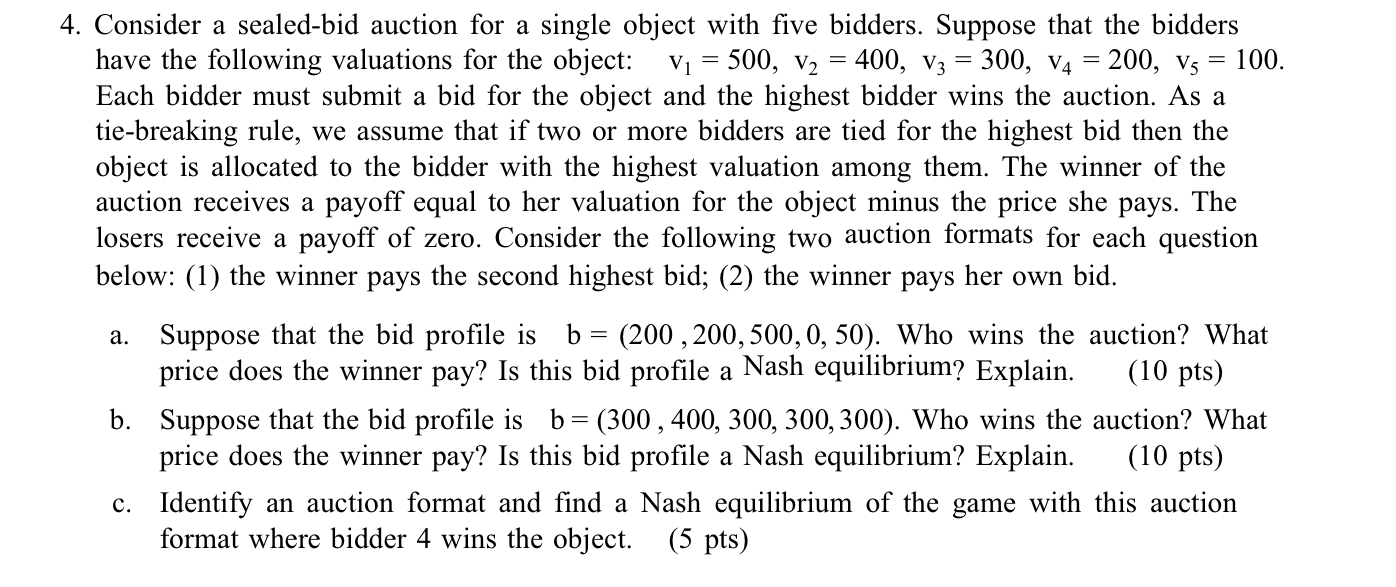
4. Consider a sealed-bid auction for a single object with five bidders. Suppose that the bidders have the following valuations for the object: v, =500, v, =400, v; =300, v, =200, v5 = 100. Each bidder must submit a bid for the object and the highest bidder wins the auction. As a tie-breaking rule, we assume that if two or more bidders are tied for the highest bid then the object is allocated to the bidder with the highest valuation among them. The winner of the auction receives a payoff equal to her valuation for the object minus the price she pays. The losers receive a payoff of zero. Consider the following two auction formats for each question below: (1) the winner pays the second highest bid; (2) the winner pays her own bid. a. Suppose that the bid profile is b = (200,200,500,0, 50). Who wins the auction? What price does the winner pay? Is this bid profile a Nash equilibrium? Explain. (10 pts) Suppose that the bid profile is b= (300, 400, 300, 300,300). Who wins the auction? What price does the winner pay? Is this bid profile a Nash equilibrium? Explain. (10 pts) Identify an auction format and find a Nash equilibrium of the game with this auction format where bidder 4 wins the object. (5 pts)
Step by Step Solution
There are 3 Steps involved in it

Get step-by-step solutions from verified subject matter experts
 Study Help