



Question: Second-Price and Third-Price Auctions 30 2 points Consider a sealed-bid auction for a single object. There are N 2 3 Consider the standard second-price auction
![uniform distribution on [0, 100]. Each bidder z simultaneously and N =](https://s3.amazonaws.com/si.experts.images/answers/2024/06/6674fd5938e1a_0656674fd591cfb9.jpg)
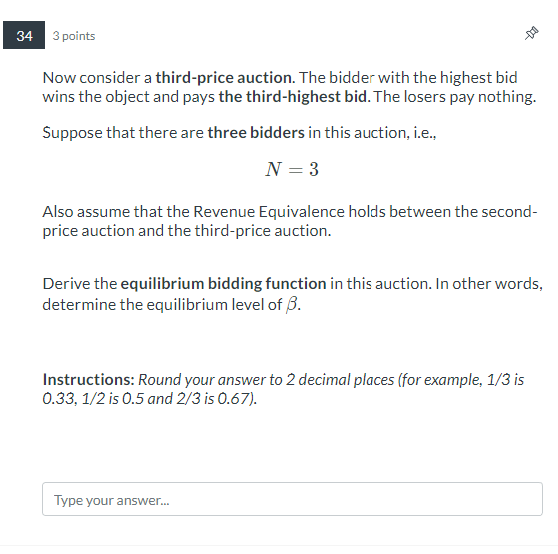
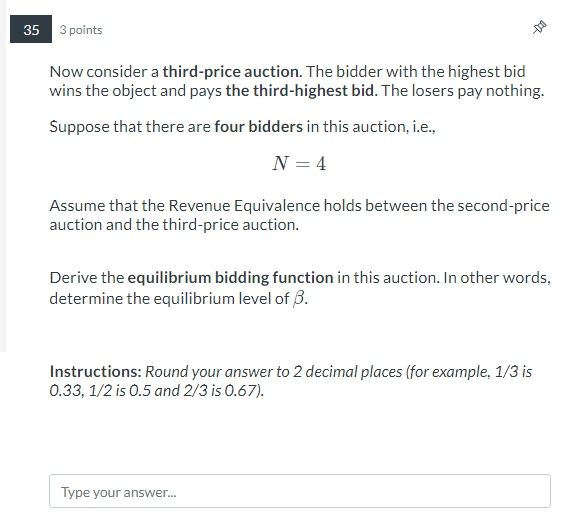
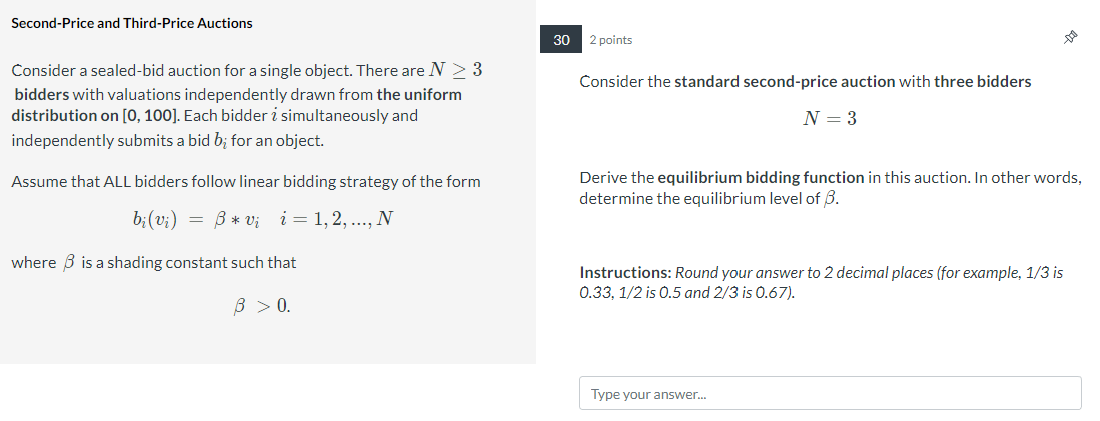
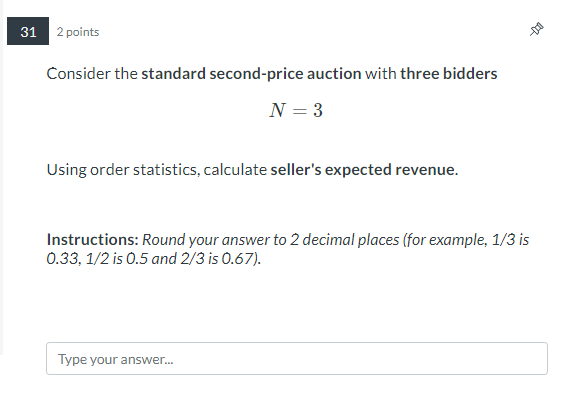
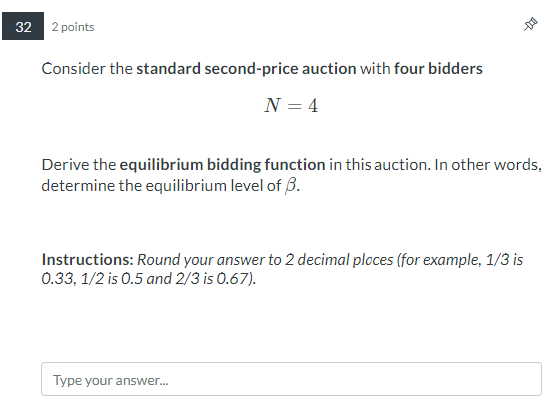
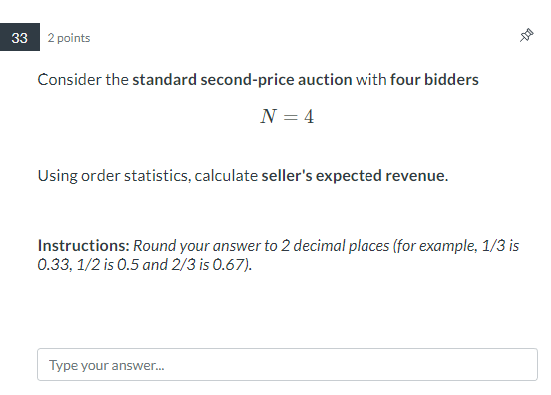
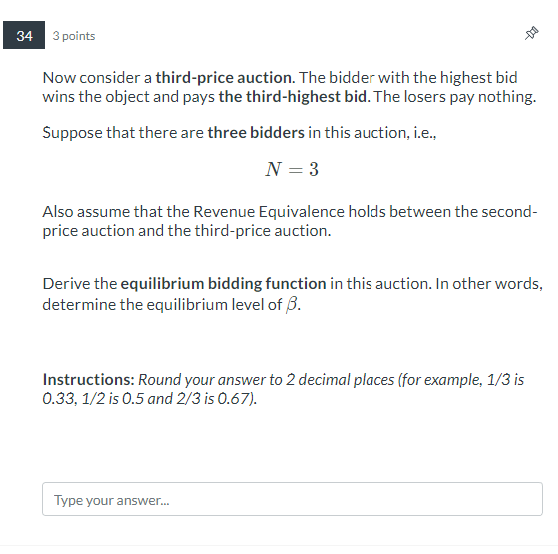
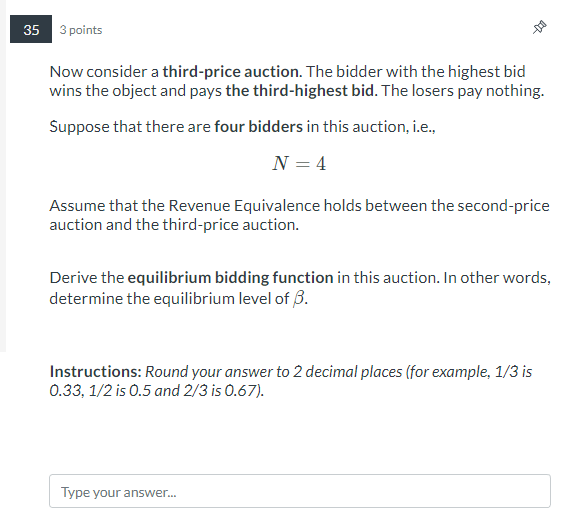
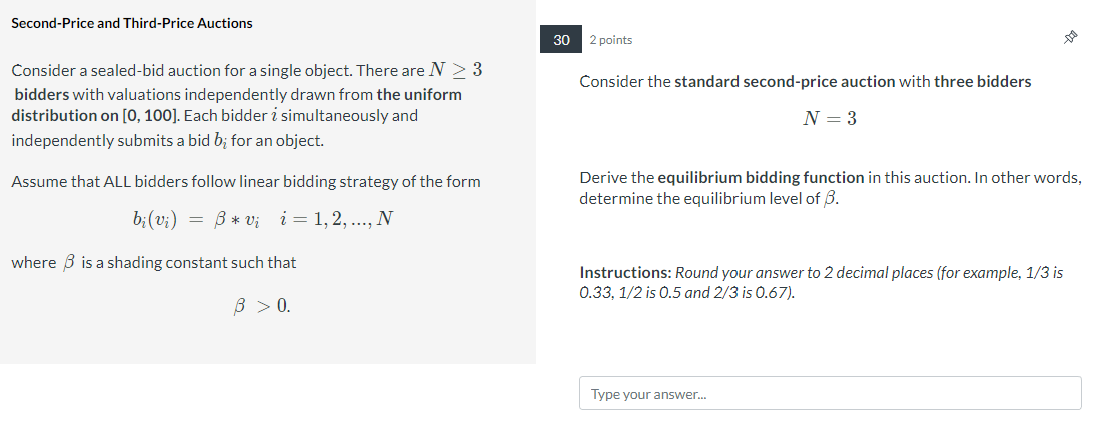
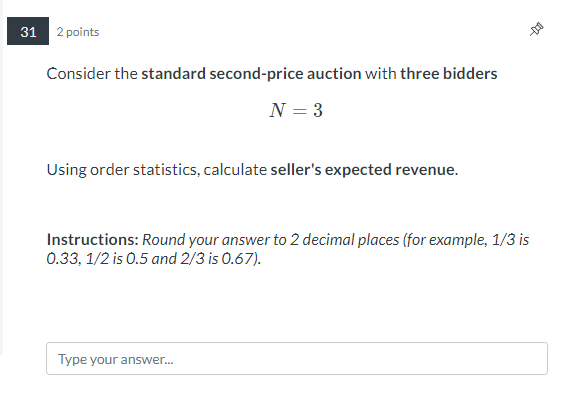
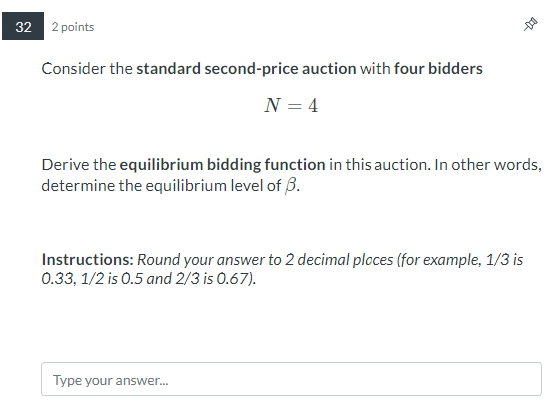
Second-Price and Third-Price Auctions 30 2 points Consider a sealed-bid auction for a single object. There are N 2 3 Consider the standard second-price auction with three bidders bidders with valuations independently drawn from the uniform distribution on [0, 100]. Each bidder z simultaneously and N = 3 independently submits a bid by for an object. Assume that ALL bidders follow linear bidding strategy of the form Derive the equilibrium bidding function in this auction. In other words, determine the equilibrium level of B. bi(vi) = B * vi i= 1, 2, ..., N where B is a shading constant such that Instructions: Round your answer to 2 decimal places (for example, 1/3 is 0.33, 1/2 is 0.5 and 2/3 is 0.67). B > 0. Type your answer...31 2 points Consider the standard second-price auction with three bidders N = 3 Using order statistics, calculate seller's expected revenue. Instructions: Round your answer to 2 decimal places (for example, 1/3 is 0.33, 1/2 is 0.5 and 2/3 is 0.67). Type your answer..32 2 points Consider the standard second-price auction with four bidders N =4 Derive the equilibrium bidding function in this auction. In other words, determine the equilibrium level of 3. Instructions: Round your answer to 2 decimal places (for example, 1/3 is 0.33, 1/2 is 0.5 and 2/3 is 0.67). Type your answer..33 2 points Consider the standard second-price auction with four bidders N =4 Using order statistics, calculate seller's expected revenue. Instructions: Round your answer to 2 decimal places (for example, 1/3 is 0.33, 1/2 is 0.5 and 2/3 is 0.67). Type your answer...34 3 points Now consider a third-price auction. The bidder with the highest bid wins the object and pays the third-highest bid. The losers pay nothing. Suppose that there are three bidders in this auction, i.e., N : 3 Also assume that the Revenue Equivalence hoids between the second- price auction and the thirdprice auction. Derive the equilibrium bidding function in this auction. In other words, determine the equilibrium ievel of ,3. Instructions: Round your answer to 2 decimal pieces (for example, 1/3 is 0.33. 1/2 is 0.5 and 2/3 is 0.67J. Type your a nswer... 3 poi n15 f Now consider a third price auction. The bidder with the highest bid wins the object and pays the third-highest bid. The losers pay nothing. Suppose that there are four bidders in this au ctio n, i.e.. N24 Assume that the Revenue Equivalence holds between the secondiprice auction and the thirdiprice auction. Derive the equilibrium bidding function in this auction. In other words, determine the equilibrium level of ,5. Instructions: Round your answer to 2 decimal places {for example, If 3 is 0.33. 1/2 is 0.5 and 2/3 is 0.67}. Type your a nswer
Step by Step Solution
There are 3 Steps involved in it

Get step-by-step solutions from verified subject matter experts