







Question: 4. Consider diffusion in a two-component system (1-2) which behaves as a regular solution: AGM = AHM TASM = NX1X2 + RTX, In X1 +
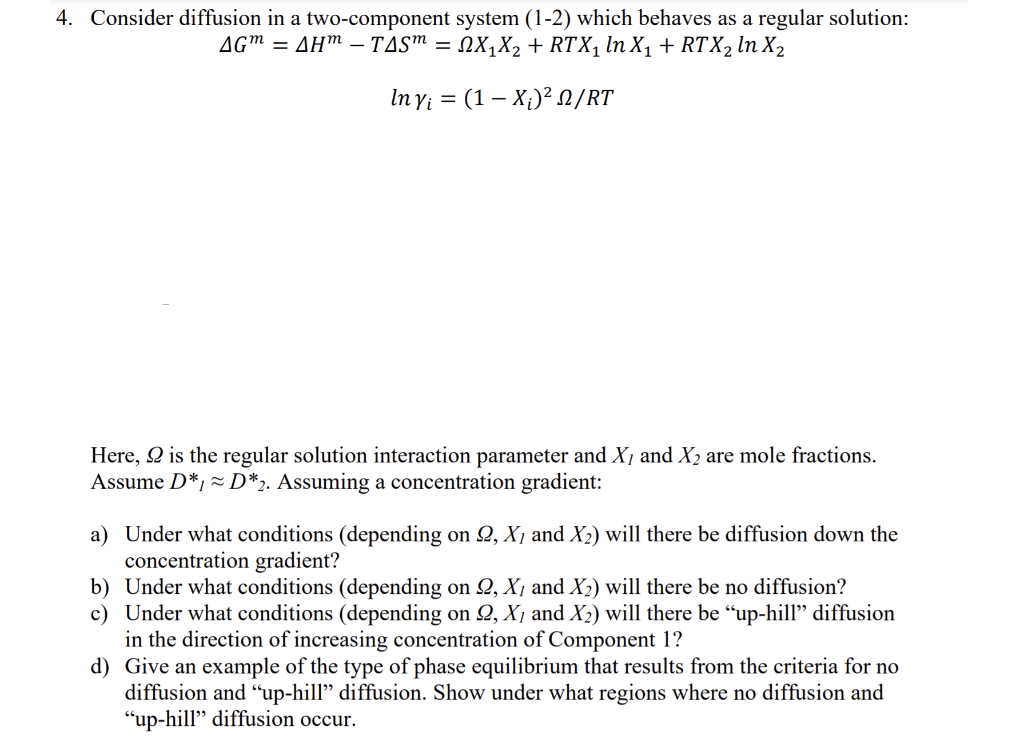
4. Consider diffusion in a two-component system (1-2) which behaves as a regular solution: AGM = AHM TASM = NX1X2 + RTX, In X1 + RTX, In X2 In Yi = (1 X;)22/RT = Here, 2 is the regular solution interaction parameter and X, and X2 are mole fractions. Assume D*, D*2. Assuming a concentration gradient: a) Under what conditions (depending on 2, X, and X2) will there be diffusion down the concentration gradient? b) Under what conditions (depending on 2, X, and X2) will there be no diffusion? c) Under what conditions (depending on 2, X, and X2) will there be "up-hill diffusion in the direction of increasing concentration of Component 1? d) Give an example of the type of phase equilibrium that results from the criteria for no diffusion and up-hill diffusion. Show under what regions where no diffusion and "up-hill diffusion occur. 4. Consider diffusion in a two-component system (1-2) which behaves as a regular solution: AGM = AHM TASM = NX1X2 + RTX, In X1 + RTX, In X2 In Yi = (1 X;)22/RT = Here, 2 is the regular solution interaction parameter and X, and X2 are mole fractions. Assume D*, D*2. Assuming a concentration gradient: a) Under what conditions (depending on 2, X, and X2) will there be diffusion down the concentration gradient? b) Under what conditions (depending on 2, X, and X2) will there be no diffusion? c) Under what conditions (depending on 2, X, and X2) will there be "up-hill diffusion in the direction of increasing concentration of Component 1? d) Give an example of the type of phase equilibrium that results from the criteria for no diffusion and up-hill diffusion. Show under what regions where no diffusion and "up-hill diffusion occur
Step by Step Solution
There are 3 Steps involved in it

Get step-by-step solutions from verified subject matter experts
 Study Help