







Question: For this problem, we will do some mass transfer related calculations of chlorobenzene in groundwater. Chlorobenzene is a common solvent as well as an intermediate
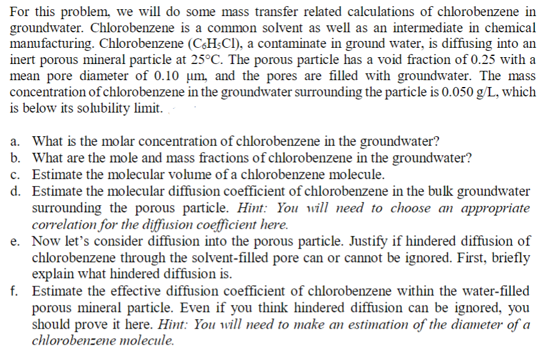
For this problem, we will do some mass transfer related calculations of chlorobenzene in groundwater. Chlorobenzene is a common solvent as well as an intermediate in chemical manufacturing. Chlorobenzene (C6H5Cl), a contaminate in ground water, is diffusing into an inert porous mineral particle at 25C. The porous particle has a void fraction of 0.25 with a mean pore diameter of 0.10m, and the pores are filled with groundwater. The mass concentration of chlorobenzene in the groundwater surrounding the particle is 0.050g/L, which is below its solubility limit. a. What is the molar concentration of chlorobenzene in the groundwater? b. What are the mole and mass fractions of chlorobenzene in the groundwater? c. Estimate the molecular volume of a chlorobenzene molecule. d. Estimate the molecular diffusion coefficient of chlorobenzene in the bulk groundwater surrounding the porous particle. Hint: You will need to choose an appropriate correlation for the diffusion coefficient here. e. Now let's consider diffusion into the porous particle. Justify if hindered diffusion of chlorobenzene through the solvent-filled pore can or cannot be ignored. First, briefly explain what hindered diffusion is. f. Estimate the effective diffusion coefficient of chlorobenzene within the water-filled porous mineral particle. Even if you think hindered diffusion can be ignored, you should prove it here. Hint: You will need to make an estimation of the diameter of a chlorobenzene molecule
Step by Step Solution
There are 3 Steps involved in it

Get step-by-step solutions from verified subject matter experts
 Study Help