







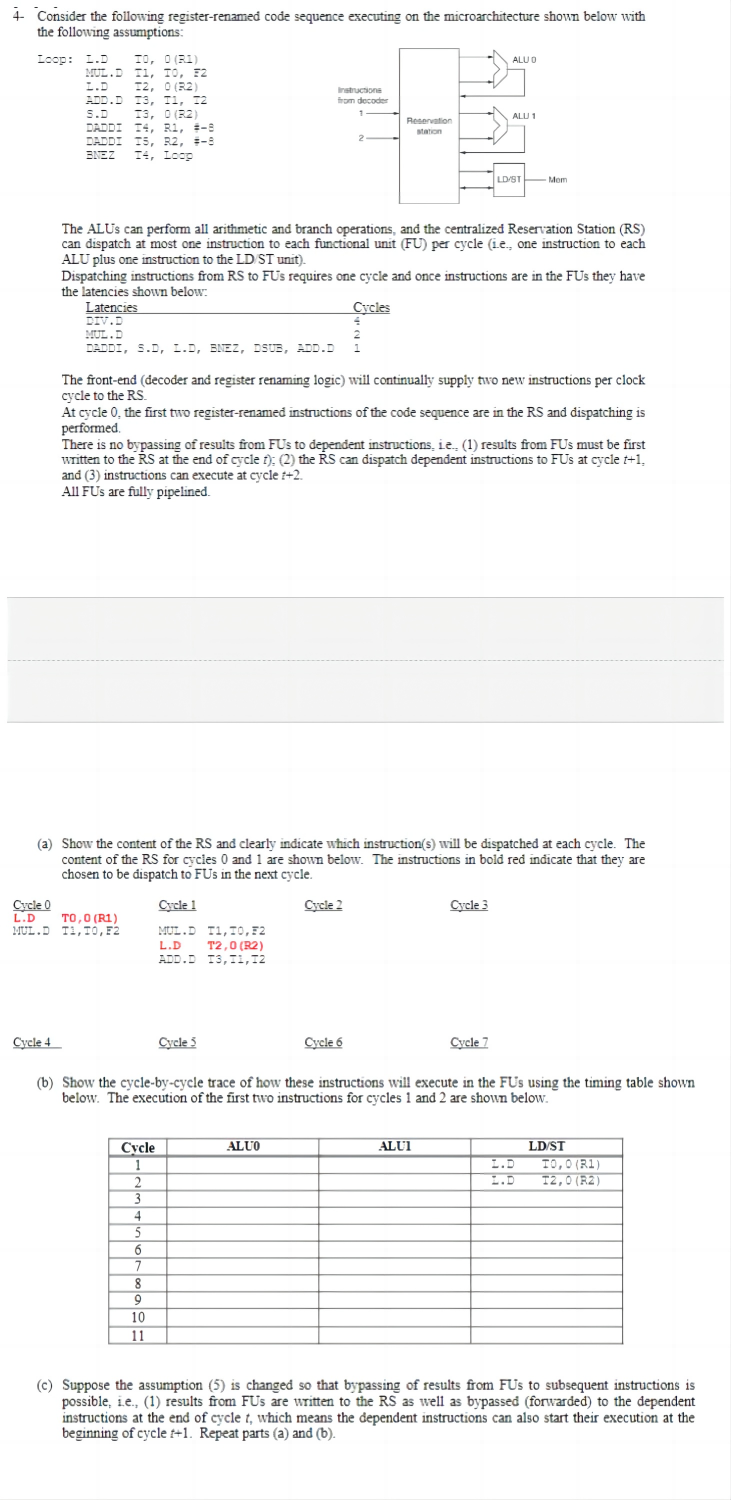
Question: 4 - Consider the following register - renamed code sequence executing on the microarchitecture shown below with the following assumptions: DADDI I S , R
Consider the following registerrenamed code sequence executing on the microarchitecture shown below with
the following assumptions:
DADDI
BIEZ Iocp
The ALUs can perform all arithmetic and branch operations, and the centralized Reservation Station RS
can dispatch at most one instruction to each functional unit FU per cycle ie one instruction to each
ALU plus one instruction to the LD ST unit
Dispatching instructions from RS to FUs requires one cycle and once instructions are in the FUs they have
the latencies shown below:
The frontend decoder and register renaming logic will continually supply two new instructions per clock
cycle to the RS
At cycle the first two registerrenamed instructions of the code sequence are in the RS and dispatching is
performed.
There is no bypassing of results from FUs to dependent instructions, ie results from FUs must be first
written to the RS at the end of cycle ; the RS can dispatch dependent instructions to FUs at cycle
and instructions can execute at cycle
All FUs are fully pipelined.
a Show the content of the RS and clearly indicate which instructions will be dispatched at each cycle. The
content of the RS for cycles and are shown below. The instructions in bold red indicate that they are
chosen to be dispatch to FUs in the next cycle.
Cycle
Cycle
Cycle
Cycle
b Show the cyclebycycle trace of how these instructions will execute in the FUs using the timing table shown
below. The execution of the first two instructions for cycles and are shown below.
c Suppose the assumption is changed so that bypassing of results from FUs to subsequent instructions is
possible, ie results from FUs are written to the RS as well as bypassed forwarded to the dependent
instructions at the end of cycle which means the dependent instructions can also start their execution at the
beginning of cycle Repeat parts a and b
Step by Step Solution
There are 3 Steps involved in it
1 Expert Approved Answer
Step: 1 Unlock

Question Has Been Solved by an Expert!
Get step-by-step solutions from verified subject matter experts
Step: 2 Unlock
Step: 3 Unlock
 Study Help