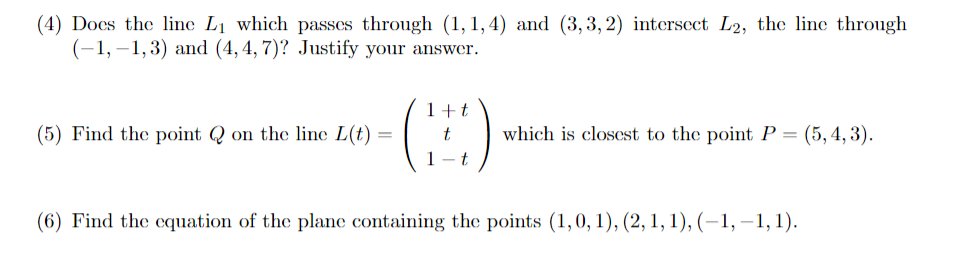
Question: (4) Does the line Li which passes through (1, 1, 4) and (3, 3, 2) intersect L2, the line through (-1, -1,3) and (4, 4,
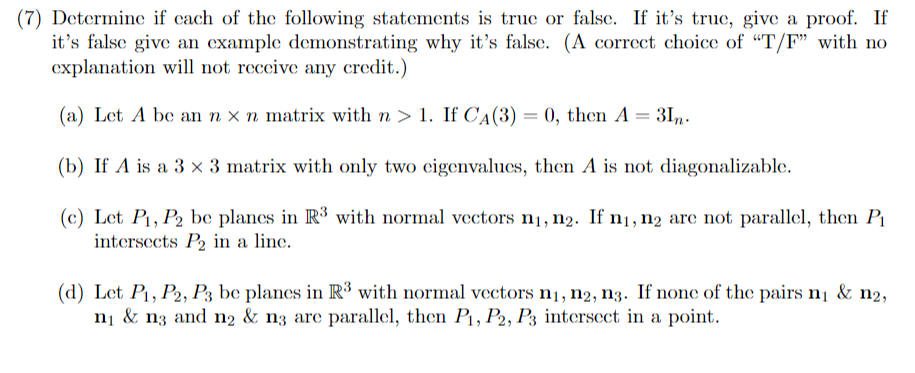
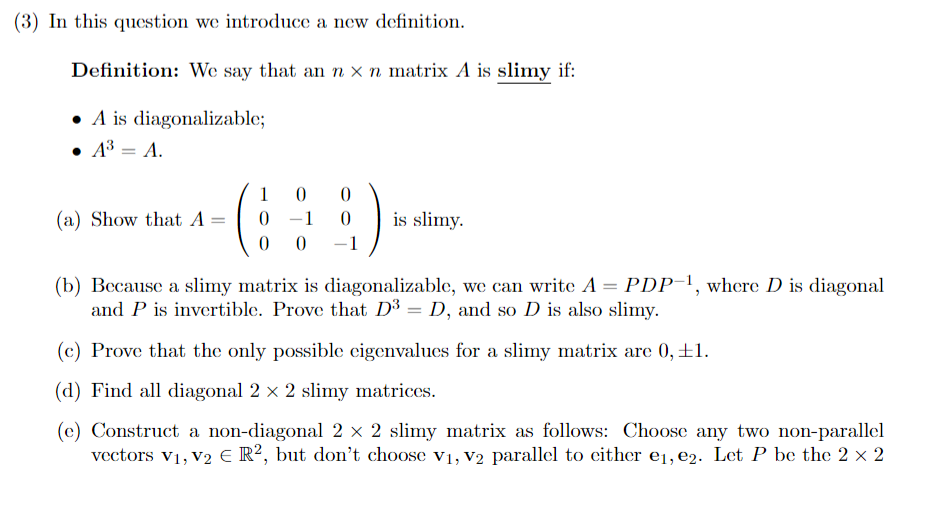
(4) Does the line Li which passes through (1, 1, 4) and (3, 3, 2) intersect L2, the line through (-1, -1,3) and (4, 4, 7)? Justify your answer. 1 +t (5) Find the point Q on the line L(t) = t which is closest to the point P = (5, 4, 3). - t (6) Find the equation of the plane containing the points (1, 0, 1), (2, 1, 1), (-1, -1, 1).matrix with columns V1 V2. Choose D a diagol'lal slimy matrix from the previous part, but don't choose D 2 I2, I2,Og.. Compute PEP" and let A = PEP1. (f) Explain why any matrix A em'mtrueted by the procedure in part (e) is slimy. (7) Determine if each of the following statements is true or false. If it's true, give a proof. If it's false give an example demonstrating why it's false. (A correct choice of "T/F" with no explanation will not receive any credit.) (a) Let A be an n x n matrix with n > 1. If CA(3) = 0, then A = 3In. (b) If A is a 3 x 3 matrix with only two eigenvalues, then A is not diagonalizable. (c) Let Pi, P2 be planes in Re with normal vectors n1, n2. If nj, n2 are not parallel, then Pi intersects P2 in a line. (d) Let PI, P2, P3 be planes in Re with normal vectors n1, n2, n3. If none of the pairs n & n2, nj & n3 and n2 & ng are parallel, then PI, P2, P3 intersect in a point.(3) In this question we introduce a new definition. Definition: We say that an n x n matrix A is slimy if: . A is diagonalizable; . A3 = A. 0 (a) Show that A = 0 is slimy. (b) Because a slimy matrix is diagonalizable, we can write A = PDP-1, where D is diagonal and P is invertible. Prove that D3 = D, and so D is also slimy. (c) Prove that the only possible eigenvalues for a slimy matrix arc 0, 11. (d) Find all diagonal 2 x 2 slimy matrices. (c) Construct a non-diagonal 2 x 2 slimy matrix as follows: Choose any two non-parallel vectors v1, V2 E R', but don't choose v1, v2 parallel to cither e1, e2. Let P be the 2 x 2
Step by Step Solution
There are 3 Steps involved in it
1 Expert Approved Answer
Step: 1 Unlock
Question Has Been Solved by an Expert!
Get step-by-step solutions from verified subject matter experts
Step: 2 Unlock
Step: 3 Unlock
Students Have Also Explored These Related Mathematics Questions!










 Study Help