







Question: 4. Evaluate Potential Solutions. Evaluate your proposed solutions considering the history of the problem, logic/reasoning, feasibility, and impact of the solution. In other words, also
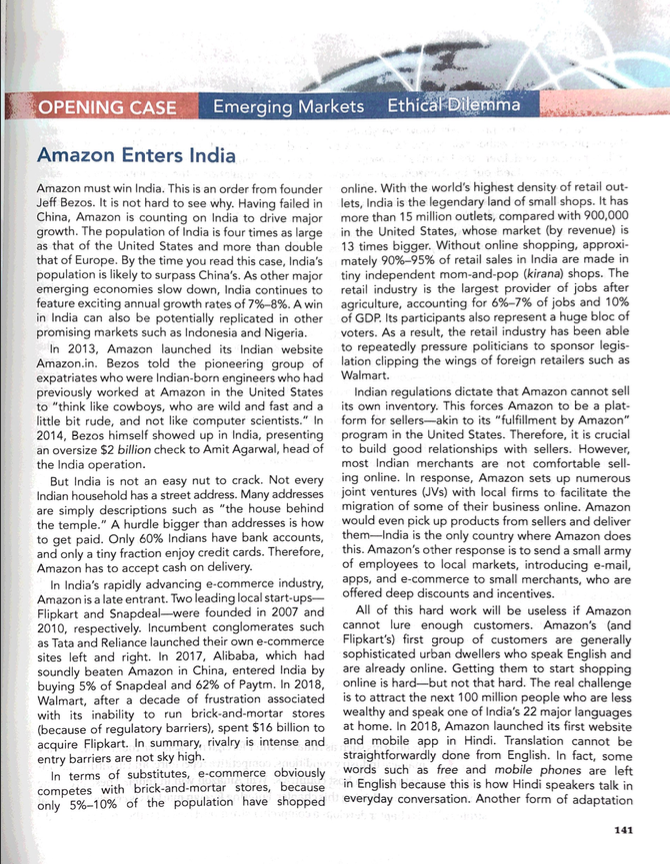
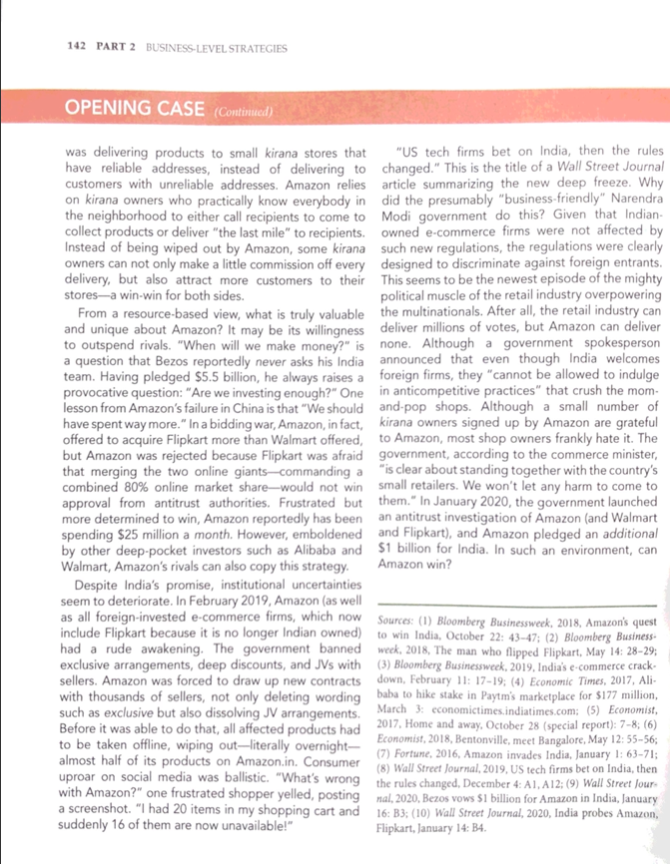
4. Evaluate Potential Solutions. Evaluate your proposed solutions considering the history of the problem, logic/reasoning, feasibility, and impact of the solution. In other words, also discuss the potential pitfalls or risks of the solutions you propose. Implement Solution. Discuss the concrete implementation steps to put your recommendations into action, considering the contextual factors. Evaluate Outcomes. What milestones or objectives (be specific) would you set for Amazon to consider their entry into India a success? Evaluate the likelihood of achieving that success.
OPENING CASE Emerging Markets Ethical Dilemma Amazon Enters India Amazon must win India. This is an order from founder online. With the world's highest density of retail out- Jeff Bezos. It is not hard to see why. Having failed in lets, India is the legendary land of small shops. It has China, Amazon is counting on India to drive major more than 15 million outlets, compared with 900,000 growth. The population of India is four times as large in the United States, whose market (by revenue) is as that of the United States and more than double 13 times bigger. Without online shopping, approxi- that of Europe. By the time you read this case, India's mately 90%-95% of retail sales in India are made in population is likely to surpass China's. As other major tiny independent mom-and-pop (kirana) shops. The emerging economies slow down, India continues to retail industry is the largest provider of jobs after feature exciting annual growth rates of 7%-8%. A win agriculture, accounting for 6%-7% of jobs and 10% in India can also be potentially replicated in other of GDP. Its participants also represent a huge bloc of promising markets such as Indonesia and Nigeria. voters. As a result, the retail industry has been able In 2013, Amazon launched its Indian website to repeatedly pressure politicians to sponsor legis Amazon.in. Bezos told the pioneering group of lation clipping the wings of foreign retailers such as expatriates who were Indian-born engineers who had Walmart. previously worked at Amazon in the United States Indian regulations dictate that Amazon cannot sell to "think like cowboys, who are wild and fast and a its own inventory. This forces Amazon to be a plat. little bit rude, and not like computer scientists." In form for sellers-akin to its "fulfillment by Amazon" 2014, Bezos himself showed up in India, presenting program in the United States. Therefore, it is crucial an oversize $2 billion check to Amit Agarwal, head of to build good relationships with sellers. However, the India operation. most Indian merchants are not comfortable sell- But India is not an easy nut to crack. Not everying online. In response, Amazon sets up numerous Indian household has a street address. Many addresses joint ventures (JVs) with local firms to facilitate the are simply descriptions such as "the house behind migration of some of their business online. Amazon the temple." A hurdle bigger than addresses is how would even pick up products from sellers and deliver to get paid. Only 60% Indians have bank accounts, them--India is the only country where Amazon does and only a tiny fraction enjoy credit cards. Therefore, this. Amazon's other response is to send a small army Amazon has to accept cash on delivery. of employees to local markets, introducing e-mail, In India's rapidly advancing e-commerce industry, apps, and e-commerce to small merchants, who are Amazon is a late entrant. Two leading local start-ups offered deep discounts and incentives. Flipkart and Snapdeal-were founded in 2007 and All of this hard work will be useless if Amazon 2010, respectively. Incumbent conglomerates such cannot lure enough customers. Amazon's (and as Tata and Reliance launched their own e-commerce Flipkart's) first group of customers are generally sites left and right. In 2017, Alibaba, which had sophisticated urban dwellers who speak English and soundly beaten Amazon in China, entered India by are already online. Getting them to start shopping buying 5% of Snapdeal and 62% of Paytm. In 2018, online is hardbut not that hard. The real challenge Walmart, after a decade of frustration associated is to attract the next 100 million people who are less with its inability to run brick-and-mortar stores wealthy and speak one of India's 22 major languages (because of regulatory barriers), spent $16 billion to at home. In 2018, Amazon launched its first website acquire Flipkart. In summary, rivalry is intense and and mobile app in Hindi. Translation cannot be entry barriers are not sky high. straightforwardly done from English. In fact, some In terms of substitutes, e-commerce obviously words such as free and mobile phones are left competes with brick-and-mortar stores, because in English because this is how Hindi speakers talk in only 5%-10% of the population have shopped everyday conversation. Another form of adaptation 141 142 PART 2 BUSINESS-LEVEL STRATEGIES OPENING CASE (Continued) was delivering products to small kirana stores that "US tech firms bet on India, then the rules have reliable addresses, instead of delivering to changed." This is the title of a Wall Street Journal customers with unreliable addresses. Amazon relies article summarizing the new deep freeze. Why on kirana owners who practically know everybody in did the presumably "business-friendly" Narendra the neighborhood to either call recipients to come to Modi government do this? Given that Indian collect products or deliver "the last mile" to recipients. owned e-commerce firms were not affected by Instead of being wiped out by Amazon, some kirana such new regulations, the regulations were clearly owners can not only make a little commission off every designed to discriminate against foreign entrants, delivery, but also attract more customers to their This seems to be the newest episode of the mighty storesa win-win for both sides. political muscle of the retail industry overpowering From a resource-based view, what is truly valuable the multinationals. After all, the retail industry can and unique about Amazon? It may be its willingness deliver millions of votes, but Amazon can deliver to outspend rivals. "When will we make money?" is none. Although a government spokesperson a question that Bezos reportedly never asks his India announced that even though India welcomes team. Having pledged $5.5 billion, he always raises a foreign firms, they cannot be allowed to indulge provocative question: "Are we investing enough?" One in anticompetitive practices" that crush the mom- lesson from Amazon's failure in China is that "We should and pop shops. Although a small number of have spent way more." In a bidding war, Amazon, in fact, kirana owners signed up by Amazon are grateful offered to acquire Flipkart more than Walmart offered, to Amazon, most shop owners frankly hate it. The but Amazon was rejected because Flipkart was afraid government, according to the commerce minister, that merging the two online giants-commanding a "is clear about standing together with the country's combined 80% online market share-would not win small retailers. We won't let any harm to come to approval from antitrust authorities. Frustrated but them." In January 2020, the government launched more determined to win, Amazon reportedly has been an antitrust investigation of Amazon (and Walmart spending $25 million a month. However, emboldened and Flipkart), and Amazon pledged an additional by other deep-pocket investors such as Alibaba and $1 billion for India. In such an environment, can Walmart, Amazon's rivals can also copy this strategy. Amazon win? Despite India's promise, institutional uncertainties seem to deteriorate. In February 2019, Amazon (as well as all foreign-invested e-commerce firms, which now Sources: (1) Bloomberg Businessweek, 2018, Amazon's quest include Flipkart because it is no longer Indian owned) to win India, October 22: 43-47; (2) Bloomberg Business had a rude awakening. The government banned week 2018. The man who flipped Flipkart, May 14:28-29; exclusive arrangements, deep discounts, and JVs with (3) Bloomberg Businessweek, 2019, India's e-commerce crack- sellers. Amazon was forced to draw up new contracts down, February 11: 17-19; (4) Economic Times, 2017, Ali- with thousands of sellers, not only deleting wording baba to hike stake in Paytm's marketplace for 5177 million, such as exclusive but also dissolving JV arrangements. March 3: economictimes.indiatimes.com; (5) Economist, Before it was able to do that, all affected products had 2017. Home and away, October 28 (special report): 7-8; (6) to be taken offline, wiping out-literally overnight- () Fortune, 2016, Amazon invades India, January 1: 63-71; almost half of its products on Amazon.in. Consumer (8) Wall Street Journal, 2019, US tech firms bet on India, then uproar on social media was ballistic. "What's wrong the rules changed, December 4: A1, A12: (9) Wall Street Jour with Amazon?" one frustrated shopper yelled, postingnal, 2020, Bezos vows $1 billion for Amazon in India, January a screenshot. "I had 20 items in my shopping cart and 16: B3: (10) Wall Street Journal, 2020, India probes Amazon, suddenly 16 of them are now unavailable!" Flipkart, January 14: B4Step by Step Solution
There are 3 Steps involved in it
1 Expert Approved Answer
Step: 1 Unlock

Question Has Been Solved by an Expert!
Get step-by-step solutions from verified subject matter experts
Step: 2 Unlock
Step: 3 Unlock
 Study Help