







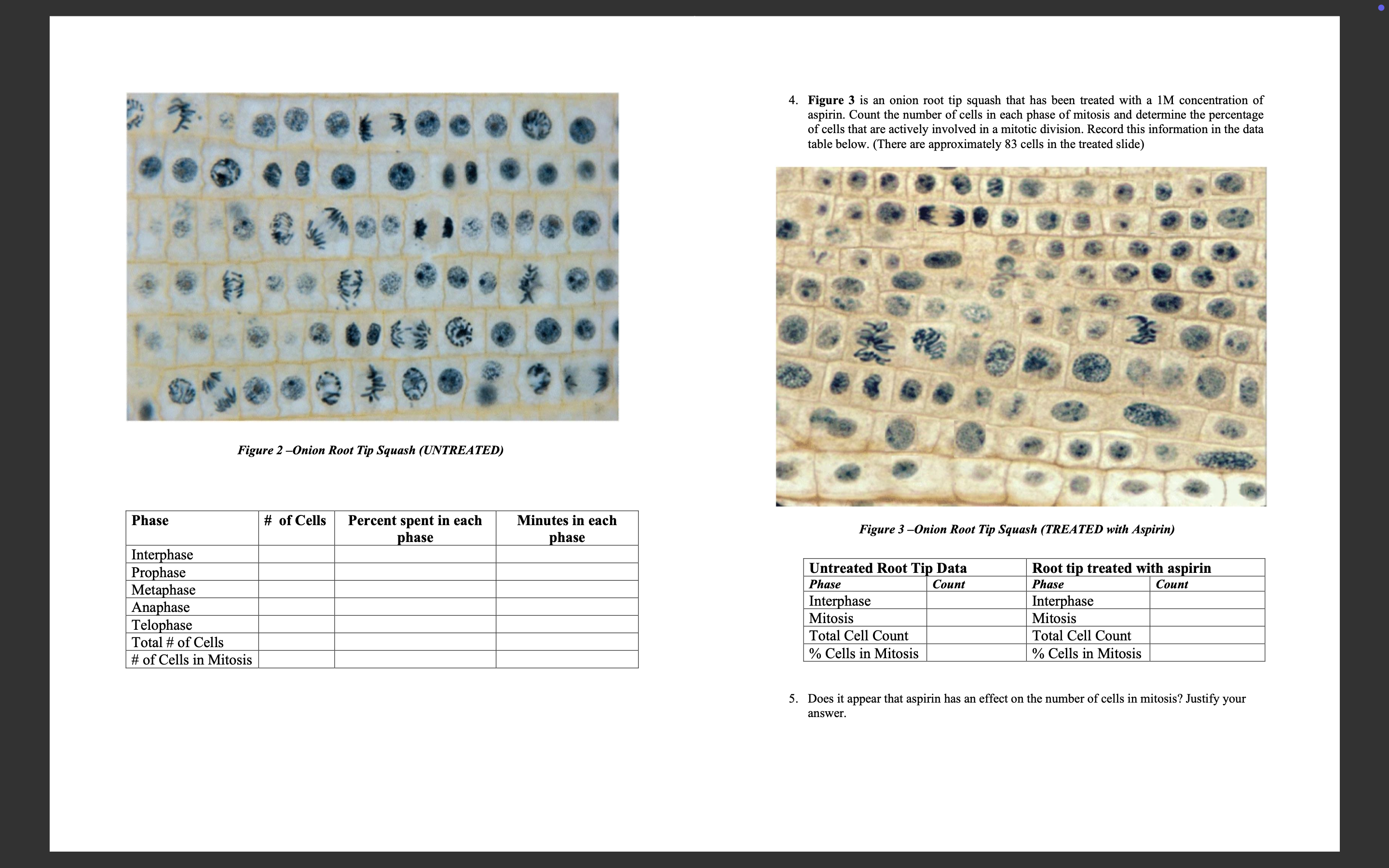
Question: 4 . Figure 3 is an onion root tip squash that has been treated with a 1 M concentration of aspirin. Count the number of
Figure is an onion root tip squash that has been treated with a M concentration of aspirin. Count the number of cells in each phase of mitosis and determine the percentage of cells that are actively involved in a mitotic division. Record this information in the data table below. There are approximately cells in the treated slide
Figure Onion Root Tip Squash UNTREATED
Figure Onion Root Tip Squash TREATED with Aspirin
Does it appear that aspirin has an effect on the number of cells in mitosis? Justify your answer. How can you be confident that the difference you see between treatments is significant or just due to chance? You must use statistics to tell you if there is a significant difference between the untreated and treated data so you can have confidence in your conclusions. For this data you will use a simple Chisquare goodness of fit test. Navigate to our course Canvas page to find the ChiSquare Explanation file to learn more about the Chisquare test.
The null hypothesis leftmathbfHright for this investigation is: Aspirin has no effect on the rate of mitosis. Do a Chisquare analysis leftchiright to determine if soaking onion root tips in a M concentration of aspirin solution significantly affects mitosis of the root tips. Use the null hypothesis to aid in determining what is expected in the aspirin trial. We will use a significance value of alpha and we have one degree of freedom mathrmdfNOTE: If aspirin had no effect on mitosis, then the number of cells in mitosis would be expected to be similar to the untreated root tip. You can use the percentages in mitosis and meiosis of the untreated to help you calculate expected in the treated. You will not have the same number of cells observed in each sample, but you can multiply the percentage by the total number of cells in the treated to determine expected numbers. Feel free to reach out to me if you need more clarity.
Chi square equation:
boldsymbolXSigma fractext observed text expected text expected
Chisquare calculation:
Step by Step Solution
There are 3 Steps involved in it
1 Expert Approved Answer
Step: 1 Unlock

Question Has Been Solved by an Expert!
Get step-by-step solutions from verified subject matter experts
Step: 2 Unlock
Step: 3 Unlock
 Study Help