







Question: Biochemistry Question: (article provided for potential asistance) Explain why conjugating an LDH inhibitor to glucose leads to preferential targeting of cancer cells? Dual Targeting of
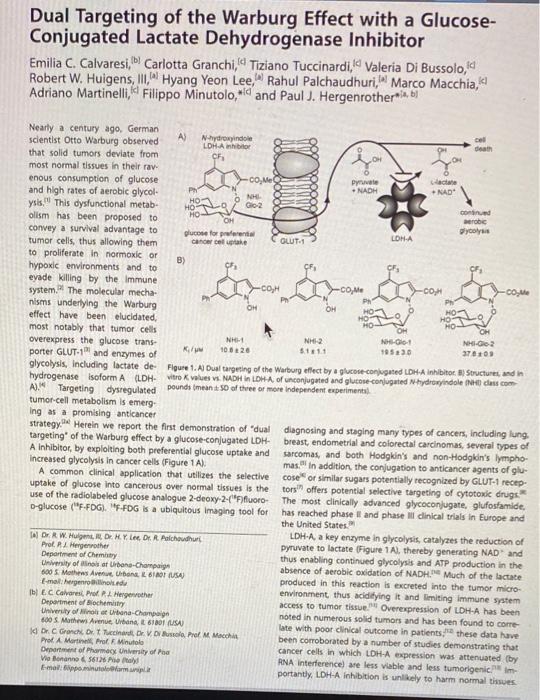
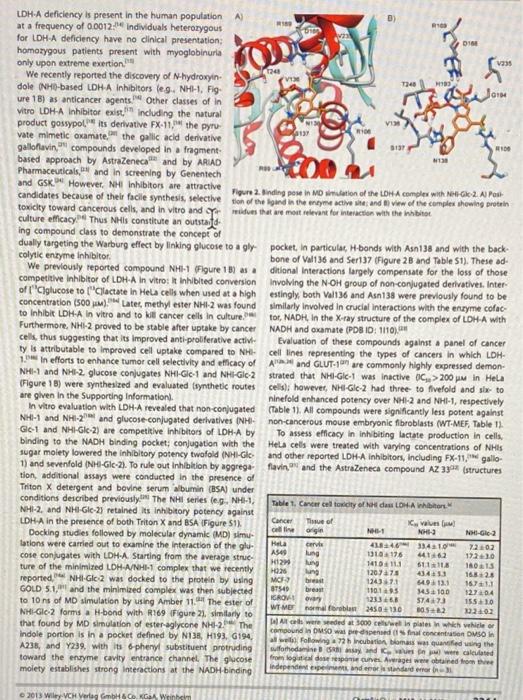
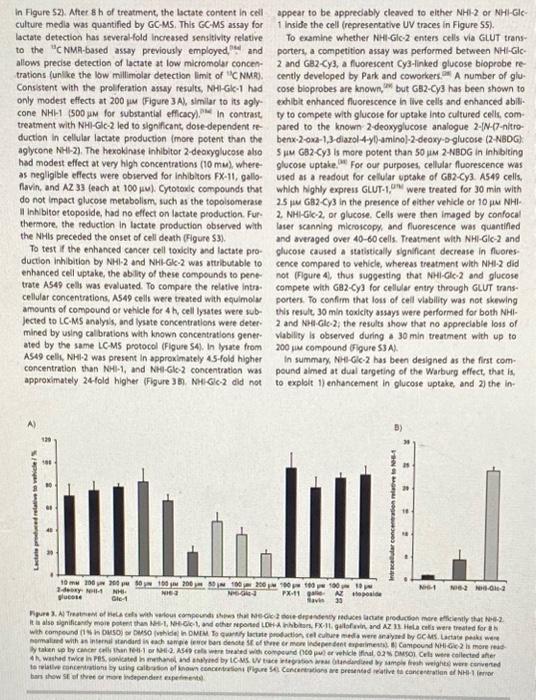
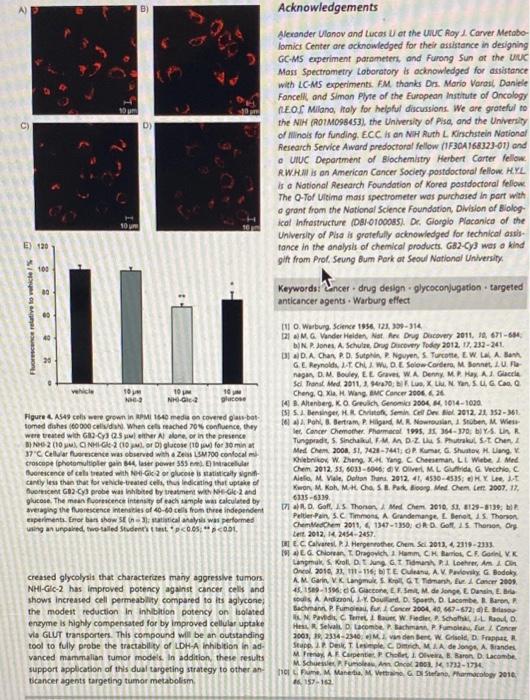
Dual Targeting of the Warburg Effect with a GlucoseConjugated Lactate Dehydrogenase Inhibitor Emilia C. Calvaresi, [bl Cariotta Granchi, [(d) Tiziano Tuccinardi,, (d) Valeria Di Bussolo, Robert W. Huigens, III, [a] Hyang Yeon Lee, (i) Rahul Palchaudhuri, [] Marco Macchia, Adriano Martinelli, "Filippo Minutolo, "(d and Paul J. Hergenrother ia,b] Nearly a century ago, German scientist Otto Warburg observed that solid tumors deviate from most normal tissues in their rav. enous consumption of glucose and high rates of aerobic glycolysib," This dysfunctional metabolism has been proposed to convey a survival advantage to tumor cells, thus allowing them to proliferate in normoxic or hypoxic environments and to eyade killing by the Immune system. ih The molecular mechar nisms underying the Warburg effect have been clucidated, most notably that tumor cells overexpress the glucose transporter GLUT-1" and enzymes of glycobysis, including lactate de: Floure 1. A) Dual targeing of the Warburg effect by a gucove conjugases LoH-A inhlbitoe al Structures, and in A..4. Targeting dysregulated poundi imean 50 of theee or move independent eaperimenta) tumor-cell metabolism is emerg. ing as a promising anticancer strategy: Herein we report the first demonstration of "dual diagnosing and staging many types of cancers, including lung. targeting" of the Warburg effect by a glucose-conjugated LDH- breast, endometrial and coiorectal carcinomas, several types of A inhibitor, by exploiting both preferential glucose uptake and sarcomas, and both Hodgkin's and non-Hodgkin's lymphoincreased glycolysis in cancer cells (Figure 1A ). mas." In addition the conjugation to anticancer agents of glu: A common clinical application that utilizes the selective cose k or similar sugars potentially recognired by GLUT-1 recepuptake of glucose into cancerous over normal tissues is the tors? offers potential selective targeting of cytotoxic drugs: use of the radiolabeled glucose analogue 2-deoxy-2-("F)fuoro-. The most clinically advanced glycoconjugate, glufosfamide. D-glucose ("F.FDG). TF.FDG is a ubiquitous imaging tool for has reached phase Il and phase Ill clinical trials in Europe and the United States. Prot, A L Hergerother Departinent of Chrmity Pyruvate to lactate FFigure 1A, thereby generating NAD* and Uoveniby of alinas of Uibore-Champuriss thus enabling continued glycolysis and ATP production in the Ga0 S. Mothens Avenue Ulbens R. 61AOP ASW absence of aerobic oxidation of NADH, pe Much of the lactace t-mol:herenrobithokinde produced in this reaction is excreted into the tumor micro(b) 6 C Cavarei Phot R \& Hergevether ( environment, thus acidifying it and limiting immune ssitem Deportment of biochemiliy access to tumor tissue. Ovil Overexpression of LDH-A has been woos. Morhmi Aremue Uband, 2 61aol noted in numerous solid tumors and has been found to correProd A Morthnix prot F Minubob been corroborated by a number of studies demonstrating that: portantly. LDH-A inhibition is unlkely to harm normal tinues. in Figure 52). After 8h of treatment, the lactate content in cell appear to be appreclably cleaved to either NHi-2 or NHi-Gleculture medla was quantified by GC-MS. This CC-MS assay for 1 inside the cell (representative UV traces in Figure 55). lactate detection has severalfold increased sensitivity relative To esamine whether NH-Gic-2 enters cells via GLUT transto the "CNMA-based assay previously employed, , and porters, a competition asay was performed between NHI-Gicallows precise detection of lactate at low micromolar concen- 2 and G82-Cy3, a fuorescent Cy3-linked glucose bioprobe retrations funike the low millimolar detection limit of liC NMas. cently developed by Park and coworkers. An A number of giu. Consistent with the prolferation asay results, NHI-Gic-1 had cose bloprobes are known, ak but GB2-Cy3 has been shown to only modest effects at 200 ju (Figure 3A, similar to its agly. extibit enhanced fluorescence in live cells and enhanced ablllcone NH-1 (S00 M for substantial efficacy). Bat in contrast. ty to compete with glucose for uptake into cultured celli, comtreatment with NHI-Gic-2 led to slgnificant, dose-dependent fe. pared to the known-2-deoxyglucose analogue 2-[N-(7-nitroduction in cellular lactate production (more potent than the benx-2-om-1,3-diazol-4-y()-amino)-2-deoxy-b-glucose (2-NBDG) aglycone NHI-2). The hexokinase inhibitor 2-deoryglucose also 5u Ga2-Cy is more potent than 50 ju 2NBDG in inhbiting had modent effect at very high concentrations (10 mu), where- glucose uptake. For our purposes, cellular fluorescence was as negligible eflects were obverved for inhbltots FX-11, gallo- used as a readout for cellular uptake of G82-Cy3. A5-49 cells. favin, and AZ33 (each at 100 u). Cytotoxic compounds that which highly express GLUT-1, , were treated for 30 min with do not impact glucose metabolism such as the topolsomerase 2.5u6.Cy3 in the presence of either vehicle of 10NH II inh bitor etoposide, had no effect on lactate production. Fur- 2. NHL-Gic-2, or glucose. Cells were then imaged by confocal thermore. the reduction in lactate production observed with laser scanning microscopy, and fluorescence was quantifed the NHls preceded the onset of cell death (Flgure S3). and averaged over 4060 cells. Treatment with NHI-Glc-2 and To test if the enhanced cancer cell tovicity and lactate pro- glucose caused a statistically sgnificant decrease in fluores duction inhlbition by NH1-2 and NHI-Gk-2 was attributable to cence compared to vehicle, whereas treatment with NHI-2 did. enhanced cell uptake, the ability of theie compounds to pene- not. (Figure A), thus suggesting that NHi-Glc-2 and glucose trate AS49 cell' was evalusted. To compure the relutive intrs- compete with G82-Cy3 for cellular entry through GLUT transcellular concentrations, AS49 cells were treated with equimola porters. To confirm that loss of cell vability was not skewing amounts of compound or vehicle for 4 h, cell lysates were wb- this result, 30 min toxicity assays were performed for both NHIJected to LC-MS analyis, and lysate concentrations were deter- 2 and Nill-Gilc-2; the results show that no appreciable loss of mined by using calbrations with known concentrations genef- vlability is observed during a 30 min treatment with up to ated by the same LC-MS protocol (Flguse 54), In bate from 200 ma compound (figure 53A. AS49 celli, NHI-2 was present in approximately 4.5-fold higher in summary, N-1--Gic-2 has been designed as the first comconcentration than NHI-1, and Nhe-Gio-2 concentration was pound aimed at dual targeting of the Warburg effect, that is. approximately 24-fold higher (Figure 3 be. Ni-Gic-2 did not to exploit 1) enhancement in glucose uptake, and 2) the inben thow st af the of mose intependint erpetineved
Step by Step Solution
There are 3 Steps involved in it

Get step-by-step solutions from verified subject matter experts
 Study Help