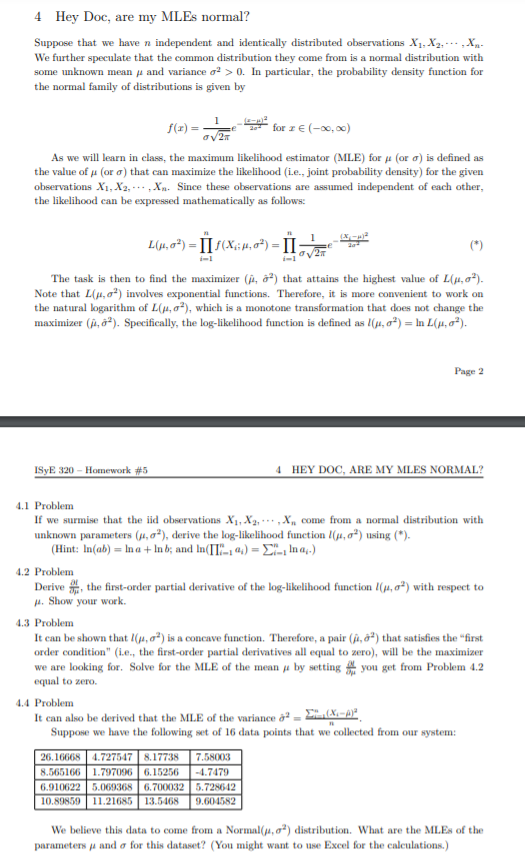
4 Hey Doc, are my MLEs normal? Suppose that we have n independent and identically distributed observations X1, X2, X- We further speculate that the common distribution they come from is a normal distribution with some unknown mean ji and variance o2 > 0. In particular, the probability density function for the normal family of distributions is given by f(3) = V2 for 2 (-2,00) As we will learn in class, the maximum likelihood estimator (MLE) for (or a) is defined as the value of (or a) that can maximize the likelihood (i.e., joint probability density) for the given observations X1, X2, ... , Xn. Since these observations are assumed independent of each other, the likelihood can be expressed mathematically as follows: L(4,02) IIF(X:4,09) II - II-LE (*) The task is then to find the maximizer (32) that attains the highest value of L(0) Note that Lyc) involves exponential functions. Therefore, it is more convenient to work on the natural logarithm of L(4,0), which is a monotone transformation that does not change the maximizer (14,02). Specifically, the log-likelihood function is defined as 1(4,0) = In Ly, o). Page 2 ISYE 320 - Homework #5 4 HEY DOC, ARE MY MLES NORMAL? 4.1 Problem If we surmise that the iid observations X1, X3,...,x, come from a normal distribution with unknown parameters (wo), derive the log-likelihood function 164, ) using (*). (Hint: In(ab) = In a + In b; and In(IT-; 2) = ?, In aj.) 4.2 Problem Derive the first-order partial derivative of the log-likelihood function (4,0%) with respect to H. Show your work 4.3 Problem It can be shown that 144,0?) is a concave function. Therefore, a pair (0) that satisfies the "first order condition" (i.e., the first-order partial derivatives all equal to zero), will be the maximizer we are looking for. Solve for the MLE of the mean by setting you get from Problem 4.2 equal to zero. 4.4 Problem It can also be derived that the MLE of the variance q? S".[X-A Suppose we have the following set of 16 data points that we collected from our system: 26.16668 4.727547 8.17738 7.58003 8.566166 1.7970966.15256-4.7479 6.910622 5.069368 6.700032 5.728642 10.89859 11.21685 13.5468 9.604582 We believe this data to come from a Normal, o?) distribution. What are the MLEs of the parameters and a for this dataset? (You might want to use Excel for the calculations.) 4 Hey Doc, are my MLEs normal? Suppose that we have n independent and identically distributed observations X1, X2, X- We further speculate that the common distribution they come from is a normal distribution with some unknown mean ji and variance o2 > 0. In particular, the probability density function for the normal family of distributions is given by f(3) = V2 for 2 (-2,00) As we will learn in class, the maximum likelihood estimator (MLE) for (or a) is defined as the value of (or a) that can maximize the likelihood (i.e., joint probability density) for the given observations X1, X2, ... , Xn. Since these observations are assumed independent of each other, the likelihood can be expressed mathematically as follows: L(4,02) IIF(X:4,09) II - II-LE (*) The task is then to find the maximizer (32) that attains the highest value of L(0) Note that Lyc) involves exponential functions. Therefore, it is more convenient to work on the natural logarithm of L(4,0), which is a monotone transformation that does not change the maximizer (14,02). Specifically, the log-likelihood function is defined as 1(4,0) = In Ly, o). Page 2 ISYE 320 - Homework #5 4 HEY DOC, ARE MY MLES NORMAL? 4.1 Problem If we surmise that the iid observations X1, X3,...,x, come from a normal distribution with unknown parameters (wo), derive the log-likelihood function 164, ) using (*). (Hint: In(ab) = In a + In b; and In(IT-; 2) = ?, In aj.) 4.2 Problem Derive the first-order partial derivative of the log-likelihood function (4,0%) with respect to H. Show your work 4.3 Problem It can be shown that 144,0?) is a concave function. Therefore, a pair (0) that satisfies the "first order condition" (i.e., the first-order partial derivatives all equal to zero), will be the maximizer we are looking for. Solve for the MLE of the mean by setting you get from Problem 4.2 equal to zero. 4.4 Problem It can also be derived that the MLE of the variance q? S".[X-A Suppose we have the following set of 16 data points that we collected from our system: 26.16668 4.727547 8.17738 7.58003 8.566166 1.7970966.15256-4.7479 6.910622 5.069368 6.700032 5.728642 10.89859 11.21685 13.5468 9.604582 We believe this data to come from a Normal, o?) distribution. What are the MLEs of the parameters and a for this dataset? (You might want to use Excel for the calculations.)




