







Question: 4. Huffman code is a way to encode information using variable-length binary strings to represent symbols depending on the frequency of each individual letter. Specifically,
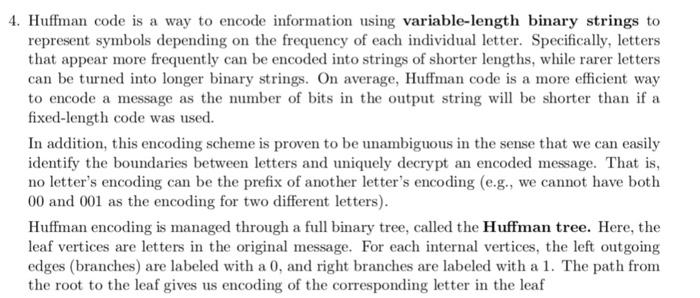
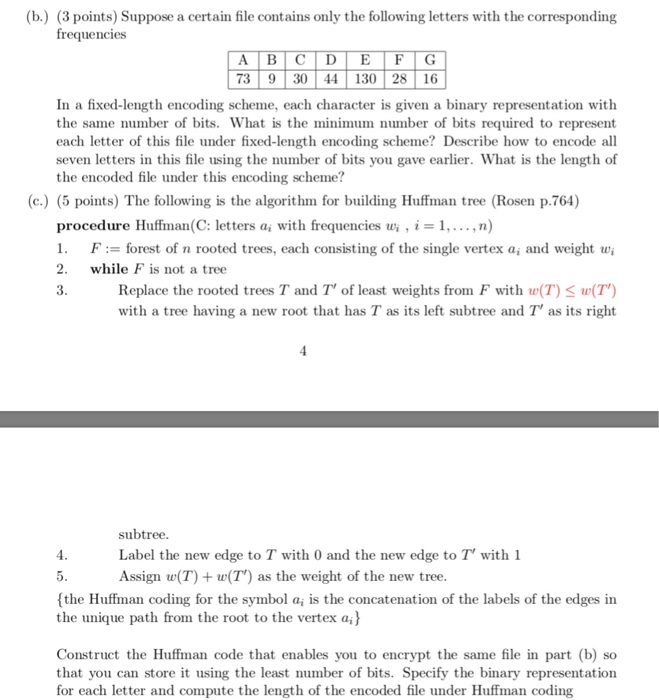
4. Huffman code is a way to encode information using variable-length binary strings to represent symbols depending on the frequency of each individual letter. Specifically, letters that appear more frequently can be encoded into strings of shorter lengths, while rarer letters can be turned into longer binary strings. On average, Huffman code is a more efficient way to encode a message as the number of bits in the output string will be shorter than if a fixed-length code was used. In addition, this encoding scheme is proven to be unambiguous in the sense that we can easily identify the boundaries between letters and uniquely decrypt an encoded message. That is, no letter's encoding can be the prefix of another letter's encoding (e.g., we cannot have both 00 and 001 as the encoding for two different letters) Huffman encoding is managed through a full binary tree, called the Huffman tree. Here, the leaf vertices are letters in the original message. For each internal vertices, the left outgoing edges (branches) are labeled with a 0, and right branches are labeled with a 1. The path from the root to the leaf gives us encoding of the corresponding letter in the leaf
Step by Step Solution
There are 3 Steps involved in it

Get step-by-step solutions from verified subject matter experts
 Study Help