







Question: 4) If f(x, y) = = (x2 + 2y?)+ 2 and v = (1,-V3), a) Find the derivative of f in the direction of i
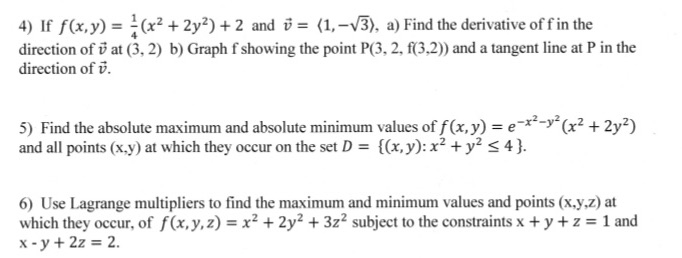
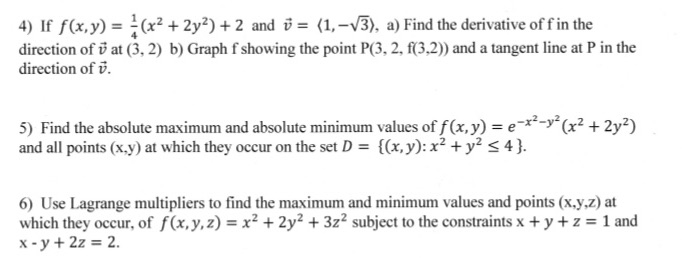
4) If f(x, y) = = (x2 + 2y?)+ 2 and v = (1,-V3), a) Find the derivative of f in the direction of i at (3, 2) b) Graph f showing the point P(3, 2, f(3,2)) and a tangent line at P in the direction of v. 5) Find the absolute maximum and absolute minimum values of f (x, y) = ex->(x2 + 2yz) and all points (x,y) at which they occur on the set D = {(x, y): x3 + y's 4]. 6) Use Lagrange multipliers to find the maximum and minimum values and points (x,y,z) at which they occur, of f(x, y,z) = x2 + 2yz + 32 subject to the constraints x + y + z = 1 and x - y + 2z = 2
Step by Step Solution
There are 3 Steps involved in it
1 Expert Approved Answer
Step: 1 Unlock

Question Has Been Solved by an Expert!
Get step-by-step solutions from verified subject matter experts
Step: 2 Unlock
Step: 3 Unlock
 Study Help