







Question: 4. In the analysis of the deterministic selection algorithm discussed in class, we proved the following upper bound: L +3. But we did not claim
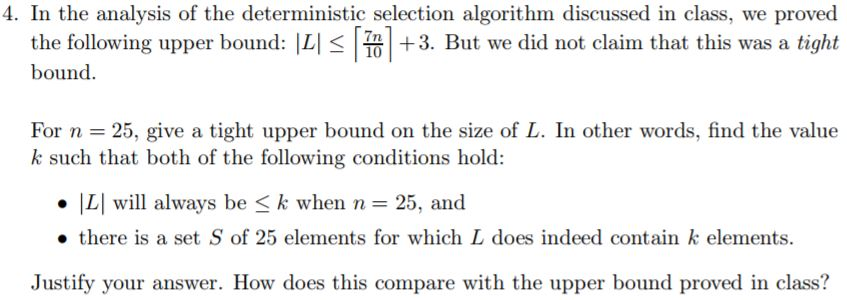
4. In the analysis of the deterministic selection algorithm discussed in class, we proved the following upper bound: L +3. But we did not claim that this was a tight bound For n = 25, give a tight upper bound on the size of L. In other words, find the value k such that both of the following conditions hold: ILI will always be k when n = 25, and there is a set S of 25 elements for which L does indeed contain k elements. Justify your answer. How does this compare with the upper bound proved in class? 4. In the analysis of the deterministic selection algorithm discussed in class, we proved the following upper bound: L +3. But we did not claim that this was a tight bound For n = 25, give a tight upper bound on the size of L. In other words, find the value k such that both of the following conditions hold: ILI will always be k when n = 25, and there is a set S of 25 elements for which L does indeed contain k elements. Justify your answer. How does this compare with the upper bound proved in class
Step by Step Solution
There are 3 Steps involved in it

Get step-by-step solutions from verified subject matter experts
 Study Help