







Question: 4. In this problem you will derive the van der Waals equation of state. This model makes the following assumptions: (1) particles do not interact
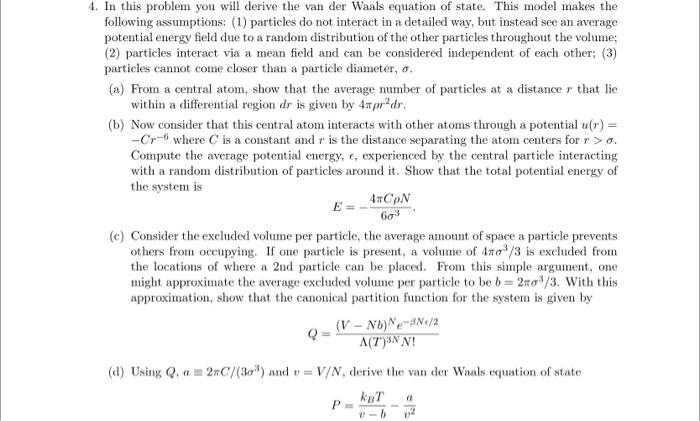
4. In this problem you will derive the van der Waals equation of state. This model makes the following assumptions: (1) particles do not interact in a detailed way, but instead see an average potential energy field due to a random distribution of the other particles throughout the volume; (2) particles interact via a mean field and can be considered independent of each other; (3) particles cannot come closer than a particle diameter, . (a) From a central atom, show that the average number of particles at a distance r that lie within a differential region dr is given by 4r2dr. (b) Now consider that this central atom interacts with other atoms through a potential u(r)= Cr6 where C is a constant and r is the distance separating the atom centers for r>. Compute the average potential energy, , experienced by the central particle interacting with a random distribution of particles around it. Show that the total potential energy of the system is E=634CN (c) Consider the exeluded volume per particle, the average amount of space a particle prevents others from occupying. If one particle is present, a volume of 43/3 is excluded from the locations of where a 2 nd particle can be placed. From this simple argument, one might approximate the average excluded volume per particle to be b=23/3. With this approximation, show that the canonical partition function for the system is given by Q=(T)3NN!(VNb)NeNe/2 (d) Using Q,a=2C/(33) and v=V/N, derive the van der Waals equation of state P=vbkBTv2a
Step by Step Solution
There are 3 Steps involved in it

Get step-by-step solutions from verified subject matter experts
 Study Help