


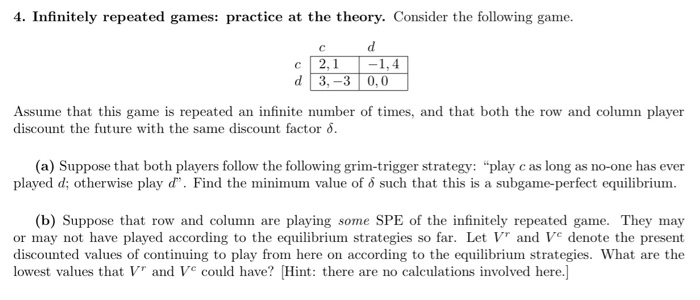
Question: 4. Infinitely repeated games: practice at the theory. Consider the following game. cd c 2 .1 -1,4 d 3, -3 0,0 Assume that this game
4. Infinitely repeated games: practice at the
4. Infinitely repeated games: practice at the theory. Consider the following game. cd c 2 .1 -1,4 d 3, -3 0,0 Assume that this game is repeated an infinite number of times, and that both the row and column player discount the future with the same discount factor d. (a) Suppose that both players follow the following grim-trigger strategy: "play c as long as no-one has ever played d; otherwise play d". Find the minimum value of such that this is a subgame-perfect equilibrium. (b) Suppose that row and column are playing some SPE of the infinitely repeated game. They may or may not have played according to the equilibrium strategies so far. Let V" and ve denote the present discounted values of continuing to play from here on according to the equilibrium strategies. What are the lowest values that V" and Ve could have? Hint: there are no calculations involved here. 4. Infinitely repeated games: practice at the theory. Consider the following game. cd c 2 .1 -1,4 d 3, -3 0,0 Assume that this game is repeated an infinite number of times, and that both the row and column player discount the future with the same discount factor d. (a) Suppose that both players follow the following grim-trigger strategy: "play c as long as no-one has ever played d; otherwise play d". Find the minimum value of such that this is a subgame-perfect equilibrium. (b) Suppose that row and column are playing some SPE of the infinitely repeated game. They may or may not have played according to the equilibrium strategies so far. Let V" and ve denote the present discounted values of continuing to play from here on according to the equilibrium strategies. What are the lowest values that V" and Ve could have? Hint: there are no calculations involved here

Step by Step Solution

There are 3 Steps involved in it

1 Expert Approved Answer
Step: 1 Unlock blur-text-image

Question Has Been Solved by an Expert!

Get step-by-step solutions from verified subject matter experts

Step: 2 Unlock
Step: 3 Unlock

Students Have Also Explored These Related General Management Questions!