







Question: 4. Is the example correct? Solve the quadratic inequality by the method of intervals -x2 + 4x 0 Multiply both sides by (-1) and change
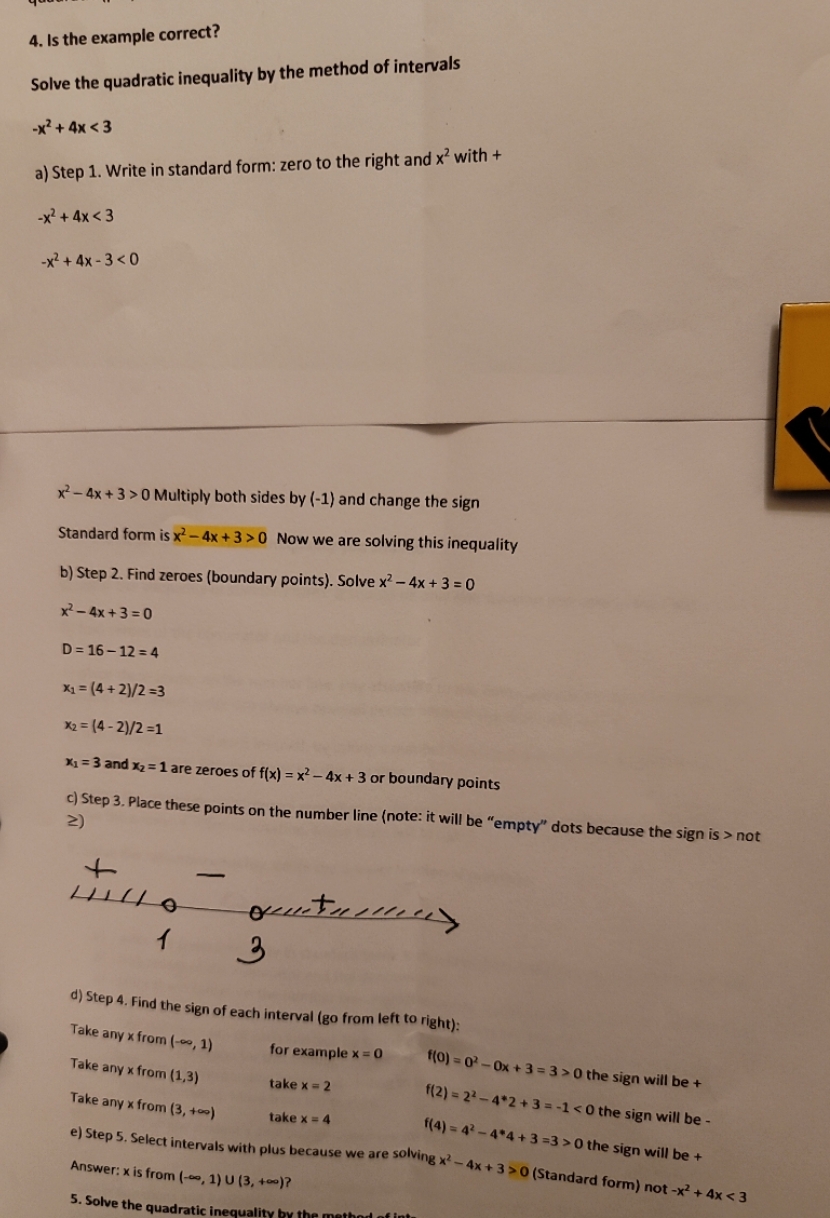
4. Is the example correct? Solve the quadratic inequality by the method of intervals -x2 + 4x 0 Multiply both sides by (-1) and change the sign Standard form is x? - 4x + 3 > 0 Now we are solving this inequality b) Step 2. Find zeroes (boundary points). Solve x2 - 4x + 3 = 0 x2 - 4x + 3=0 D =16- 12 = 4 X1 = (4+ 2)/2 =3 X2 = (4-2)/2 =1 X1 = 3 and x2 = 1 are zeroes of f(x) = x2 - 4x + 3 or boundary points c) Step 3. Place these points on the number line (note: it will be "empty" dots because the sign is > not 2) 3 d) Step 4. Find the sign of each interval (go from left to right): Take any x from (-co, 1) for example x = 0 f(0) = 03 - 0x + 3 = 3 > 0 the sign will be + Take any x from (1,3) take x = 2 f(2) = 23-4*2+3 = -1 0 the sign will be + e) Step 5. Select intervals with plus because we are solving x2 - 4x + 3 >0 (Standard form) not -x2 + 4x
Step by Step Solution
There are 3 Steps involved in it

Get step-by-step solutions from verified subject matter experts
 Study Help