







Question: Thank you! 2 1. Considerthe function f(g;) : () _ 1. Graph the function on desmos. Use that graph, as well as your mathematical knowledge,
Thank you!
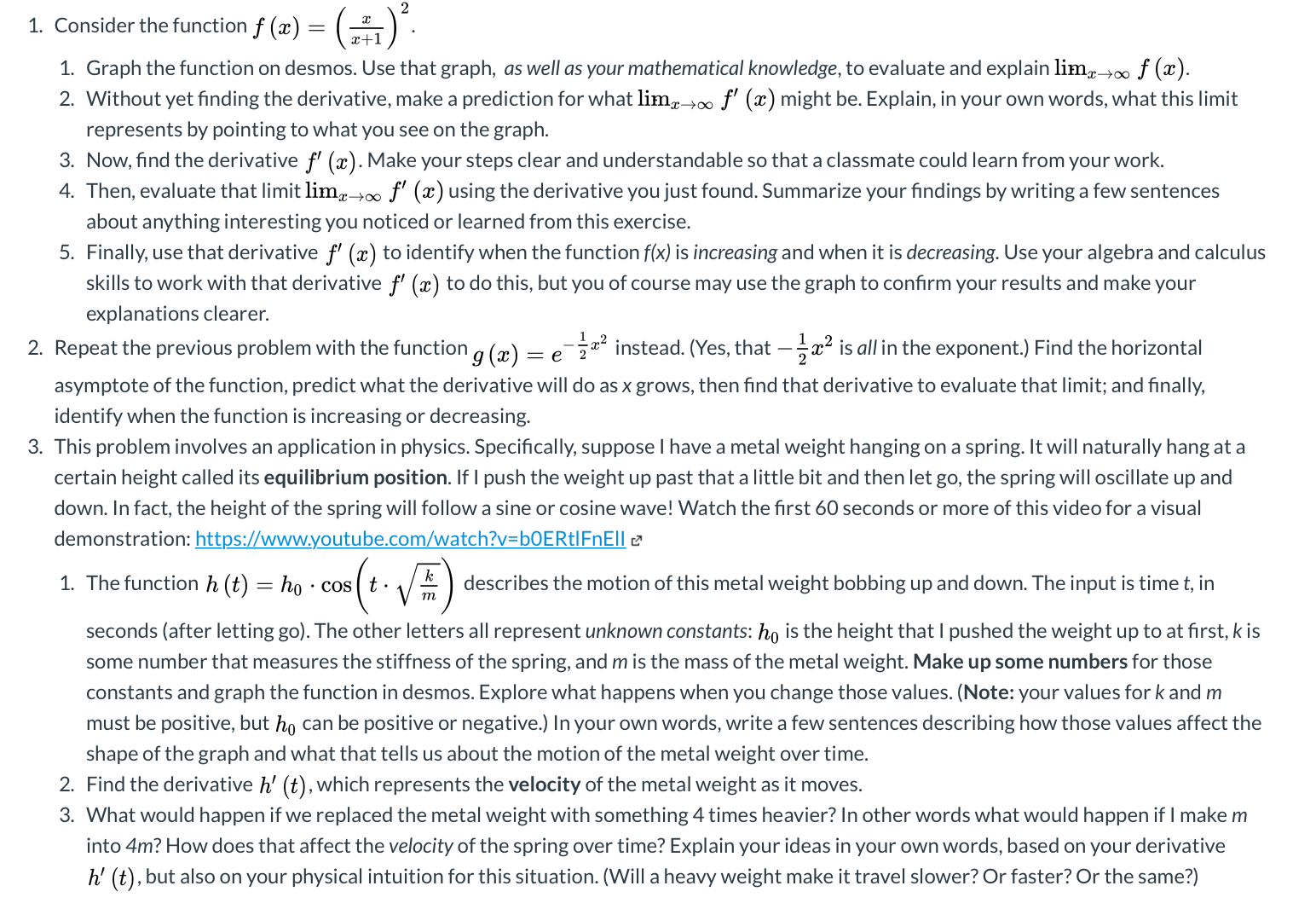
2 1. Considerthe function f(g;) : () _ 1. Graph the function on desmos. Use that graph, as well as your mathematical knowledge, to evaluate and explain limaHm f (3:). 2. Without yet nding the derivative, make a prediction for what 111111400 f' (3:) might be. Explain, in your own words, what this limit represents by pointing to what you see on the graph. Now, nd the derivative f' (3:) . Make your steps clear and understandable so that a classmate could learn from your work. 4. Then, evaluate that limit 11mm.mo f' (m) using the derivative you just found. Summarize your ndings by writing a few sentences about anything interesting you noticed or learned from this exercise. 5. Finally, use that derivative f' (as) to identify when the function fix) is increasingand when it is decreasing. Use your algebra and calculus skills to work with that derivative f' (:c) to do this, but you of course may use the graph to conrm your results and make your explanations clearer. 5-0 l 2 asymptote of the function, predict what the derivative will do as x grows, then nd that derivative to evaluate that limit; and nally, identify when the function is increasing or decreasing. 3. This problem involves an application in physics. Specically, suppose I have a metal weight hanging on a spring. It will naturally hang at a certain height called its equilibrium position. If I push the weight up past that a little bit and then let go, the spring will oscillate up and down. In fact, the height of the spring will follow a sine or cosine wave! Watch the rst 60 seconds or more of this video for a visual demonstration: mpSJ/wwwyoutu be.com/watch?v= bOE RtanEll r2- 2. Repeat the previous problem with the function g (2:) = 5%\"? instead. (Yes, that m2 is all in the exponent.) Find the horizontal 1. The function h (t) 2 ho - cos (:5 - 1 i%) describes the motion of this metal weight bobbing upand down. The input is time t, in seconds (after letting go). The other letters all represent unknown constants: ho is the height that I pushed the weight up to at rst, k is some number that measures the stiffness of the spring, and m is the mass of the metal weight. Make up some numbers for those constants and graph the function in desmos. Explore what happens when you change those values. (Note: your values for k and m must be positive, but he can be positive or negative.) In your own words, write a few sentences describing how those values affect the shape ofthe graph and what that tells us about the motion of the metal weight over time. 2. Find the derivative h' (t) , which represents the velocity of the metal weight as it moves. 3. What would happen if we replaced the metal weight with something 4 times heavier? In other words what would happen if I make m into 4m? How does that affect the velocity of the spring over time? Explain your ideas in your own words, based on your derivative h' (t), but also on your physical intuition for this situation. (Will a heavy weight make it travel slower? Or faster? Or the same?)
Step by Step Solution
There are 3 Steps involved in it

Get step-by-step solutions from verified subject matter experts
 Study Help