







Question: 4 Let. i = (1,0,0), j = (0, 1,0), and k = (0,0, 1). We can represent any vector in R as a unique linear
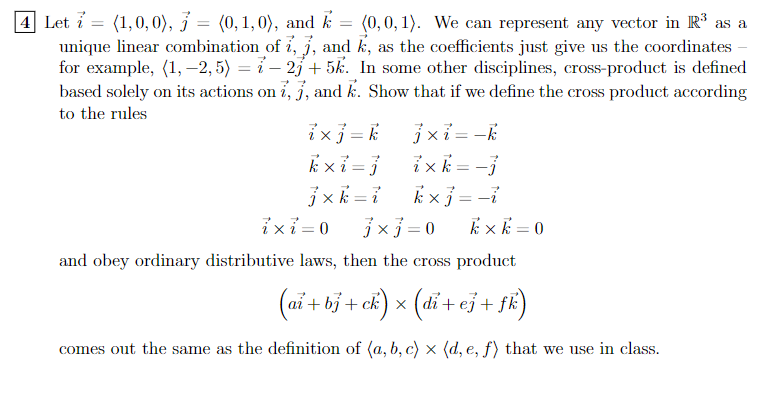
4 Let. i = (1,0,0), j = (0, 1,0), and k = (0,0, 1). We can represent any vector in R" as a unique linear combination of i, j, and k, as the coefficients just give us the coordinates for example, (1, -2,5) = 1 - 2j + 5k. In some other disciplines, cross-product, is defined based solely on its actions on i, , and k. Show that if we define the cross product according to the rules i xi = k j xi =-k kxi=j ixk=-j jxk=i kxj=-i ixi=0 jXi =0 k xk=0 and obey ordinary distributive laws, then the cross product (ait bitch x (di tej + fl) comes out the same as the definition of (a, b, c) x (d, e, f) that we use in class
Step by Step Solution
There are 3 Steps involved in it
1 Expert Approved Answer
Step: 1 Unlock

Question Has Been Solved by an Expert!
Get step-by-step solutions from verified subject matter experts
Step: 2 Unlock
Step: 3 Unlock
 Study Help