







Question: 4. Let X be a nonnegative, integer valued random variable. Since X is nonnegative and integer valued, we can assume that X is a
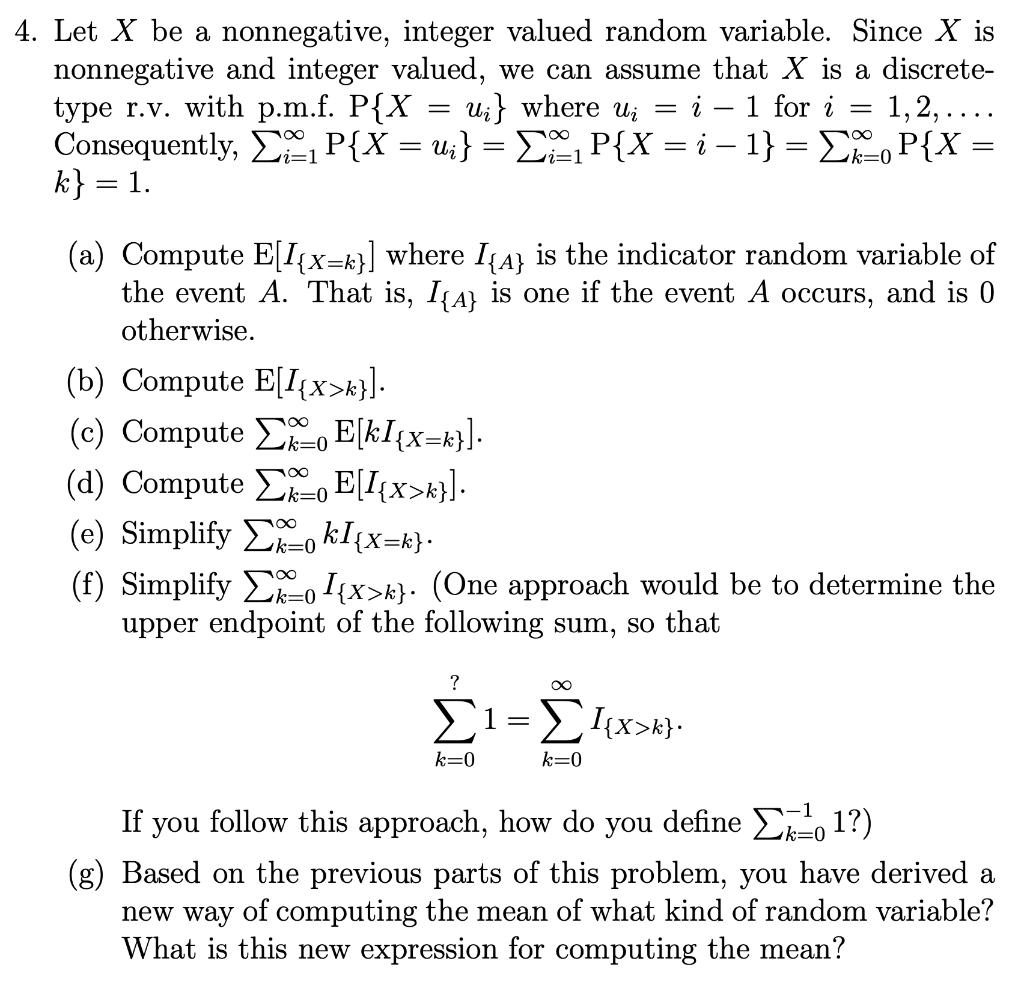
4. Let X be a nonnegative, integer valued random variable. Since X is nonnegative and integer valued, we can assume that X is a discrete- type r.v. with p.m.f. P{X = u} where ui Consequently, k} = 1. = i - 1 for i = 1, 2,.... k=0 i P{X = ui} = P{X = i 1} = P{X = i=1 (a) Compute E[I{x=k}] where I{A} is the indicator random variable of the event A. That is, I{^} is one if the event A occurs, and is 0 otherwise. (b) Compute E[I{x>k}]. (c) Compute0 E[kI{x=k}]. (d) Compute0 E[I{x>k}] (e) Simplify (f) Simplify =okI{x=k}. 01{x>k}. (One approach would be to determine the upper endpoint of the following sum, so that ? k=0 1 = I{x>k}* k=0 If you follow this approach, how do you define -101?) (g) Based on the previous parts of this problem, you have derived a new way of computing the mean of what kind of random variable? What is this new expression for computing the mean?
Step by Step Solution
There are 3 Steps involved in it

Get step-by-step solutions from verified subject matter experts
 Study Help