







Question: Let X(t) = cos(wt + theta) and Y(t) = sin(wt + theta), where theta is uniformly distributed in the interval (-pi, pi). (You may find
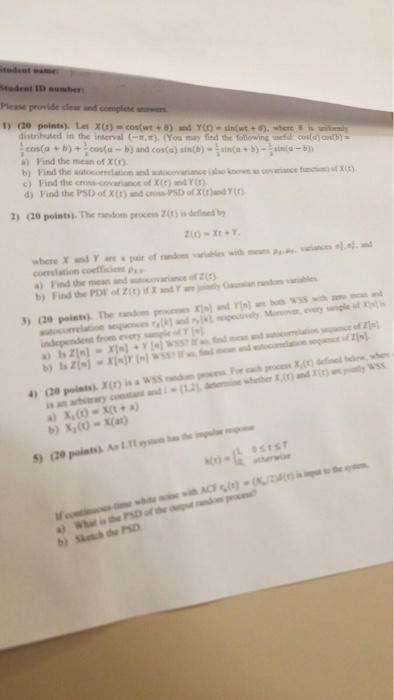
Let X(t) = cos(wt + theta) and Y(t) = sin(wt + theta), where theta is uniformly distributed in the interval (-pi, pi). (You may find the following useful. cos(a) cos(b) = 1/2 cos(a + b) + 1/2 cos (a - b) and cos(a) sin(b) = 1/2 sin (a + b) - 1/2 sin(a - b)) Find the mean of X(t). Find the autocorrelation and autocovariance (also known as covariance function) of X(t). Find the cross-covariance of X(t) and Y(t). Find the PSD of X(t) and cross-PSD of X(t) and Y(t) The random process z(t) is defined by Z(t) = Xt + Y. Where X and Y are a pair of random variables with means mu_x, mu_y, Variance and correlation coefficient rho_x, y. Find the mean and autocovariance of Z(t). Find the PDF of Z(t) if X and Y are jointly Gaussian random variables. The random processes Gamma(s) and Y[n] are both WSS with zero mean and autocorrelation sequences r_s [k] and r)t [k] respectively. Morover, every sample of x[x] is independend from every sample of Y[n] Is Z[n] = X[n] + Y[n] Wss If we, find mean and autocorrelation sequence of Z[n] Is Z[n] = X[n]Y + Y[n] Wss If we, find mean and autocorrelation sequence of Z[n] X(t) is a Wss random process. For each process X_i (t) defined below, where is an arbitrary constant and t = [1, 2], determine whether X_i (t) and X(t) are jointly Wss X_1 (t) = X(t + a) X_2 (t) = X(at) A I T1 system has the impulse response h(x) = {1 0 lessthanorequalto t lessthanorequalto T 0, otherwise If continous time white point with is input to the system What is the PSD of the output random process? Sketch the PSD. Let X(t) = cos(wt + theta) and Y(t) = sin(wt + theta), where theta is uniformly distributed in the interval (-pi, pi). (You may find the following useful. cos(a) cos(b) = 1/2 cos(a + b) + 1/2 cos (a - b) and cos(a) sin(b) = 1/2 sin (a + b) - 1/2 sin(a - b)) Find the mean of X(t). Find the autocorrelation and autocovariance (also known as covariance function) of X(t). Find the cross-covariance of X(t) and Y(t). Find the PSD of X(t) and cross-PSD of X(t) and Y(t) The random process z(t) is defined by Z(t) = Xt + Y. Where X and Y are a pair of random variables with means mu_x, mu_y, Variance and correlation coefficient rho_x, y. Find the mean and autocovariance of Z(t). Find the PDF of Z(t) if X and Y are jointly Gaussian random variables. The random processes Gamma(s) and Y[n] are both WSS with zero mean and autocorrelation sequences r_s [k] and r)t [k] respectively. Morover, every sample of x[x] is independend from every sample of Y[n] Is Z[n] = X[n] + Y[n] Wss If we, find mean and autocorrelation sequence of Z[n] Is Z[n] = X[n]Y + Y[n] Wss If we, find mean and autocorrelation sequence of Z[n] X(t) is a Wss random process. For each process X_i (t) defined below, where is an arbitrary constant and t = [1, 2], determine whether X_i (t) and X(t) are jointly Wss X_1 (t) = X(t + a) X_2 (t) = X(at) A I T1 system has the impulse response h(x) = {1 0 lessthanorequalto t lessthanorequalto T 0, otherwise If continous time white point with is input to the system What is the PSD of the output random process? Sketch the PSD
Step by Step Solution
There are 3 Steps involved in it

Get step-by-step solutions from verified subject matter experts
 Study Help