







Question: 4. Methodology The regression model used in this study was similar to the one used by Petersen [5], [6] with some modifications. The regression used

4. Methodology
The regression model used in this study was similar to the one used by Petersen [5], [6] with some modifications. The regression used in this study includes the major independent variables that were used in Petersen's regression. Because of the nature of our data sample, the regression model in this study was changed to include a few more publication location variables: Canada, Australia, and Asia. The circulation variable was not included in Petersen's earlier study but was viewed as a factor that affects subscription prices and tested as an observed variable in regressions in Petersen's latter study [7] and in Chressanthis and Chressanthis' 1994 study. [8] The results were inconclusive. While Petersen found that there was an inverse relationship between the circulation and subscription prices, Chressanthis and Chressanthis concluded that the circulation variable was only marginally significant. Noll and Steinmueller specifically examined this issue. They plotted the circulation against subscription prices and found that economies of scale exist: the larger the circulation of a journal is, the lower the subscription price. In our preliminary testing of the regression model with circulation as an observed variable in this study, it was found that the coefficient of the circulation variable was not statistically significant. The total number of journal titles in the regression equation was 305 (out of the total 386 titles in our data sample) since 81 titles did not have circulation data. Most of journals with missing circulation data were big foreign commercial publishers that do not release their circulation data to the general public. The author personally had a number of telephone interviews with a number of publishers and tried to get the circulation data. The author was told that the circulation data could not be released to the general public. Noll and Steinmueller also reported difficulties in finding circulation data from foreign publishers for their analyses. [4](p. 37) If the circulation variable had been included in our final regression analysis, the total number of titles in the data sample would have been reduced to 305 from 386. It may have produced biased estimates for other observed variables. For example, average subscription prices of journals would be lower since many high priced journals would have been excluded from the calculation due to the missing circulation data. For the above reasons, the circulation variable was excluded in our final regression model. But the preliminary regression results provide some evidence that, at least for the sample of the 305 business journals, journals with larger circulations do not necessarily have lower subscription prices. Individual subscription prices were not considered as a factor in our study for at least two reasons. First, data on this variable were not available for most of 386 business journals. Therefore, it would not be accurate to estimate the effect of individual subscription prices on library subscription prices with a large amount of missing data. Second, this kind of analysis would be more valid if time-series data were utilized to examine how the individual demand for journals changes overtime as a result of the changes in individual subscription prices. The use of a one-year subscription price as Chressanthis and Chressanthis did in their study could hardly prove that an increase in demand for journals subscribed by libraries is the result of a decrease in the demand for individual subscriptions. And therefore, it can hardly justify that higher library subscription prices are the result of higher individual subscription prices. The positive correlation between library subscription prices and individual subscription prices found in Chressanthis Chressanthis' 1992 study could simply be the fact that the costs of producing, marketing, and distributing certain journals are higher. Therefore, the publishers of those journals would charge higher subscription prices from both individuals and libraries. Unlike the prices of some goods and services, we consume daily that may change daily, monthly, or quarterly. Subscription prices are set annually. In general, they do not change during a year once the price has been set. To observe the effect of a journal price increase, one needs to look at the change in journal prices in one year and the change in journal subscriptions in the subsequent year or years. Such a longitudinal study, while strongly encouraged, is beyond the scope of our study. The impact factor was also used in Petersen [7] and Chressanthis and Chressanthis' [8] studies on economics journals. The hypothesis is that in general subscription prices of higher quality journals as measured by citation rankings are higher despite some exceptions such as American Economic Review, which is among the most prestigious journal in economics, but costs much less than other lower ranking journals (it only costs a library $240 per year in 2004). Petersen found that the impact factor was statistically significant (on a one-tail test). Chressanthis and Chressanthis found that the impact factor was not significant. Despite the inconclusive findings on the effect of the impact factor, there is a practical problem in using this variable in business discipline. There are uniform ranking mechanisms for a single subject area such as economics, accounting, etc., but there is no uniform ranking systems for business discipline as a whole and it is quite understandable since each subject area in business has its own body of knowledge and criteria for evaluating the quality of its journals. For the purpose of this study, which covers the entire business discipline, we did not include the impact factor in our regression analysis. In this study, we examine what factors affect subscription prices charged by publishers for libraries and other institutions. Subscription prices are the dependent variable in the regression model. Total number of issues published per year (ISSYR) is an independent variable. It is hypothesized that the more issues published in a year, the more costly a journal is because more labor and materials are used. The age of a journal (AGE) is an independent variable and measures how long a journal has been established. It is hypothesized that the older the journal is, the more costly it is because the age of a journal can be positively related to the reputation of the journal. It normally takes a long time for journals to build their reputation. A number of dummy variables were created and used in the regression. Dummy variables are separate dichotomous variables. They are often used to capture certain qualitative effects. Commercial publishers (COM), advertisement in a journal (ADV), illustrations (ILLS), and publishing places such as the UK (UK), Europe (EURO), Canada (CANA), Australia (ASTR), and Asia (ASIA) were treated as dummy variables. Australia by geographical definition is located in Asia but because of Australia's economic system differs from those in other Asian countries; the distinction was made using two separate dummy variables. COM is the dummy variable for commercial publishers. It is hypothesized that commercial publishers charge higher prices than do nonprofit publishers. The use of dummy variable differentiates commercial publishers from nonprofit publishers. If a publisher is a commercial publisher, then 1 is coded. If a publisher is a nonprofit organization such as an association, society, university press, foundation, and educational center, then 0 is coded. ADV is the dummy variable for advertisement. It is hypothesized that advertisement will bring in revenues to journals so it can reduce journal prices. If advertisements appear in a journal, then 1 is coded. If no advertisement is placed in a journal, 0 is coded. ILLS is the dummy variable for illustrations. It is hypothesized that it takes more labor and time to do illustrations in a journal. They increase costs and therefore subscription prices. It is also assumed that the publication locations make a difference in terms of prices because currency exchange rates differ from country to country and they fluctuate daily. The shipping of journals from other countries also incurs additional costs and they are eventually passed on to subscribers. The dummy variables representing various publication locations are UK for the UK, EURO for Europe, CANA for Canada, ASSTR for Australia, and ASIA for Asia. The following is the regression model:
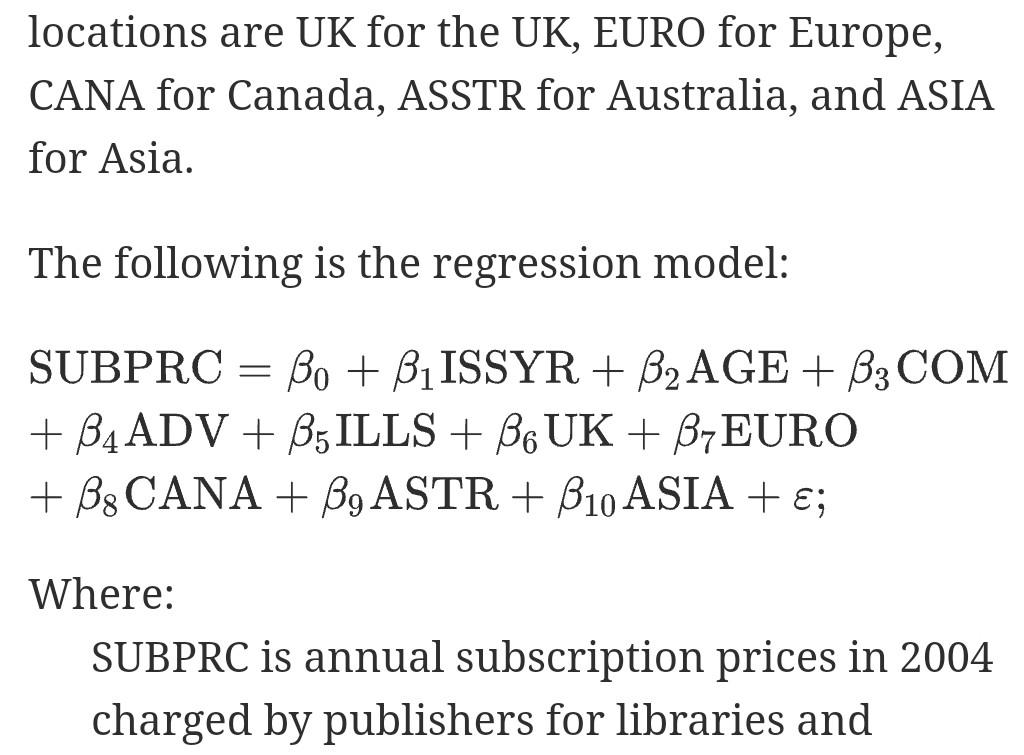
Where:
SUBPRC is annual subscription prices in 2004 charged by publishers for libraries and institutions. It is the dependent variable.
ISSYR is the total number of issues published in one year.
AGE is the total number of years since the journal was established.
COM is the dummy variable for commercial publishers.
ADV is the dummy variable for advertisement.
ILLS is the dummy variable for illustrations.
UK is the dummy variable for journals published in the U.K.
EURO is the dummy variable for journals published in Europe.
ASTRA is the dummy variable for journals published in Australia.
CANA the dummy variable for journals published in Canada.
ASIA is the dummy variable for journals published in Asia.
Step by Step Solution
There are 3 Steps involved in it

Get step-by-step solutions from verified subject matter experts
 Study Help