



Question: YOU HAVE TO READ THE ARTICLE TO RESPOND. DO NOT GOOGLE. ARTICLE: 1. Introduction Libraries have been struggling with price increases in scholarly journals for

YOU HAVE TO READ THE ARTICLE TO RESPOND. DO NOT GOOGLE.
ARTICLE:
1. Introduction
Libraries have been struggling with price increases in scholarly journals for about 15 years or so. The subscription costs started escalating dramatically in the past decade, and have been spiraling out of control in recent years. On the one hand, many libraries' budgets have been at least static and in many cases they are declining when inflation is taken into account. On the other hand, journal subscription prices have been increasing year after year at a much higher rate than that of inflation and the costs of producing, distributing, and marketing these journals. Although journals in some disciplines such as the sciences, technology, and medicine have much higher subscription costs and commercial publishers tend to charge higher prices, such price escalation has been spreading into many other disciplines. As a result of not being able to keep up with price increases, libraries have no choices but cut some of their journal subscriptions to protect their core journal collections. This practice has seriously undermined academic libraries' ability to support their faculty's scholarly research. Many authors call it library crisis, the crisis in scholarly publishing, and dysfunction of the scholarly communications system. In recent years, this crisis issue has been complicated by the emergence of full text databases such as Academic Search Premier that covers a variety of academic subjects, Business Source Premier that covers business subject, and an array of full text electronic journal products such as EBOSCO. While they provide additional values to library services and library users can access full text articles from their workplaces, home, or anywhere where they have Internet access at almost any time, they all are limited in terms of time periods and subjects covered. For example, Business Source Premier covers over 2000 periodicals in business but many of the full text articles are limited to the most recent years. In some cases, libraries choose to maintain print subscriptions of certain journals in order to have their electronic counterparts through full text journal services. Another important issue is the ownership of journals. Libraries own the print journals to which they subscribe, and many academic libraries have been accumulating these print journals since their inception. Libraries' journals constitute a valuable collection for research and teaching. But the same cannot be said for subscribed databases that only provide libraries access rights. What libraries can access and how much they can access depend on how much libraries are willing to pay. Without the ownership of full text databases, libraries put themselves in the mercy of publishers who want to make sure that libraries pay maximum prices. Given these limitations, almost all academic research libraries have not canceled their print journal collections simply because some of them can be accessed through full text databases and electronic journal services. In terms of costs, some large academic research libraries may have to pay for these full text databases and services in addition to paying print journals because these full text databases and services provide their clients with more convenience of accessing full text articles than do print journals and because they are not yet willing to give up the ownership of their journal collections. Some small libraries with limited resources may choose to cancel some of their print journals since many journals are available from these full text databases and e-journal services but this has not become a widespread common practice yet among large academic libraries. The issue of costs of print journals is still a major concern of academic libraries since large part of their libraries budgets is still consumed by journal subscriptions. The Scholarly Publishing and Academic Resources Coalition (SPARC) has emerged to deal with the dysfunctional scholarly publishing market. Its goal is helping to create systems that expand information dissemination and use in a networked digital environment while responding to the needs of scholars and academe and aims to introduce top-quality STM journals at a significantly lower price than those currently available. Ultimately, SPARC-endorsed journals give libraries the opportunity to more than offset their costs with reductions in the number of high-priced journals to which they subscribe. SPARC has over 300 members in North America, Asia, and Europe. While SPARC helps stimulate competition in the market by nurturing high-quality, low-cost journals published by researchers, societies or publishers with scientist- and library-friendly values and practices and certainly helps to alleviate library crisis, commercial publishers still dominate large portion of scholarly journals.
2. Literature review
Libraries have long suspected that commercial publishers reap monopolistic profits. Libraries initiated and sponsored studies on costs and prices of journals published by commercial publishers as early as 15 years ago and called for more competition in the scholarly publishing area and reforming the current scholarly publishing system. Individual library and information science researchers and economists have also participated in serious research inquiry into the determinants of prices and costs of scholarly journals. A body of literature on the economics of scholarly publishing has emerged as a result of continuous research efforts. While much of the literature is characterized by descriptive reports, a few studies are empirical economic analyses. In 1989, the Association of Research Libraries contracted Economic Consulting Services, Inc. to study four commercial publishers in four different countries including the UK, Netherlands, West Germany, and the U.S. They examined costs associated with editing labor, typesetting, paper, postage, and factors associated with prices including size of journal, subject matter, exchange rate fluctuations, and circulation. [1, p. 8] The findings showed that journal prices increased at a faster rate than journal costs and seemed to confirm librarians' suspicions. Following this study, a number of other studies on journals in specific subject areas using a variety of research methodologies were conducted by both library science researchers and economists. In fact, the research concern about costs of scientific journals can be traced back to at least 1981 when Donald W. King and others examined the cost structure of scientific journal publishing. [2] In 1997, Carol Tenopir and Donald W. King [3] examined scholarly publishing trends in the U.S. between 1975 and 1995 in nine fields including physical sciences, math and statistics, computer sciences, environmental sciences, engineering, life sciences, psychology, social sciences, and other fields/multi-fields and different types of publishers such as commercial, society, educational, and others. They analyzed average direct and indirect cost factors related to the first copy of an article, reproduction and distribution, circulation, and other factors affecting journal prices. They found that with inflation, increases in the size of journals, costs of labor, printing equipment, and paper accounted for some increases in journal prices, the majority of the remaining increases are attributable to pricing policies of commercial publishers.... [3, p. 152] The journal crisis has also drawn the research attention from academic economists. Roger Noll and W. Edward Steinmueller studied scientific journal prices. [4] They specifically looked at the relationship between the prices of journals and paid circulation. They observed that there was an inverse relationship between the journal prices and circulation. Journals with larger circulations tend to have lower subscription prices. They also explained the reason for increases in journal subscription prices. The demand from academic faculties for publishing created an array of secondary specialized journals that were almost certain to have low circulations given limited readership interest in the narrow topics they covered. The low circulation drove up average costs of these journals. Another economist, H. Craig Petersen, used regression analysis to study the factors that affect journal prices for 439 randomly selected journals in a variety of academic fields.[5], [6] Dummy variables were used to differentiate publication locations and types of publishers. He used the similar regression model for about 81 top economic journals in 1992. [7] The findings showed that a variety of variables affect journal prices including locations of publication, types of publishers, frequency of publication, and page numbers of journals. Journals published in Europe had higher prices than those published in the U.S.; journals with more publication frequency and number of pages were charged with higher prices; commercial publishers charged more than did associations and university publishers. Chressanthis and Chressanthis modified Petersen's model by adding individual subscription prices to the regression equation for the top 99 economic journals. [8] It was assumed that there was an inverse relationship between individual subscription prices and the demand for journals. When individual subscription prices increase, individuals would be likely to cancel the subscriptions and expect libraries to buy journals for them. If libraries are not able to keep up with such individual demand given their budget constraints, total circulation (demanded by both libraries and individuals) would fall. A decrease in individual journal circulation would lead to an increase in library subscription prices. Most of their regression results were also consistent with the previous research assumptions that publications locations, quality of journals, age of journals, and number of pages are the important determinants of journal prices. But frequency of publication and advertisement in journals variables were not statistically significant and the coefficient of the circulation variable was only marginally significant at the 0.10 level for one-tailed test in four regression models and barely statistically significant at the 0.05 level in another model. [8, p. 378] Richard E. Quandt reviewed and analyzed the issue in a larger macroeconomic context [9, pp. 349375] and provided a simulation model for journal subscription by libraries. [10, pp. 610617] Previous empirical research has covered a number of disciplines including the sciences, technology, and math, economics, engineering and computer science, statistics, psychology, and the social sciences. None of them covered business discipline. This paper argues that journal prices vary by discipline. Science journal prices, for example, are much higher than those of social sciences. This is because the demand for timely research results is greater in these areas. The costs of producing, distributing, and marketing journals in these disciplines are higher. The average price in 2004 per title for top 10 scientific, engineering, math and computer science disciplines ranges from $1048 to $2695, the highest among all the disciplines while the average price per title in general works, music, language, and literature is only around $100. [11, pp. 56] Grouping all the disciplines together would result in a tremendous bias in estimating journal prices. The best approach for estimating journal prices should be by discipline. Petersen [7] and Chressanthis and Chressanthis [8] singled out economic journals as the focus of their investigation. It is important to differentiate business journals from journals in other disciplines since the determinants of business journal prices may differ from those in other disciplines.
3. This study
This study examines scholarly journals in business discipline, including areas of accounting, finance, marketing, management, international business, real estate, industries, business law, entrepreneurship, insurance, and many interdisciplinary business areas. In general, economics journals that deal with only economics topics were not included since they had been covered by previous studies. But economics journals that crisscrossed with other business areas such as economics and business, economics and law, economics and technologies, economics and industries, economics and management, and economics and finance were included in this study.
4. Methodology
The regression model used in this study was similar to the one used by Petersen [5], [6] with some modifications. The regression used in this study includes the major independent variables that were used in Petersen's regression. Because of the nature of our data sample, the regression model in this study was changed to include a few more publication location variables: Canada, Australia, and Asia. The circulation variable was not included in Petersen's earlier study but was viewed as a factor that affects subscription prices and tested as an observed variable in regressions in Petersen's latter study [7] and in Chressanthis and Chressanthis' 1994 study. [8] The results were inconclusive. While Petersen found that there was an inverse relationship between the circulation and subscription prices, Chressanthis and Chressanthis concluded that the circulation variable was only marginally significant. Noll and Steinmueller specifically examined this issue. They plotted the circulation against subscription prices and found that economies of scale exist: the larger the circulation of a journal is, the lower the subscription price. In our preliminary testing of the regression model with circulation as an observed variable in this study, it was found that the coefficient of the circulation variable was not statistically significant. The total number of journal titles in the regression equation was 305 (out of the total 386 titles in our data sample) since 81 titles did not have circulation data. Most of journals with missing circulation data were big foreign commercial publishers that do not release their circulation data to the general public. The author personally had a number of telephone interviews with a number of publishers and tried to get the circulation data. The author was told that the circulation data could not be released to the general public. Noll and Steinmueller also reported difficulties in finding circulation data from foreign publishers for their analyses. [4](p. 37) If the circulation variable had been included in our final regression analysis, the total number of titles in the data sample would have been reduced to 305 from 386. It may have produced biased estimates for other observed variables. For example, average subscription prices of journals would be lower since many high priced journals would have been excluded from the calculation due to the missing circulation data. For the above reasons, the circulation variable was excluded in our final regression model. But the preliminary regression results provide some evidence that, at least for the sample of the 305 business journals, journals with larger circulations do not necessarily have lower subscription prices. Individual subscription prices were not considered as a factor in our study for at least two reasons. First, data on this variable were not available for most of 386 business journals. Therefore, it would not be accurate to estimate the effect of individual subscription prices on library subscription prices with a large amount of missing data. Second, this kind of analysis would be more valid if time-series data were utilized to examine how the individual demand for journals changes overtime as a result of the changes in individual subscription prices. The use of a one-year subscription price as Chressanthis and Chressanthis did in their study could hardly prove that an increase in demand for journals subscribed by libraries is the result of a decrease in the demand for individual subscriptions. And therefore, it can hardly justify that higher library subscription prices are the result of higher individual subscription prices. The positive correlation between library subscription prices and individual subscription prices found in Chressanthis Chressanthis' 1992 study could simply be the fact that the costs of producing, marketing, and distributing certain journals are higher. Therefore, the publishers of those journals would charge higher subscription prices from both individuals and libraries. Unlike the prices of some goods and services, we consume daily that may change daily, monthly, or quarterly. Subscription prices are set annually. In general, they do not change during a year once the price has been set. To observe the effect of a journal price increase, one needs to look at the change in journal prices in one year and the change in journal subscriptions in the subsequent year or years. Such a longitudinal study, while strongly encouraged, is beyond the scope of our study. The impact factor was also used in Petersen [7] and Chressanthis and Chressanthis' [8] studies on economics journals. The hypothesis is that in general subscription prices of higher quality journals as measured by citation rankings are higher despite some exceptions such as American Economic Review, which is among the most prestigious journal in economics, but costs much less than other lower ranking journals (it only costs a library $240 per year in 2004). Petersen found that the impact factor was statistically significant (on a one-tail test). Chressanthis and Chressanthis found that the impact factor was not significant. Despite the inconclusive findings on the effect of the impact factor, there is a practical problem in using this variable in business discipline. There are uniform ranking mechanisms for a single subject area such as economics, accounting, etc., but there is no uniform ranking systems for business discipline as a whole and it is quite understandable since each subject area in business has its own body of knowledge and criteria for evaluating the quality of its journals. For the purpose of this study, which covers the entire business discipline, we did not include the impact factor in our regression analysis. In this study, we examine what factors affect subscription prices charged by publishers for libraries and other institutions. Subscription prices are the dependent variable in the regression model. Total number of issues published per year (ISSYR) is an independent variable. It is hypothesized that the more issues published in a year, the more costly a journal is because more labor and materials are used. The age of a journal (AGE) is an independent variable and measures how long a journal has been established. It is hypothesized that the older the journal is, the more costly it is because the age of a journal can be positively related to the reputation of the journal. It normally takes a long time for journals to build their reputation. A number of dummy variables were created and used in the regression. Dummy variables are separate dichotomous variables. They are often used to capture certain qualitative effects. Commercial publishers (COM), advertisement in a journal (ADV), illustrations (ILLS), and publishing places such as the UK (UK), Europe (EURO), Canada (CANA), Australia (ASTR), and Asia (ASIA) were treated as dummy variables. Australia by geographical definition is located in Asia but because of Australia's economic system differs from those in other Asian countries; the distinction was made using two separate dummy variables. COM is the dummy variable for commercial publishers. It is hypothesized that commercial publishers charge higher prices than do nonprofit publishers. The use of dummy variable differentiates commercial publishers from nonprofit publishers. If a publisher is a commercial publisher, then 1 is coded. If a publisher is a nonprofit organization such as an association, society, university press, foundation, and educational center, then 0 is coded. ADV is the dummy variable for advertisement. It is hypothesized that advertisement will bring in revenues to journals so it can reduce journal prices. If advertisements appear in a journal, then 1 is coded. If no advertisement is placed in a journal, 0 is coded. ILLS is the dummy variable for illustrations. It is hypothesized that it takes more labor and time to do illustrations in a journal. They increase costs and therefore subscription prices. It is also assumed that the publication locations make a difference in terms of prices because currency exchange rates differ from country to country and they fluctuate daily. The shipping of journals from other countries also incurs additional costs and they are eventually passed on to subscribers. The dummy variables representing various publication locations are UK for the UK, EURO for Europe, CANA for Canada, ASSTR for Australia, and ASIA for Asia. The following is the regression model:SUBPRC=0+1ISSYR+2AGE+3COM+4ADV+5ILLS+6UK+7EURO+8CANA+9ASTR+10ASIA+;Where: SUBPRC is annual subscription prices in 2004 charged by publishers for libraries and institutions. It is the dependent variable. ISSYR is the total number of issues published in one year. AGE is the total number of years since the journal was established. COM is the dummy variable for commercial publishers. ADV is the dummy variable for advertisement. ILLS is the dummy variable for illustrations. UK is the dummy variable for journals published in the U.K. EURO is the dummy variable for journals published in Europe. ASTRA is the dummy variable for journals published in Australia. CANA the dummy variable for journals published in Canada. ASIA is the dummy variable for journals published in Asia.
5. Data collection
The ABI Inform/Global journal listing was used as a master list. ABI Inform Global is a comprehensive electronic index for business periodicals. It covers over 1000 business journals, magazines, and newspapers. Magazines, newspapers, and trade journals that are not scholarly were excluded. Pure economics journals that deal with only economics topics were excluded since the previous studies covered that area. The titles of journals from this list were entered into Ulrichweb.com (Ulrich's online database) to find data on circulation, number of issue published, types of publishers, age of journals, advertisement, illustration, publication location, and subscription prices. Since Ulrich's online database does not have all the data on all the variables and subscription prices for some journals are not up to date (2004), additional efforts were made to search publishers' Web sites and use original print journals to obtain updated information on types of publishers, subscription prices, and circulation. A total of 386 journals were eventually used in this study.
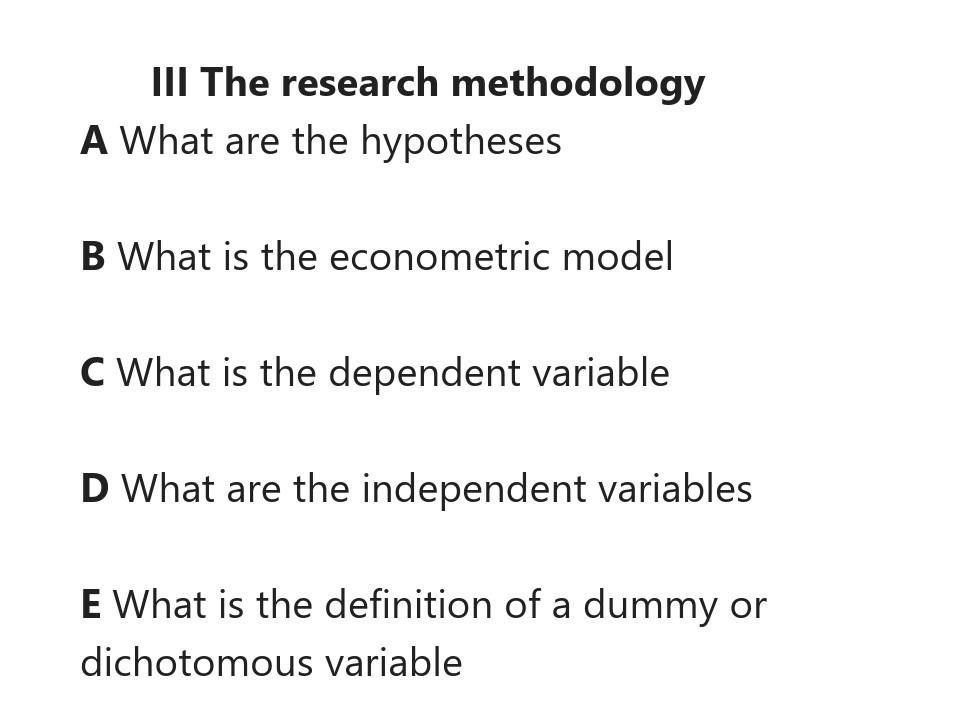
Instructions: All the answers must be from the following article. Do not copy and paste from other sources since they are too general to be useful. Place your answers under each question so you do not lose track of them. III The research methodology A What are the hypotheses B What is the econometric model C What is the dependent variable D What are the independent variables E What is the definition of a dummy or dichotomous variableStep by Step Solution
There are 3 Steps involved in it

Get step-by-step solutions from verified subject matter experts