







Question: 4. (Modified from Problem 9.108 from the textbook) Let Y7, --- .Y, L Exp(#) where 8 > 0 is an unknown parameter. For a fixed

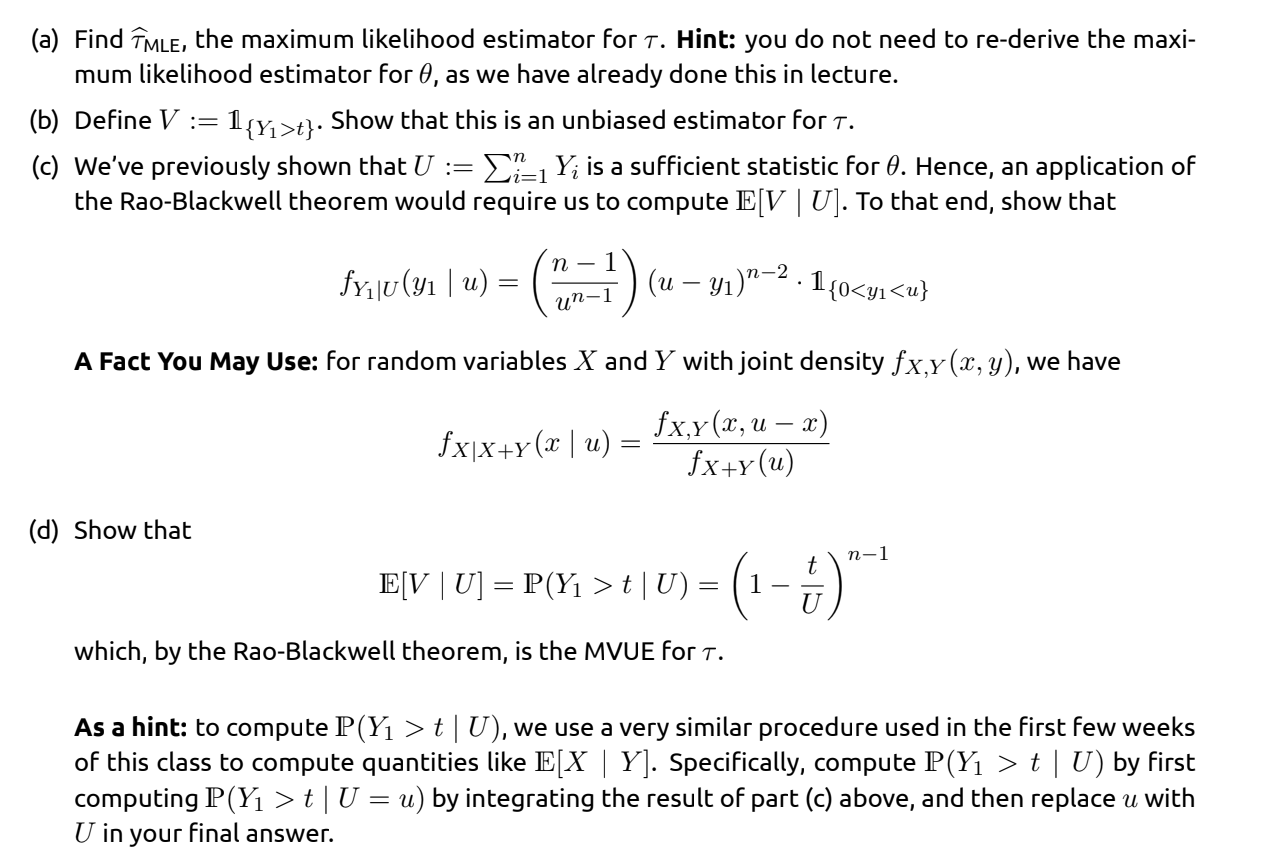
4. (Modified from Problem 9.108 from the textbook) Let Y7, --- .Y, L Exp(#) where 8 > 0 is an unknown parameter. For a fixed value , define the parameter 7 as 7 := /, (a) Find TmLe, the maximum likelihood estimator for 7. Hint: you do not need to re-derive the maxi- (b (c ) ) mum likelihood estimator for f, as we have already done this in lecture. Define V' := 1y, -4). Show that this is an unbiased estimator for 7. We've previously shown that U := > , Y] is a sufficient statistic for . Hence, an application of the Rao-Blackwell theorem would require us to compute E[V | U]. To that end, show that n1 _ fy1|U(?Jl | u) = (u\"_l) (uy1)" 2. L{0
Step by Step Solution
There are 3 Steps involved in it

Get step-by-step solutions from verified subject matter experts
 Study Help