







Question: 4. Next, you need repeat the experiment with the incident angle at 25 degree, 35, and 55 degree. You need find the respective refraction angle
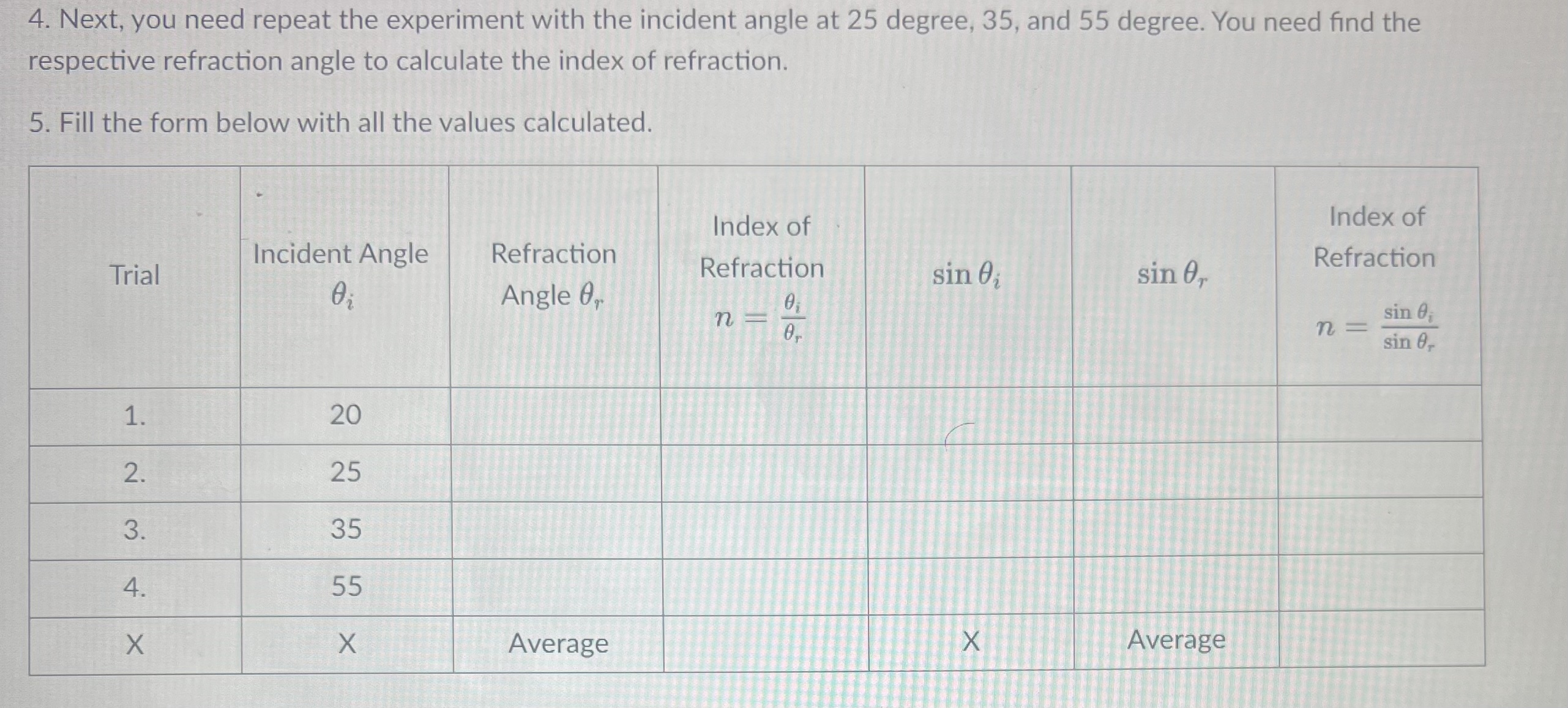
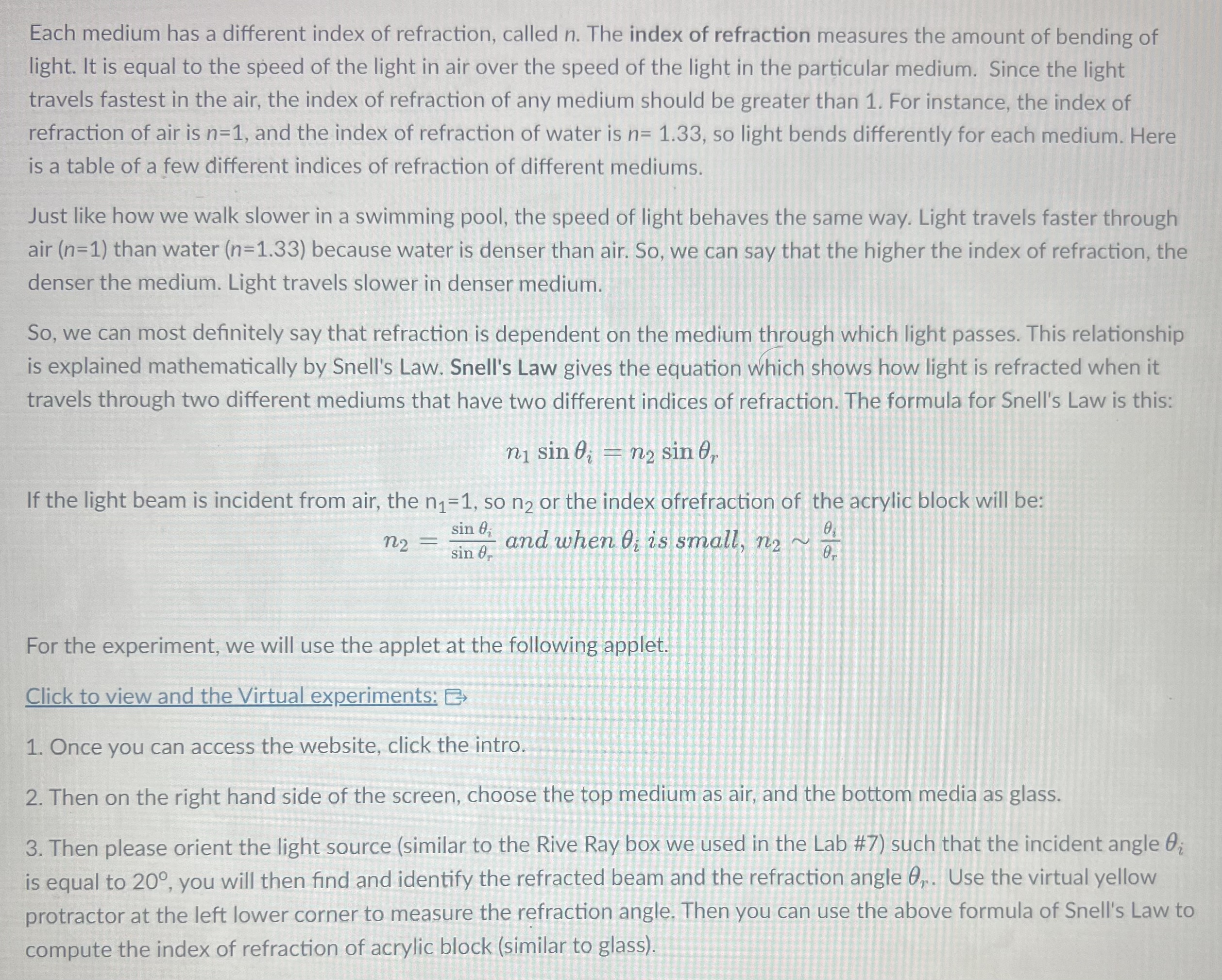
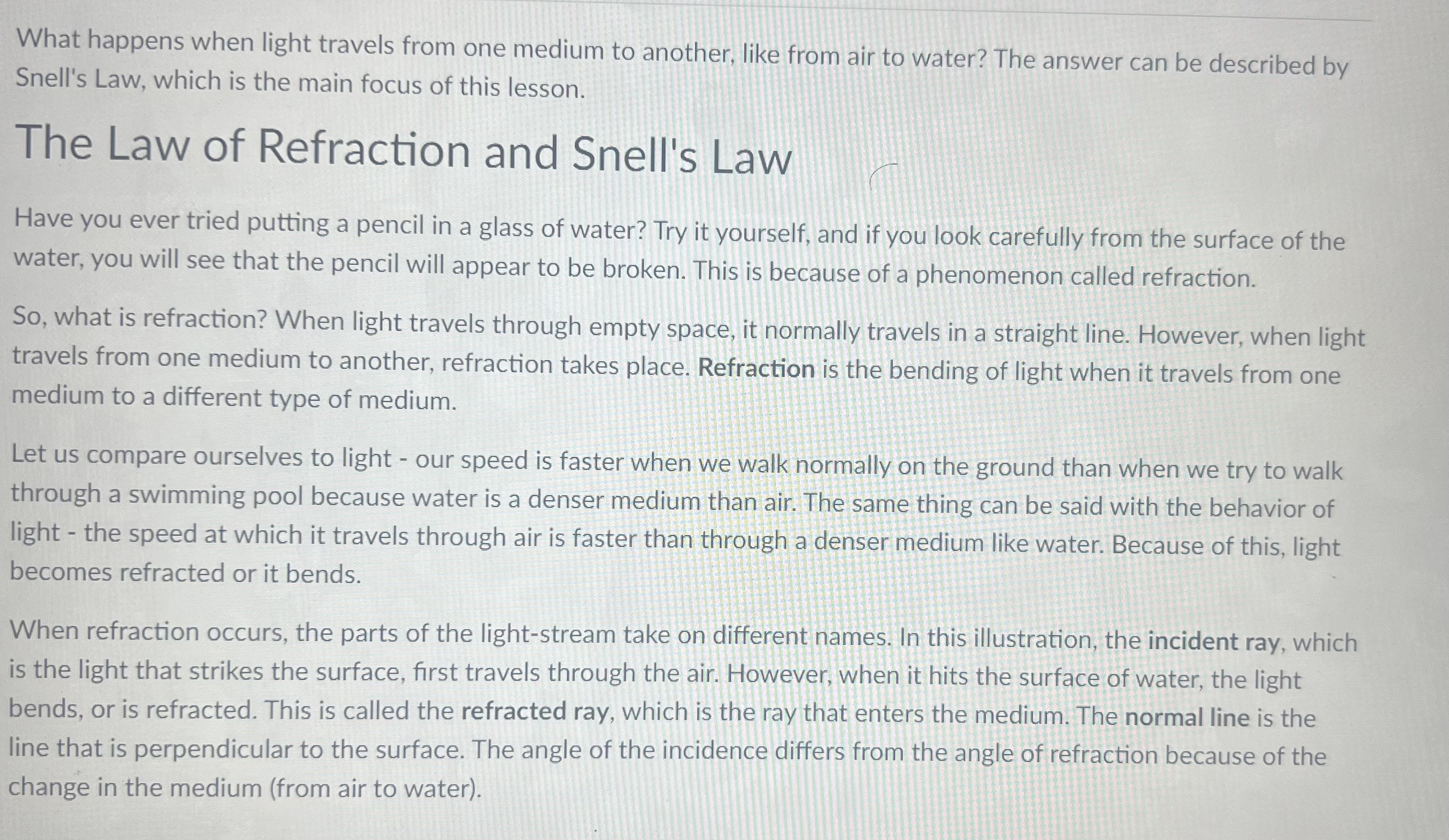
4. Next, you need repeat the experiment with the incident angle at 25 degree, 35, and 55 degree. You need find the respective refraction angle to calculate the index of refraction. 5. Fill the form below with all the values calculated. Index of Index of Incident Angle Refraction Refraction Trial Refraction sin Oi sin 0, Angle Of n sin 0, n = sin Or 1. 20 2. 25 3. 35 4. 55 X X Average X AverageEach medium has a different index of refraction, called n. The index of refraction measures the amount of bending of light. It is equal to the speed of the light in air over the speed of the light in the particular medium. Since the light travels fastest in the air, the index of refraction of any medium should be greater than 1. For instance, the index of refraction of air is n=1, and the index of refraction of water is n= 1.33, so light bends differently for each medium. Here is a table of a few different indices of refraction of different mediums. Just like how we walk slower in a swimming pool, the speed of light behaves the same way. Light travels faster through air (n=1) than water (n=1.33) because water is denser than air. So, we can say that the higher the index of refraction, the denser the medium. Light travels slower in denser medium. So, we can most definitely say that refraction is dependent on the medium through which light passes. This relationship is explained mathematically by Snell's Law. Snell's Law gives the equation which shows how light is refracted when it travels through two different mediums that have two different indices of refraction. The formula for Snell's Law is this: ni sin 0 # n2 sin 0, If the light beam is incident from air, the n1=1, so n2 or the index ofrefraction of the acrylic block will be: n2 sin 02 sin OF and when 0 is small, n2 0, For the experiment, we will use the applet at the following applet. Click to view and the Virtual experiments: 1. Once you can access the website, click the intro. 2. Then on the right hand side of the screen, choose the top medium as air, and the bottom media as glass. 3. Then please orient the light source (similar to the Rive Ray box we used in the Lab #7) such that the incident angle Oi is equal to 20, you will then find and identify the refracted beam and the refraction angle 0,. Use the virtual yellow protractor at the left lower corner to measure the refraction angle. Then you can use the above formula of Snell's Law to compute the index of refraction of acrylic block (similar to glass).What happens when light travels from one medium to another, like from air to water? The answer can be described by Snell's Law, which is the main focus of this lesson. The Law of Refraction and Snell's Law Have you ever tried putting a pencil in a glass of water? Try it yourself, and if you look carefully from the surface of the water, you will see that the pencil will appear to be broken. This is because of a phenomenon called refraction. So, what is refraction? When light travels through empty space, it normally travels in a straight line. However, when light travels from one medium to another, refraction takes place. Refraction is the bending of light when it travels from one medium to a different type of medium. Let us compare ourselves to light - our speed is faster when we walk normally on the ground than when we try to walk through a swimming pool because water is a denser medium than air. The same thing can be said with the behavior of light - the speed at which it travels through air is faster than through a denser medium like water. Because of this, light becomes refracted or it bends. When refraction occurs, the parts of the light-stream take on different names. In this illustration, the incident ray, which is the light that strikes the surface, first travels through the air. However, when it hits the surface of water, the light bends, or is refracted. This is called the refracted ray, which is the ray that enters the medium. The normal line is the line that is perpendicular to the surface. The angle of the incidence differs from the angle of refraction because of the change in the medium (from air to water)
Step by Step Solution
There are 3 Steps involved in it

Get step-by-step solutions from verified subject matter experts
 Study Help