







Question: [4 parts] Given: Consider two different implementations, M1 and M2 of the same instruction set. Each machine has a processor with a 4 GHz clock
![[4 parts] Given: Consider two different implementations, M1 and M2 of](https://dsd5zvtm8ll6.cloudfront.net/si.experts.images/questions/2024/09/66f4f49473f63_42766f4f493ea8d6.jpg)
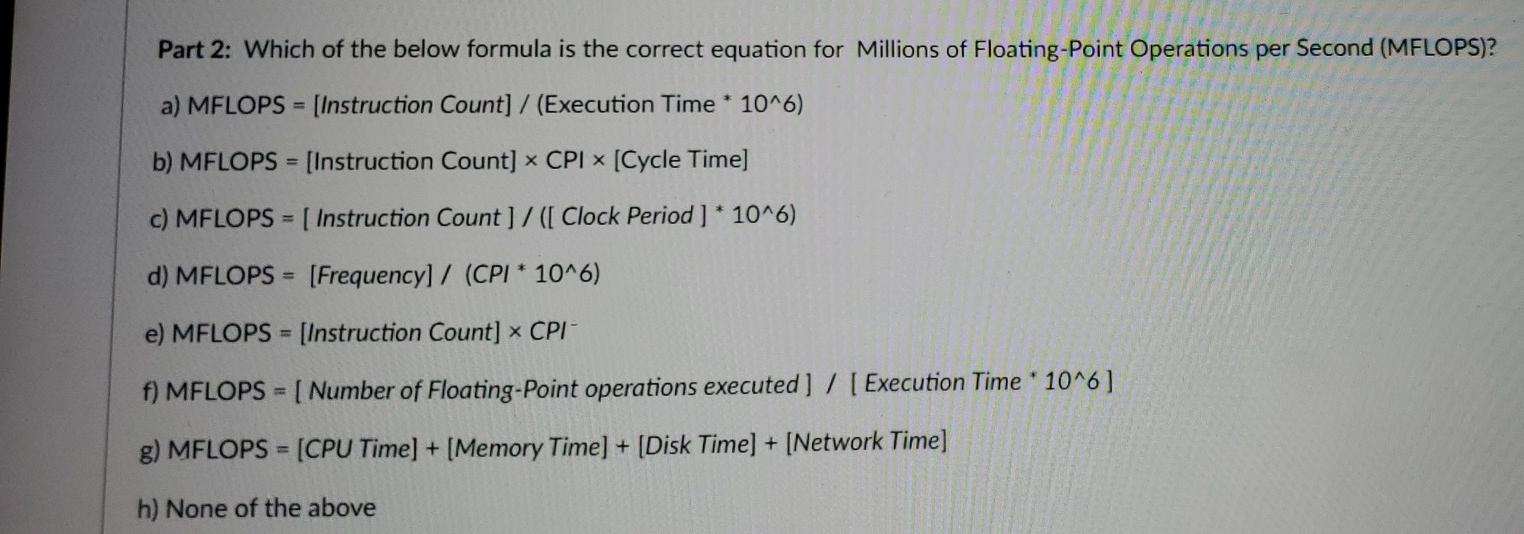
[4 parts] Given: Consider two different implementations, M1 and M2 of the same instruction set. Each machine has a processor with a 4 GHz clock rate. The following performance measurements are observed for WEATHER FORECAST benchmark: M1, M2 M1, M2 Instruction Type Dynamic Instruction Count (Billions) Cycles Per Instruction Bitwise Logic 15, 4.4 1,2 Floating Point 2.5, 2.2 14,3 Branch 2.5, 3.0 2,2 Part 1: What is the effective CPI for each machine M1, and M2? Part 2: Which of the below formula is the correct equation for Millions of Floating-Point Operations per Second (MFLOPS)? a) MFLOPS = [Instruction Count] / (Execution Time *10^6) b) MFLOPS = [Instruction Count] CPI (Cycle Time] c) MFLOPS = [ Instruction Count]/([ Clock Period ] *10^6) d) MFLOPS = [Frequency] / (CPI* 10^6) e) MFLOPS = [Instruction Count] x CPI f) MFLOPS = [Number of Floating-Point operations executed] / [ Execution Time *10^6] g) MFLOPS = [CPU Time] + [Memory Time] + [Disk Time] + [Network Time] h) None of the above
Step by Step Solution
There are 3 Steps involved in it

Get step-by-step solutions from verified subject matter experts
 Study Help