







Question: (4%) Problem 7: Consider the parallel-plate capacitor shown in the gure. The plate separation is 2.5 mm and the the electric eld inside is 26
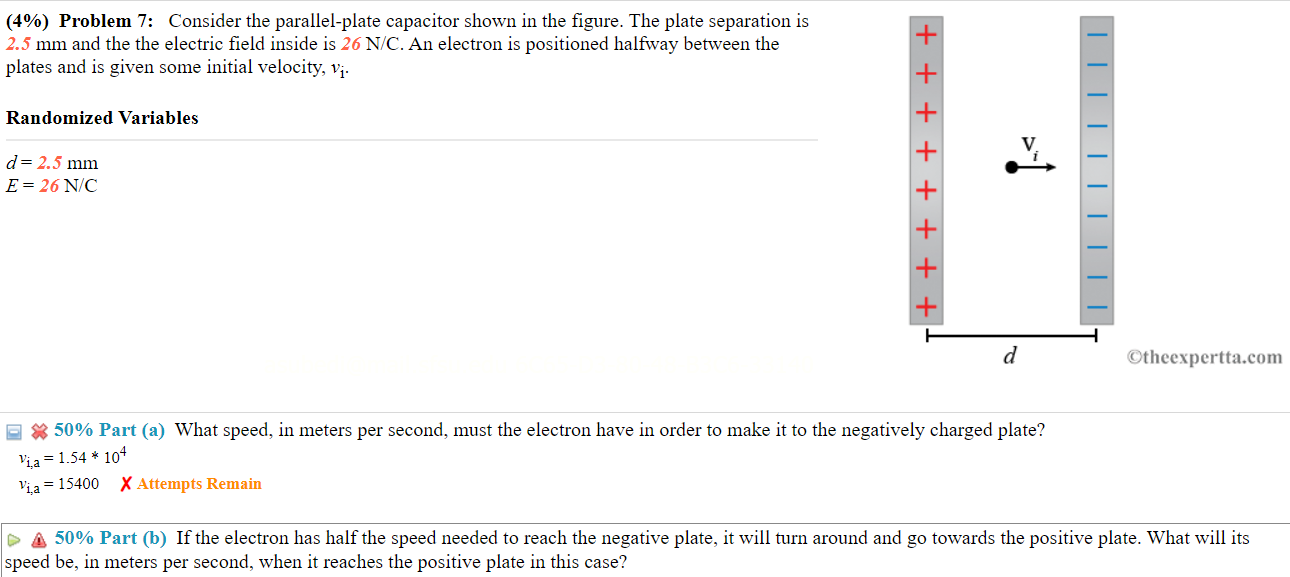
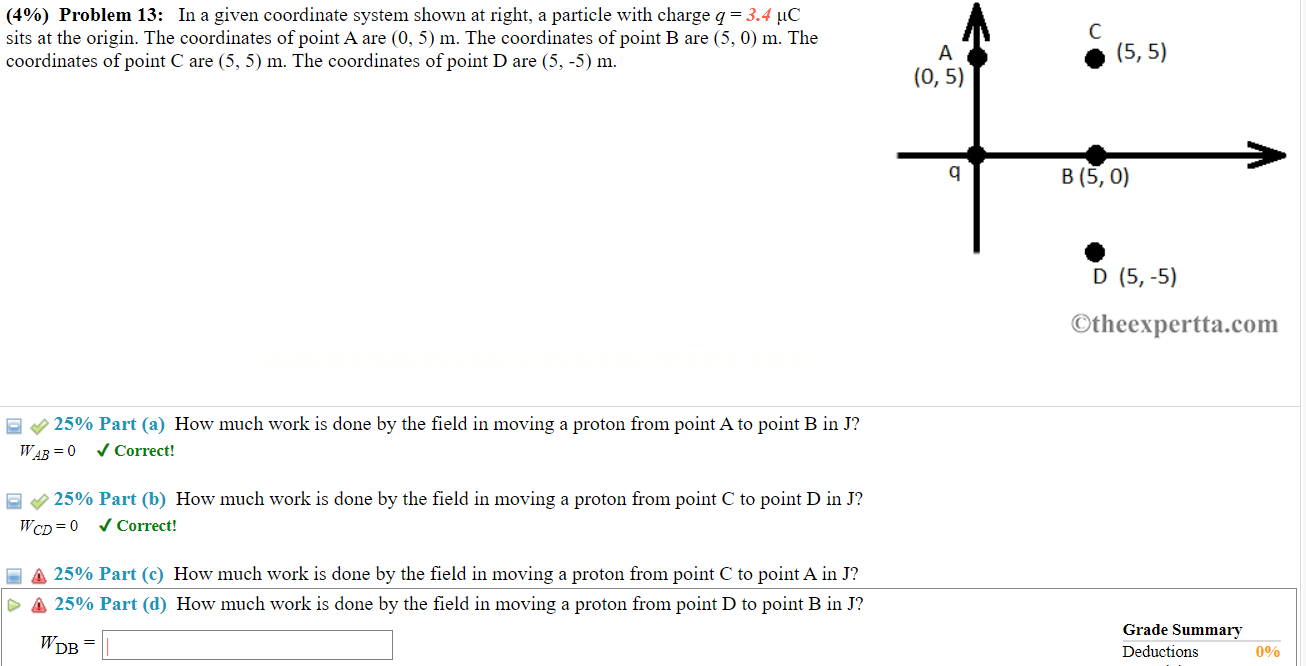
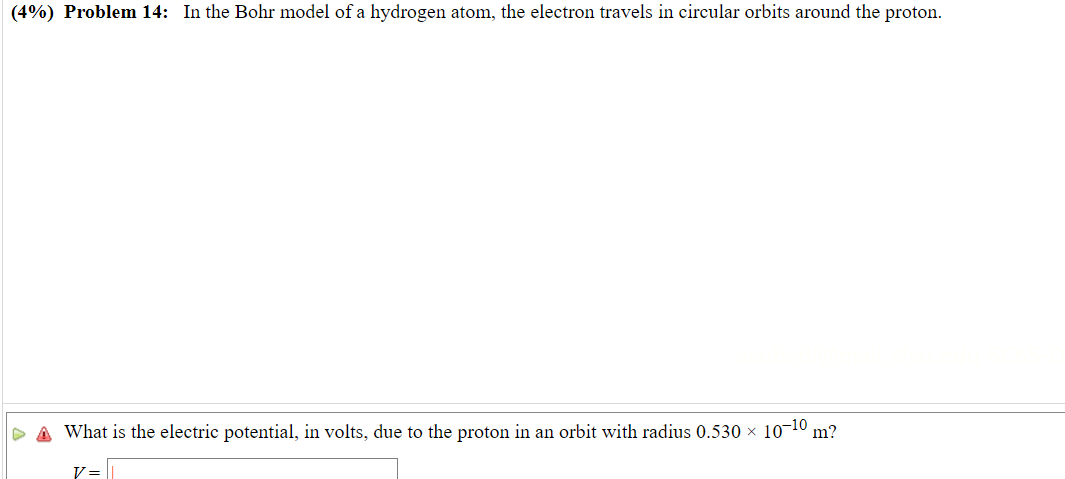
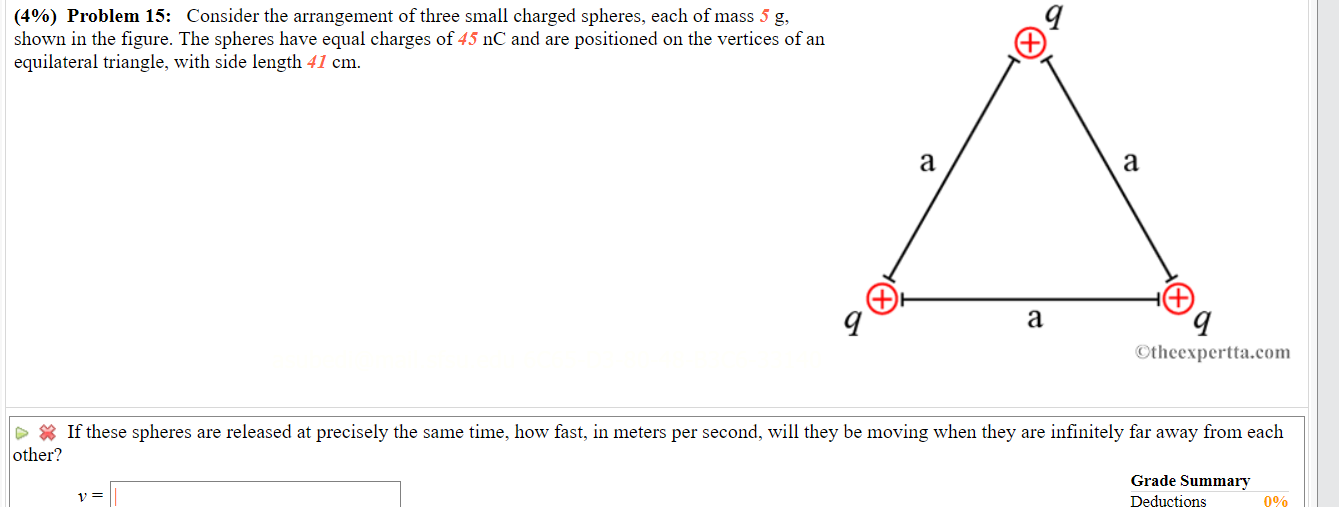
(4%) Problem 7: Consider the parallel-plate capacitor shown in the gure. The plate separation is 2.5 mm and the the electric eld inside is 26 N/C. An electron is positioned halfway between the plates and is given some initial velocity, Vi- Randomized Variables V d = 2.5 m ._f.. E = 26 N/C || d thccxpcrtta.cum a 50%: Part (a) What speed, in meters per second, must the electron have in order to make it to the negatively charged plate? V\" = 1.54 *104 vLil = 15400 X Attempts Remain D a 50% Part (b) If the electron has half the speed needed to reach the negative plate, it will turn around and go towards the positive plate. What will its speed be, in meters per second, when it reaches the positive plate in this case? (4%) Problem 13: In a given coordinate system shown at right, a particle with charge q = 3.4 [AC sits at the origin. The coordinates of point A are (0, 5) m. The coordinates of point B are (5, 0) m. The coordinates of point C are (5, 5) H1. The coordinates of point D are (5, -5) m. B (5, 0) D (5r -5) (Othccxpcrttaxom E of 25% Part (a) How much work is done by the eld in moving a proton from point A to point B in I? WAS = 0 J Correct! g Q? 25% Part (b) How much work is done by the eld in moving a proton from point C to point D in J? Wm = o J Con-mt! E 5 25% Part (c) How much work is done by the eld in moving a proton from point C to point A in I? [)2 a 25% Part ((1) How much work is done by the eld in moving a proton from point D to point B in J? Grade Summary WDB: l Deductions [I '3'?) (4%] Problem 14: In the Bohr model of a hydrogen atom, the electron travels in circular orbits around the proton. [2: 3 What is the electric potential, in volts, due to the proton in an orbit with radius 0.530 X 10¹⁰ m? V=| (4%) Problem 15: Consider the arrangement of three small charged spheres, each of mass 5 g1 q shown in the gure. The spheres have equal charges of 45 nC and are positioned on the vertices of an a.) equilateral triangle, with side length 41 cm. q a 9'? Ulllccxpcrltamum D If these spheres are released at precisely the same time, how fast, in meters per second, will they be moving when they are innitely far away from each other? Grade Summary v 2 l' Deductions 0%
Step by Step Solution
There are 3 Steps involved in it

Get step-by-step solutions from verified subject matter experts
 Study Help