







Question: 4. Read the article CordaCutting Still Doesn't Beat the Cable Bundle from WIRED Magazine at. a. htt swuvwiredcomfsto f 've-me-a-bundle-for-cord-cuttersf A PDF is also available
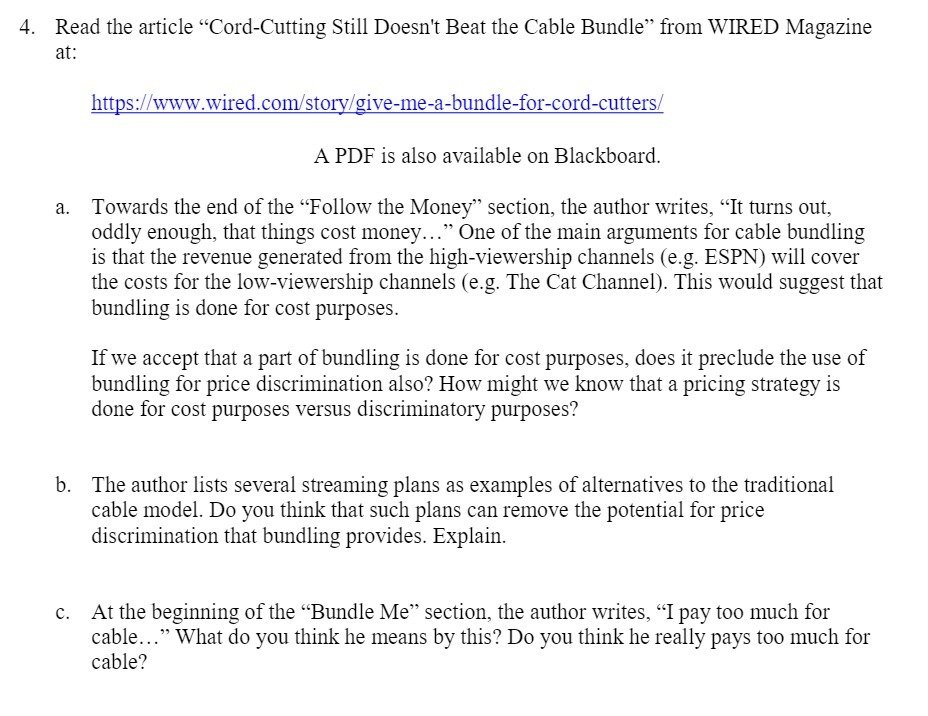
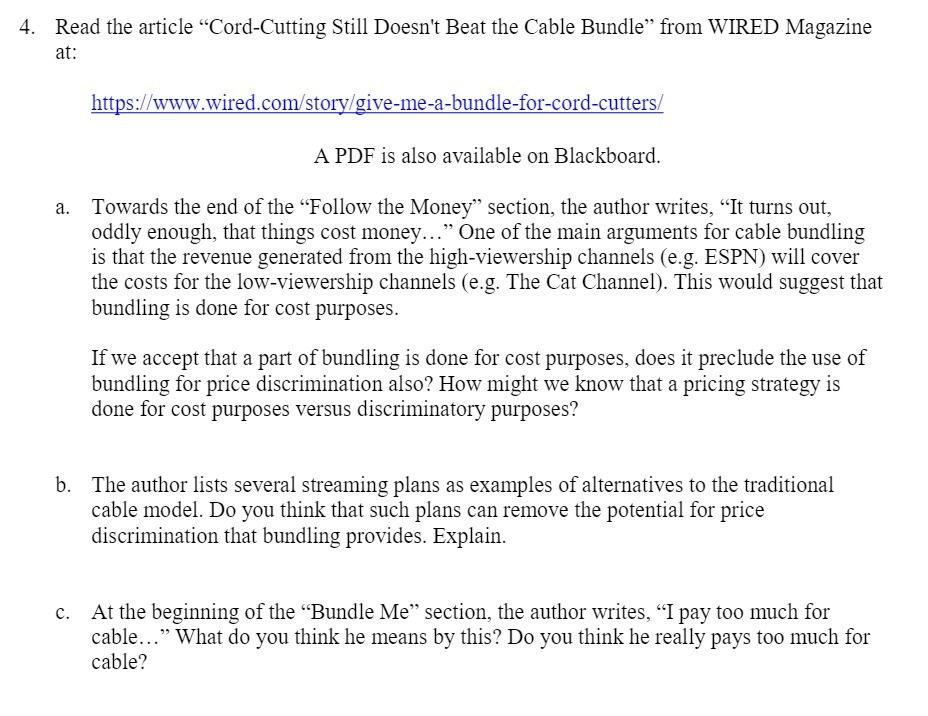
4. Read the article \"CordaCutting Still Doesn't Beat the Cable Bundle" from WIRED Magazine at. a. htt swuvwiredcomfsto f 've-me-a-bundle-for-cord-cuttersf A PDF is also available on Blackboard. Towards the end of the \"Follow the Money" section, the author writes, \"It turns out, oddly enough, that things cost money. . One of the main arguments for cable bundling is that the revenue generated from the high-viewership channels (e. g. ESPN) will cover the costs for the low-viewership channels (e. g. The Cat Channel). This would suggest that bundling is done for cost purposes. If we accept that a part of bundling is done for cost purposes, does it preclude the use of bundling for price discrimination also? How might we know that a pricing strategy is done for cost purposes versus discriminatory purposes? The author lists several streaming plans as examples of alternatives to the traditional cable model. Do you think that such plans can remove the potential for price discrimination that bundling provides. Explain. At the beginning of the \"Bundle Me\" section, the author writes, \"I pay too much for cable. . What do you think he means by this? Do you think he really pays too much for cable
Step by Step Solution
There are 3 Steps involved in it

Get step-by-step solutions from verified subject matter experts
 Study Help